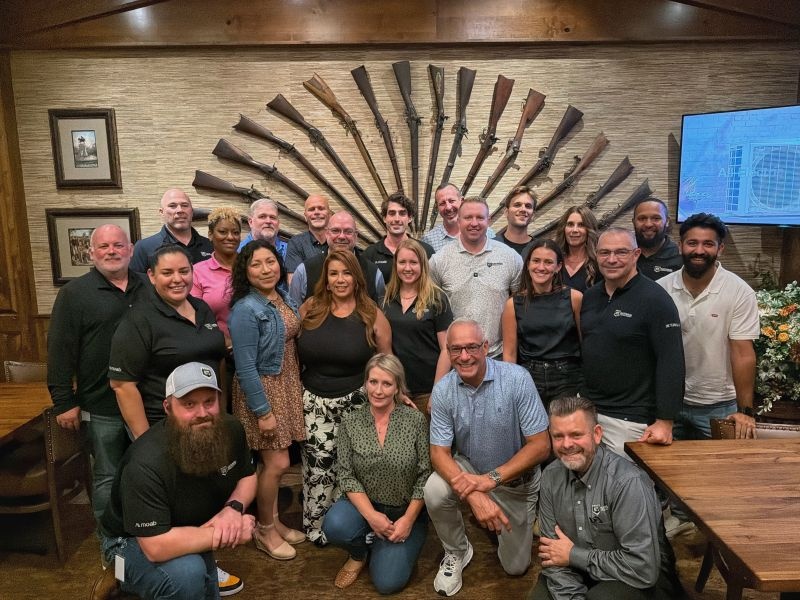
Charles Soll had a software rollout to celebrate. National Trench Safety had gone live on Moab earlier in the year, and now there was a photograph with the team: a crowded group, a few company shirts, a wall decorated with an impressive assortment of rifles. Enterprise software rarely gets such an emphatic backdrop. In his account of the occasion, Soll spent more time on the day's conversations than the night's celebration.
They had discussed the product roadmap, what the team was encountering in the field, and how to make doing business easier for customers. He singled out Sean Blakely and Collin Cremers for leading the project from the beginning. The software was live; the conversation continued. For a founder selling an operating system to an equipment business, that distinction matters. Installation gives the relationship a starting point.
“One of my favorite parts of working with NTS is how closely we get to build together,” Soll wrote. It is a useful opening to his story because it puts him among the people expected to use what he builds. There is a product in the photograph, though nobody is holding it. Its work happens elsewhere, in the daily decisions about equipment, orders, deliveries, and bills.
From the app to the equipment yard
Soll's earlier career included product management at Uber. The connection with Moab is easy to see at the level of the problem: software has to help people coordinate activity in the physical world. A screen can show that something has been requested. The work becomes useful when somebody knows what to do next. At Moab, those next steps can involve a piece of equipment, a driver, a branch, and an invoice.
Before Uber, Soll studied at Université Paris-Sorbonne from 2009 to 2013, earning a bachelor's degree in economics. He later co-founded Tend, with that chapter running from 2019 to 2021. These are distinct stages in a career that has included studying businesses, working on products inside one, and starting businesses himself. The economics degree belongs in the record without requiring a tidy explanation for every choice that followed.
By 2022, he was describing the mechanics of leading a product organization: eight product managers, four product designers, and teams arranged around the problems different customers faced. Product managers worked with engineering, design, and data science colleagues to choose priorities and execute a roadmap. The interesting detail is the order of operations. The customer problem helped determine the team structure.
That earlier account offers a practical way to read his later work. An organization grows more complicated, its users need different things, and somebody has to decide where responsibility sits. Moab takes that question into equipment rental. Soll's conversations with National Trench Safety cover both the business in the field and the software roadmap. The people doing the work have information the roadmap needs.
- 2009-2013Economics at Paris-Sorbonne
- UberProduct management
- 2019-2021Co-founder at Tend
- February 2026Moab's public launch
A business with several clocks
Equipment rental asks several departments to agree about the same object. Inventory needs to know where it is. Dispatch needs to know where it should go. Service needs to know whether it is ready. Billing needs to know what happened. Each department can keep excellent records and still leave the next department waiting. The problem is the distance between those records.
Moab's product spans inventory, orders and billing, service and repairs, dispatch, payables and receivables, and financial statements. In ordinary language, it tries to connect the commercial promise to the operational work and the financial record. A rental business may see one transaction. Its employees see several jobs, each with a deadline and somebody asking for an update.
This makes Soll's choice of market unusually concrete. Equipment has a location and a condition. It can be available, committed, or awaiting attention. Software that serves the business has to respect those differences. A charming interface has limited bargaining power with a delivery schedule. The vehicle still has to leave, and the equipment still has to be there.
Moab's stated aim is to put teams around a shared operational picture, replacing disconnected systems and manual work. That is a substantial request of a customer. An operating system touches the routines people rely on to get through a day. For Soll, the conversations around a rollout are therefore part of the work of building the product, rather than a social reward appended to it.
The meeting after the meeting
Soll's public updates return to customers visiting Moab's New York headquarters. One describes a visit from Jason Monahan of Axis Portable Air, Fernando Pinera of National Trench Safety, and Bruce D. of Tailwind Capital. Another describes hosting Taylor Graves and Matt Hopper of Texas First Rentals for a demonstration of pre-release AI features. These are specific people, businesses, and occasions.
The pattern gives the story its scale. Moab has institutional investors, but the work Soll chooses to describe includes getting customers into a room and talking about how their operations are changing. A pre-release demonstration is particularly revealing as an occasion: it places something still being developed in front of people with an existing business to run.
His National Trench Safety account likewise moves between the company's future plans and what employees are seeing in the field. Those two views need each other. A roadmap can describe an elegant future. A customer can explain why Tuesday is difficult. Soll's public emphasis is on building with the people who can supply that second account.
“One of my favorite parts of working with NTS is how closely we get to build together.”Charles Soll · September 2026
It would be easy to turn these visits into a personality verdict. The more useful observation is narrower: he publicly credits collaborators and names the people responsible for a project. That gives his account of company progress a cast. National Trench Safety's rollout belongs to a group, and he makes room for that group in the telling.
What a customer's year can tell you
Axis Portable Air adopted Moab in December 2024. Moab's case study reports that Axis increased revenue by 50% over the following year while headcount increased by 10%. It also reports roughly 99% on-time delivery during peak season. These are company-published customer results. They describe a period of growth alongside a software deployment, without establishing that software alone caused the growth.
For Soll, the useful part of this example is the relationship between business volume and the people coordinating it. The case study describes a move from one branch per coordinator to three, and email-to-order processing in under eight minutes for national accounts. Those are units an operator can recognize. They make an abstract discussion about efficiency answerable to a working day.
Same period. Company-published case study; these figures do not isolate the effect of Moab.
The example also sets a useful standard for any ambition around AI. A customer buying an operating system needs to know whether it helps orders move and teams coordinate. A discussion about models eventually has to reach those questions. Soll's customer updates and Moab's published results meet on that ground: the existing business, with its existing demands.
Two rounds before the announcement
Moab emerged from stealth on February 17, 2026, announcing $16 million across two funding rounds. The $8 million Seed closed in April 2024; the $8 million Series A followed in October 2025. Elad Gil led both, with significant investment from Ironspring Ventures and participation from Karim Atiyeh and Dave Yuan. The public announcement arrived after the financing and customer work were underway.
At launch, Soll was identified as co-founder and CEO, alongside co-founder and CTO Patrick Anderson, formerly Ramp's Head of Core Engineering and its eleventh employee. Moab's current leadership page lists Soll as President and Anderson as CEO. The titles have changed; the founding partnership remains central to the company's story.
The launch also included a forecast for 2027: more than $2.5 billion in annual transaction volume and more than $4 billion in fleet assets managed through the platform. Those figures describe the company's expectations. They are useful as a statement of the size of the responsibility Moab wants to assume, with the distinction between an ambition and an accomplished result kept intact.
$8MSeed · April 2024
$8MSeries A · October 2025
A brother gets the last word
The funding announcement prompted a reply from Dean Soll: “Proud of you Little Bro!” Dean went on to compare building an equipment-industry ERP from scratch with starting a specialty thermal contracting company. Charles replied that he could not wait for Dean to have a customer portal for one of Moab's customers. Family congratulations had become a product conversation in remarkably few lines.
It is an amusing glimpse of the overlap between Soll's chosen market and the people around him. The portal was still something he was looking forward to; the exchange documents the anticipation, rather than a completed transaction. Even in a congratulatory thread, the conversation found its way back to how somebody might use the software.
That is where his public story keeps landing. A rollout becomes a discussion of field experience. A visit becomes a demonstration. A brother's joke becomes a possible customer portal. Soll has chosen work whose usefulness depends on other people getting their work done. The next chapter will have plenty of opportunities to be measured that way. Somewhere, somebody will be waiting for equipment.