An excavator has poor manners as an internet purchase. It cannot slip through a letterbox. It needs transport, somebody to arrange it, and somebody else to make sure it works when it arrives. Nabil Kassam has spent much of his career around the business that happens after a customer clicks. His ventures bring a familiar digital promise into a world of machinery, maintenance and people with a job to finish.
The appeal of online equipment rental is obvious enough: find the machine, check availability, make a reservation. The interesting question is how to keep that promise once it leaves the screen. Kassam’s work offers a useful case because he has occupied several positions around it: entrepreneur, equipment operator, software executive and investor. The transaction looks different from each seat.
The idea meets the yard
At Noble Iron’s Los Angeles fulfillment center, software development and equipment operations shared a workplace. The lead architect behind FleetLogic, a field-service application, had previously worked at Apple. He spent time with mechanics and drivers. The yard became a place to test products against the work they were supposed to improve.
Kassam’s explanation of equipment sharing was suitably physical. Renting an excavator requires transport and service arrangements well beyond matching an owner with a customer. Noble Iron’s proposed asset pool would let third parties put available equipment into the fleet while the company handled logistics and support. The owner’s idle machine could become somebody else’s working tool.
That arrangement also changed how he talked about other rental businesses. They could buy software or participate in the pool. A company selling a similar service could still have something useful to contribute. His view of innovation left room for experiments that failed and for ideas from people doing the fieldwork.
“Our management philosophy is to adapt proactively.”
Nabil Kassam, 2017
A bad year to need a fleet
The route there began before Noble Iron. Kassam participated in Rent On The Dot, an online equipment marketplace launched in 1999. He also gained rental experience through Stephenson’s in Canada. Later, while studying for his Stanford MBA, he saw booking services such as OpenTable and considered what a similar model might do for construction equipment.
Then came 2008. For a new business needing expensive machines and willing lenders, the timing was punishing. Kassam’s concise description was “The worst.” The team began developing its pilot in Houston. A financing arrangement with Terex and banks allowed it to acquire roughly $30 million in equipment assets by assuming a distressed company’s debt.
There is a practical continuity in that beginning: experience with troubled businesses helped him approach a new venture. Building an operation meant working with assets and obligations already in existence. The opportunity had to make sense to the people providing the machinery and the financing, as well as to the customers who might rent it.
A mentor stays in the picture
Kassam became Noble Iron’s CEO on January 1, 2014, taking over from Willie Swisher while continuing as founder and chairman. Swisher remained on the board. A change in the organization chart preserved a relationship that had helped shape the business.
Kassam called Swisher “a mentor and a dear friend.” Swisher, for his part, described the experience of building Noble Iron alongside him and expressed support for the next stage. The exchange supplies a human detail in a career otherwise easily reduced to company names and transactions.
Mentorship has a particular texture when the people involved are also business partners. They have an operation to run, decisions to disagree about and employees who need clarity about who is responsible. Here, the handover gave Kassam the executive role while keeping Swisher involved as a director. Experience remained available even as authority changed hands.
The customer inherits the whole process
By 2020, Texada’s proposition reached well beyond taking a reservation. Milton Rents, an affiliate of Milton CAT in New England, selected its rental management, field service and e-commerce applications. The package linked work in the office with maintenance, dispatch, inventory and customer transactions.
Pete Laurie, Milton Rents’ director of rental services, emphasized the value of Texada’s industry experience alongside its technology. That is a revealing customer criterion. A software supplier has to understand why a workflow exists before offering a better version. For an equipment business, several departments may contribute to one customer’s experience.
Payments brought another part of that process into the platform. In August 2021, Cooper Equipment Rentals began a Texada Pay pilot at five of its 50 branches. Kassam described benefits in automated collections, payment security and fewer expensive errors. His ambitions could be expressed in the ordinary language of an office trying to finish its day.
The figures soon gave that work a scale. Texada Pay processed more than $74 million in transaction volume during 2021, compared with $23 million in 2020. Those were payments moving through the product, rather than software revenue. The distinction matters when judging what the numbers say about adoption.
In October 2021, Texada also became SANY America’s recommended rental management and dealership software vendor. The planned work covered rental and sales operations, service, logistics, online commerce and reporting. It widened the setting for the same question: can information travel through an equipment business without making every team start again?
Two sales, two different chapters
In May 2017, Noble Iron sold its Los Angeles rental operations to Sunbelt Rentals for a reported $46.5 million in cash. Texada Software and separately held intellectual property were outside that transaction. The operating yard changed ownership while the software business continued.
Kassam described the fulfillment center as a laboratory that had helped produce FleetLogic and Gateway. Selling the equipment operation therefore left behind something more portable: applications that other businesses could use. The site had supplied both a service to customers and experience for product development.
Five years later, on June 30, 2022, Noble Iron completed the sale of Texada to Banneker Partners for gross proceeds of $37.2 million. The transaction included its software business in Canada and Australia. Noble Iron invested $4.2 million into an approximately 7.4 percent rollover interest in the buyer’s parent partnership.
That remaining interest was sold in January 2023. By then, Noble Iron had returned approximately C$27.27 million to shareholders through a December 2022 capital distribution. The record describes a sequence of operating, selling and returning capital, with each decision belonging to its own moment. The equipment sale and the software sale tell different parts of the career.
A door into manufacturing
A photograph outside Mastergrain’s manufacturing facility in Midland, Ontario, places Kassam beside Iqbal Kassam and Chris Edwards. Snow falls in front of the building. The sign above them sells a finished product with a pleasingly literal connection to the visit: doors. Industrial investment occasionally provides its own illustration.
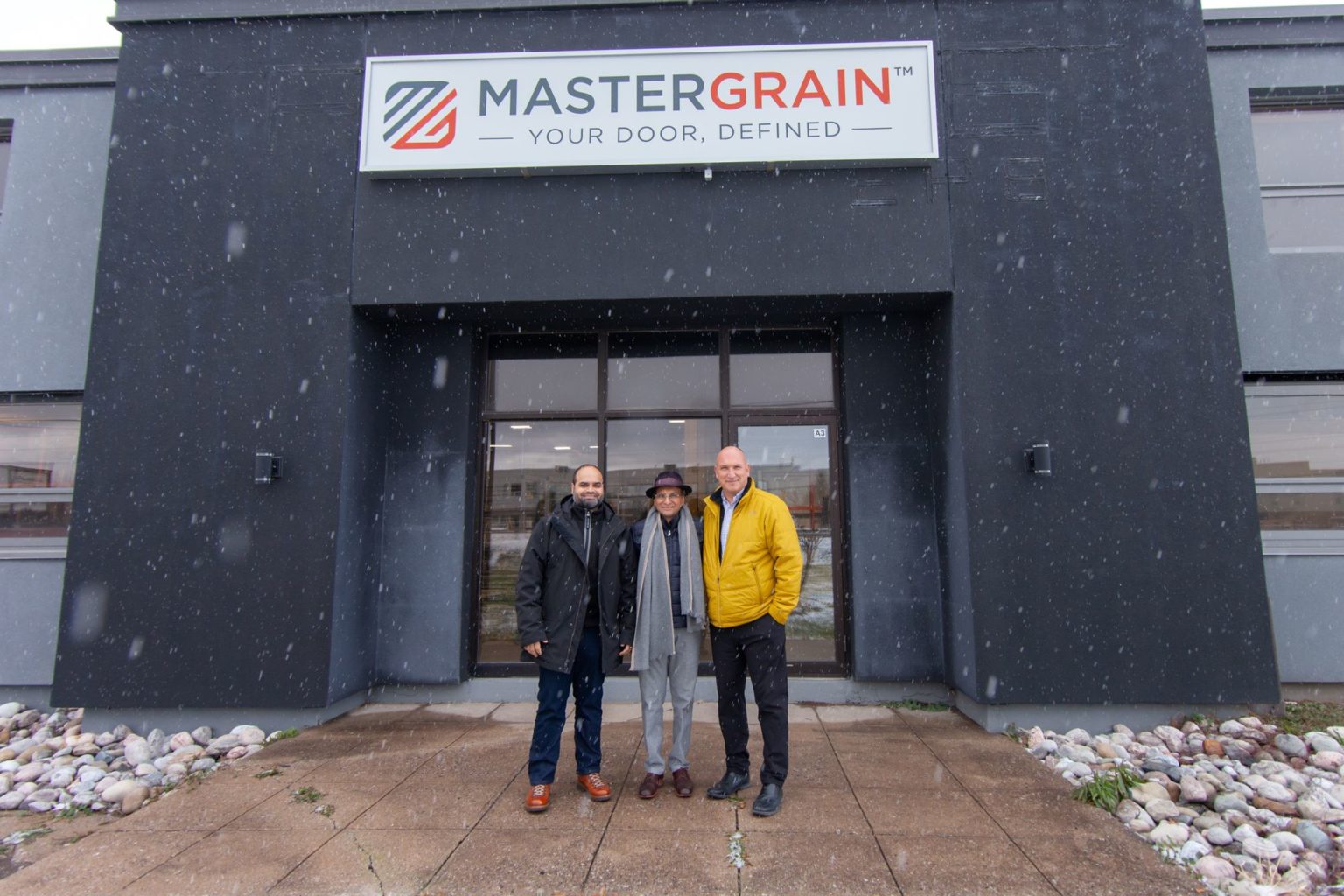
Weber’s history reaches back to 1962. Zynik acquired it in 2007, and the Mastergrain fiberglass-door brand launched the following year using its nickel vapor deposition capabilities. The business later moved into pre-hung door manufacturing. An established industrial capability found another product and another market.
This is useful context for Kassam’s wider work. Software can travel easily; manufacturing capabilities have an address, equipment and accumulated know-how. A new owner encounters a business that people have already spent years building. Its history is part of what is being acquired.
Time belongs on the balance sheet
Kassam is now Zynik Capital’s Executive Director, responsible for strategy, teams and operations across its network of businesses and investments. His education includes an undergraduate degree from Harvard and an MBA from Stanford. The job connects his experience founding ventures with the responsibility of supporting established companies.
Zynik describes itself as a family-owned investment company that acquires and permanently holds manufacturing businesses. Its 2026 media kit lists 32 companies and more than 1,800 associates across six operating platforms. These figures belong to the group, rather than to Kassam individually. They convey the range of workplaces within his current setting.
The network continued to expand in July 2026, when AarKel Tooling Technologies announced its acquisition of Superior Tool and Mold in Windsor. Superior had been established in 1993 and made custom injection molds for automotive, industrial and consumer customers. The addition brought another existing body of technical knowledge into Zynik’s tooling group.
For an executive working across that network, the challenge is partly one of scale and partly one of attention. Different businesses have their own customers, equipment and expertise. A commitment to keeping them requires decisions about what to improve and what already works well enough to deserve preservation.
An education that keeps its work boots on
Zynik makes space for learning through an annual two-day seminar, bringing together colleagues from its companies with business leaders and Harvard faculty. Participants examine and debate business cases. The format offers people from different operations a chance to compare experience away from the immediate demands of their own workplaces.
The 2026 gathering was the seminar’s 16th year. It included recognition for associates with more than 40 years of service and celebrated 32 new Founder Scholarship recipients. A company can record experience as tenure; it can also give people time to share what that experience has taught them.
The scholarship program supports eligible children and grandchildren of current, former and retired associates pursuing trade certifications, college diplomas and undergraduate degrees. Its scope makes room for several routes into working life. In an industrial group, that is a practical acknowledgment that knowledge arrives through different kinds of education.
Kassam’s career has repeatedly put business ideas near the work they depend on. The rental yard, the software customer and the manufacturing company each bring their own test. A reservation has to become a delivery. Information has to reach the next person. Ownership has to become useful to an operating business. The machinery gives the idea its weight.