A hedge fund index arrives dressed as fact. It has decimals, historical series and the grave bedside manner of a Bloomberg terminal. Yet before anyone calculates a return, somebody has made a choice about who belongs in the set. Jon Caplis has built the second half of his career around that first, easily ignored decision.
Caplis is the founder and CEO of PivotalPath, the New York research and analytics firm he started in 2013. Its basic contention is almost mischievously plain: a fund can only be judged in the right context. The benchmark must contain the relevant managers. The peer group must compare like with like. The underlying information must be good enough to bear the weight placed upon it.
That sounds like housekeeping. In a private industry where managers are generally not required to report returns to commercial databases, it becomes architecture. The omitted funds can change the silhouette of the whole market. A neat average built on a self-selecting sample may be precise in the way a beautifully printed train timetable is precise after half the stations have disappeared.
An apprenticeship in the machinery
Caplis did not discover this problem from the clean side of a software demo. He spent roughly ten years inside hedge funds, learning the business in roles that exposed him to both investment judgment and operational consequence. After studying finance at Washington University in St. Louis, where his LinkedIn record dates his attendance from 1999 to 2003, he began as an analyst and trader at Chesapeake Partners, a multibillion-dollar event-driven fund.
Event-driven investing teaches an alertness to the gap between the announced story and what actually happens. His next chapter widened the aperture. At Global Domain Partners, a systematic hedge fund he co-founded, Caplis served as chief operating officer. The job description sprawled: quantitative research, investment process, trading execution, compliance, oversight and the rest of the machinery that keeps a fund from becoming an expensive thought experiment.
Then came Campbell & Company, the systematic manager, where he was co-head of portfolio allocation and risk management. He sat on the investment committee and led specialized recruiting. By the time he left to found PivotalPath, he had encountered hedge funds from several angles: analyst, trader, co-founder, operator, risk manager, allocator of capital and recruiter of talent. The later company reads like a synthesis of those desks.
The funds hiding in plain sight
The central difficulty is incentive. Successful funds often have limited reason to broadcast results. They may already be full. They may prefer privacy. They may worry that performance will be flattened into a headline without the strategy context that made it possible. Reporting is voluntary, and silence can be rational.
Commercial databases therefore risk describing the managers willing to report rather than the institutional universe allocators hope to understand. Caplis has argued that this selection problem can make industry performance look weaker than it is. The damage extends beyond public reputation. Benchmarks feed portfolio models, manager reviews, compensation conversations and allocation decisions. Leave out an important cohort and the error migrates.
“AI is only as good as the data you have to work on.”Jon Caplis, Educational Alpha, 2025
His line about artificial intelligence lands because it refuses the glamorous part of the conversation. PivotalPath’s work begins earlier, with the dull heroic labor of coverage, classification and permission. What strategy is a fund actually running? Which peers provide a fair comparison? Does a liquid vehicle carry assets whose behavior or liquidity belongs elsewhere? An algorithm can accelerate an answer. It cannot rescue a crooked question.
Conceptual illustration: a return becomes decision-useful only after coverage, strategy classification and peer selection supply context.
Trust before traffic
PivotalPath faced the familiar cold-start problem of a two-sided network, made colder by confidentiality. Allocators wanted a richer universe. Managers wanted confidence that sensitive information would be handled carefully. A portal with nobody inside is merely a well-lit waiting room.
Caplis has explained that the company started by building credibility with allocators. It behaved like a research consultant, learning what institutions needed across the full cycle of due diligence. Manager relationships followed because the use case was specific and the audience was known. PivotalPath says confidential manager information is shared only with institutional investor clients. The public indices are the visible expression of a larger private research practice.
This is one reason Caplis’s founder advice emphasizes people. In a 2023 interview, he urged founders to surround themselves with a strong team, choose colleagues whose skills complement their own and invest in their development. In a company that asks both sides of a private market to trust its judgment, hiring is part of the data model. Every relationship either strengthens the sample or introduces another blank space.
Fairness, translated into finance
There is a personal thread beneath the methodology. Caplis has said he was raised by parents who devoted their working lives to nonprofits. From them, he learned kindness, fairness, family and the value of building connections that help people. His chosen field supplies few violins for such sentiments. It does, however, offer a practical definition of fairness: judge a manager against the right evidence.
That idea gives PivotalPath its editorial spine. The firm’s current public description says it supports institutional investors with more than $650 billion in combined hedge fund investments. It covers more than 3,000 institutionally relevant funds representing over $3 trillion in assets. Its tools stretch from manager screening and portfolio analytics to custom benchmarks and public indices.
PivotalPath was named Best Index Provider at the 2023 Hedgeweek US Awards.
It was the only research firm in Alternative Fund Insight’s 2024 Power25 allocator ranking.
The firm says its institutional clients collectively invest more than $650 billion in hedge funds.
Caplis is Series 3 licensed and has worked across event-driven and systematic strategies.
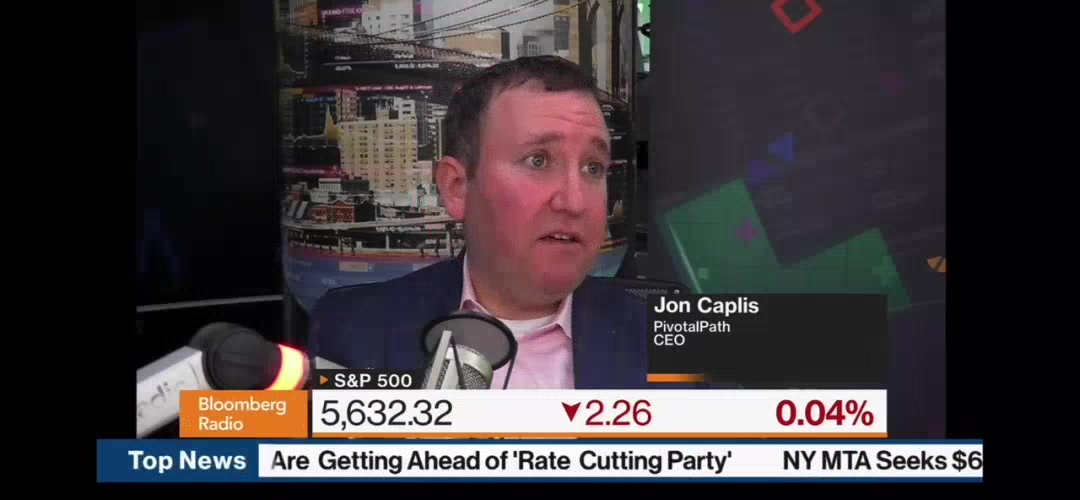
Awards are pleasant; repeated use is more revealing. PivotalPath indices appear on the Bloomberg Terminal and in institutional research. Caplis has become a regular interpreter of hedge fund performance for Bloomberg Radio, Institutional Investor, CAIA and specialist investment podcasts. He tends to pull the conversation beneath the headline return: dispersion among strategies, market beta hiding inside apparent alpha, liquidity terms, capacity and the difference between a celebrated launch and a useful one.
A common language for private markets
The current phase of Caplis’s work is expansive. In 2025 he spoke at length about portable alpha, separately managed accounts, multi-strategy capacity and the use of AI in diligence. In February 2026, speaking live from the Global Alts gathering in Miami, he discussed performance, flows, private-credit pressure and the structures allocators were exploring. The following month, a CAIA seminar in Singapore put him in front of managers for a practical walkthrough of how institutional investors evaluate returns and ask questions.
The geography changes. The ambition stays consistent: narrow the informational distance between the people managing money and the institutions deciding where it belongs. Caplis’s maxim that assets need to match liabilities sounds almost antique beside fashionable promises of frictionless access. Its durability is the point. Structure matters. Terms matter. A return divorced from the obligations around it is another orphaned number.
PivotalPath’s own growth has made the company part of the market it measures. With that comes a useful tension. The broader its coverage, the more representative its benchmarks can become. The more influential those benchmarks become, the more discipline their construction demands. Authority in data is rented monthly.
Caplis appears comfortable with that bargain. His career has been less a leap from finance into technology than a patient move upstream, from trading outcomes to the machinery used to interpret them. The product is partly software, partly research and partly a negotiated peace among people who have good reasons to keep their cards close.
A benchmark is a story about who counts. Caplis keeps asking who was left out.YesPress
There is wit in the predicament. Hedge funds are paid to find what markets misprice, yet the industry itself can be mispriced by an incomplete list. Caplis’s answer is not a louder forecast. It is a better guest list, a sharper seating plan and an insistence that every number introduce its context before speaking.
For a founder, that may be the most portable insight in the PivotalPath story. Look for the consequential work others mistake for clerical detail. Learn the problem from more than one seat. Build trust before expecting participation. And whenever a confident chart arrives, polished and punctual, count the empty chairs.