The original data room was exactly what it sounded like: a guarded room where buyers and their advisers inspected a company's private records. The ritual involved travel, binders, photocopiers and a small forest's worth of paper. If a banker needed to distribute loan documents, the machinery could include couriers, fax machines and overnight parcels. It was expensive, slow and strangely dependent on whether the right envelope reached the right desk.
In 1996, a tiny New York startup walked into J.P. Morgan with a PowerPoint deck, webpage mockups and an unfinished product. The pitch was simple: move this exchange onto a secure website. The company was IntraLinks, founded by financial-services veterans Mark Adams, John Muldoon and Arthur Sculley. Major banks began using its online workspaces for loan syndication in 1997. The browser had found one of its least glamorous and most valuable jobs.
The first failureThe room before the room
What failed first was not software. It was the physical workflow. Copies were hard to update, travel delayed review, and distribution created security gaps. A seller could lock papers in a room, but that control evaporated when a page was copied or a disc was burned. Intralinks centralized the files, assigned access at the user level and recorded activity. People in different firms and countries could inspect the same material without sharing the same air.
That distinction still matters. Dropbox and Google Drive move files. A transaction platform has to answer harder questions: Who can see this version? Can they print it? What changed? Who opened page 47? Can an administrator revoke a downloaded document? Is there a defensible audit trail after the deal closes? The product is less a cupboard than a permission machine.
The durable wedgeA narrow product with expensive consequences
Intralinks grew because it picked a workflow where delay and error have obvious price tags. Its early customers completed more than $5 trillion in syndicated-loan transactions on the platform in 2004. It expanded into M&A diligence, fund reporting and secure enterprise collaboration. The company now says it facilitates more than 10,000 M&A deals annually, serves 515,000 professionals across 100,000 organizations, and supports $44 trillion in assets under management.
The customer list follows the paperwork: investment banks, private-equity firms, corporate-development teams, lenders, law firms, fund managers and institutional investors. These groups do not buy storage by the gigabyte. They buy controlled access, proof, support at inconvenient hours and fewer opportunities for a junior employee to email confidential material to the wrong John.
What it costThe $1.5 billion handoff
The corporate history is more dramatic than the user interface. Intralinks raised venture and strategic capital, went through a TA Associates buyout in 2007 and sold 11 million shares at $13 in a 2010 IPO, raising $143 million. Synchronoss bought it in January 2017 for $850 million after working-capital adjustments. Ten months later, Siris Capital acquired it for roughly $1 billion. In November 2018, SS&C Technologies paid $1.5 billion - $1 billion in cash and $500 million in stock.
Why did SS&C pay up? Intralinks arrived with more than 800 employees, more than 4,000 clients and deep overlap with SS&C's banks, funds and blue-chip corporations. SS&C already ran financial software and administration. Intralinks owned the moment when documents crossed organizational boundaries. Put together, the parent could serve the books, the workflow and the communication around a transaction.
What changed their mindThe room learns to read
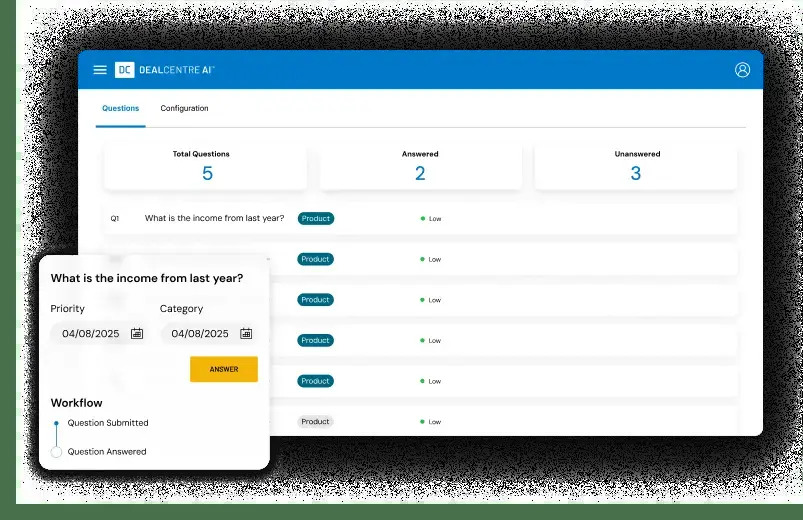
A plain VDR ends up as a well-secured island. Files arrive after a deal begins and become an archive when it ends. Intralinks changed its product thesis: the room should help prepare the sale, market it, execute diligence and preserve what the team learned. DealCentre AI is the clearest expression of that shift.
Its proprietary Link engine searches and summarizes documents, helps classify and redact material, and powers Ask Link, a conversational tool that can answer questions against one file or a larger document set while pointing users back to relevant pages. The surrounding product tracks the deal pipeline, buyer outreach, permissions, questions and reporting. Intralinks says customers have achieved average time savings of 72 percent in AI-powered deal marketing and up to 66 percent faster work in its end-to-end experience compared with traditional VDR processes. Those are vendor-reported figures, not a promise for every room.
The credible advantage is context. A generic assistant can summarize a PDF. DealCentre knows which PDF, which version, which user, which deal stage and which access policy apply. In confidential finance, the permission model is part of the answer.

Beyond M&AOne login, the whole fund lifecycle
FundCentre AI applies the same idea to alternative investments. A general partner can market a fund, track prospects in a built-in CRM, automate subscription packages, onboard investors and publish reports through a branded portal. InView aggregates reports and extracts data. Managed services teams can source documents from administrators, organize them and handle distribution. Intralinks says more than one of every two dollars raised globally touches its platform.
The small operational stories are more revealing. Crescera Capital used FundCentre during a $500 million raise after email distribution became repetitive and error-prone. One upload replaced repeated sends, while activity data showed whether investors had opened the material. Riverstone Holdings said quarterly reporting that took days could be completed in hours. A large financial firm used SecurityHub Pro with Identity+ to preserve shared-inbox workflows while identifying individuals, avoiding a re-onboarding effort across more than 77 data rooms that it estimated could take six months to a year.
PositioningWhat buyers are actually paying for
Intralinks competes most directly with Datasite, iDeals, DFIN Venue, Firmex and Ansarada. Lighter products such as DealRoom, SecureDocs and Digify cover parts of the market; Box and ordinary cloud drives compete when the job is general collaboration rather than a regulated transaction. Intralinks does not publish list pricing. The sales model uses custom quotes, with software subscriptions, project use and professional services shaped around the client and transaction.
Best aligned with global, regulated, multi-party work where identity, auditability, service and lifecycle breadth justify an enterprise sale.
Datasite, iDeals, DFIN Venue, Firmex and Ansarada compete on transaction workflow, AI, usability, pricing structure and regional depth.
Faster setup and simpler economics can win straightforward mid-market diligence without complex governance needs.
Good for ordinary collaboration. A weak substitute when post-download control, transaction support and defensible audit records matter.
Its differentiation is therefore institutional rather than magical. The company has a known login among bankers and investors, multilingual 24/7 support, a large installed network, information-rights controls and products that reach before and after diligence. The tradeoff is weight. A startup running one uncomplicated raise may care more about a public price, instant setup and a spare interface than a global service operation.
The copyable partWin the risky inch, then widen the mile
The useful lesson is not “build a VDR.” It is how Intralinks entered. The founders chose a narrow, visibly broken process inside an enormous industry. They borrowed credibility from a demanding first customer. They made security and auditability product features, not compliance copy. Then they expanded one adjacent task at a time: from delivery to diligence, from diligence to marketing and Q&A, from fundraising to onboarding and reporting.
- Find a workflow where the cost of delay, leakage or confusion is easy to explain.
- Win a reference customer whose standards reassure the next ten customers.
- Keep the audit trail. Historical workflow data becomes useful context for automation.
- Expand before and after the original job instead of wandering into unrelated features.
- Add AI where people already search, classify, redact and reconcile - with permissions intact.
The boundaryWhere the playbook breaks
This model works when information is sensitive, many organizations participate, the process repeats and the cost of a mistake exceeds the software bill. It weakens when the work is casual, the team is tiny or procurement takes longer than the project. AI also helps less when the underlying documents are thin, badly scanned or inconsistently organized. No model can infer the missing schedule that nobody uploaded.
There is another condition: trust must compound faster than complexity. A full-lifecycle platform becomes valuable when a shared identity, document model and audit history remove handoffs. It becomes clutter when every module introduces another screen, permission and sales conversation. Intralinks' next test is not whether Link can summarize a contract. It is whether the company can make thirty years of controls feel like leverage rather than luggage.
The old data room had a lock on the door and a guard outside. Intralinks put both into software. Its new ambition is larger but recognizable: keep the lock, teach the room what is inside, and help the people doing the deal get home before dawn.