BREAKINGSpoiler Alert keeps 500,000+ tons out of landfills●FORBES 30 Under 30, Social Entrepreneurs, 2017●CLIENTS Nestle · Kraft Heinz · Danone●SERIES A $11M raised, Dec 2021●CAMPBELL +36% discount sales in five months●BREAKING Spoiler Alert keeps 500,000+ tons out of landfills●FORBES 30 Under 30, Social Entrepreneurs, 2017●CLIENTS Nestle · Kraft Heinz · Danone●SERIES A $11M raised, Dec 2021●CAMPBELL +36% discount sales in five months●
Co-Founder & CEO · Spoiler Alert
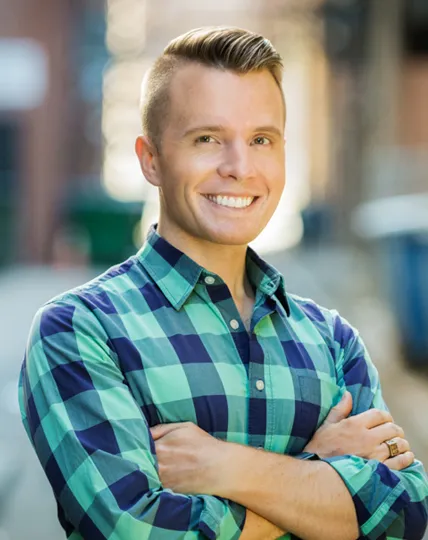
Ricky Ashenfelter
He looked at a warehouse of green beans nobody would buy and saw a marketplace. Everyone else saw the trash.
Boston, MAMIT Sloan, MBA '15GeorgetownFood-tech
Ricky Ashenfelter. Runs a Boston company from Bend, Oregon - and calls it a feature.
The Waste-Free Economy
Selling the food nobody wanted to sell
Somewhere in a distribution center right now, a pallet of yogurt is quietly ticking toward its sell-by date. A few years ago that pallet had exactly two futures: a deep-discount fire sale nobody had time to arrange, or a dumpster. Ricky Ashenfelter built a third door. His company, Spoiler Alert, is the software that opens it.
Ashenfelter is the co-founder and chief executive of Spoiler Alert, a Boston-based B2B platform that helps the largest food and consumer-goods brands on earth move excess and short-dated inventory before it spoils. Not through guilt. Through data, price, and speed. The pitch he gives is deliberately unsentimental: "At a high level, we're a waste-prevention software built for sales and supply-chain teams. You can think of it as a private business-to-business eBay of sorts."
That framing is the whole trick. Food waste is usually sold as a moral emergency - and it is one. It sits near the top of Project Drawdown's list of climate solutions, and by some counts accounts for roughly 8 percent of global greenhouse gas emissions. But moral emergencies do not automatically clear inventory. Sales teams do. Ashenfelter's insight was to stop asking food companies to be virtuous and start asking them to be fast.
He tends to talk about the mission in the same breath as the margin, which is unusual for someone in his corner of the climate world. The vision he repeats - "power the waste-free economy" - is not a wish for a cleaner planet at the expense of the balance sheet. It is a claim that the two goals are the same goal, that the pallet you divert is also the pallet you monetize. For a founder who studied both finance and the environment, that is less a marketing line than a worldview he has been assembling since college.
By The Numbers
500K+tons kept out of landfills
2015founded at MIT Sloan
$13.65Mtotal funding raised
+36%discount-sales lift, Campbell
The Real Villain
The enemy isn't waste. It's the meeting about the waste.
Ask most people why good food gets thrown out and they will reach for a story about greed or carelessness. Ashenfelter reaches for a spreadsheet. The culprit, he argues, is the gap between the moment inventory goes stale and the moment somebody decides what to do about it.
"Companies are taking pretty manual and slow approaches to deciding what to do with excess inventory," he has said. "When you have slow decision-making, you're losing days or even weeks of shelf life on that product." Every day a decision sits in an inbox is a day of value evaporating off the box.
Spoiler Alert's answer is to surface the surplus early and route it automatically - to a discount grocer, a nonprofit, or a recycler - while there is still shelf life to sell. "There is a tremendous amount of underutilized data that exists in the manufacturing and distribution space that results in good food going to waste," he says. The company's job is to make that data actually do something.
Where Ashenfelter aims
Food waste as climate priority#1
Share of global emissions~8%
Campbell discount-sales lift+36%
Shelf life lost to slow decisionsdays-weeks
Figures cited by Ashenfelter and Spoiler Alert (Project Drawdown; company case studies).
Before The Startup
The finance major who kept reading the footnotes about carbon
At Georgetown he did something that looks, in hindsight, like a thesis statement: he studied finance and environmental studies at the same time. One discipline teaches you where the money moves. The other teaches you what it costs the planet. Most students pick a side. He kept both windows open.
The early career followed the seam between the two. He worked at the U.S. EPA's Climate Protection Partnerships Division and was an early employee at ClearCarbon Inc., a carbon-accounting firm. Then came Deloitte, where he was a key member of the Sustainability practice, leading energy and supply-chain analyses for major food, retail, and CPG companies. That is where he got a close look at the machinery of how food actually moves - and where it gets stuck.
In 2013 he enrolled at the MIT Sloan School of Management. Within his first year in the entrepreneurship program he had co-founded Spoiler Alert with classmate Emily Malina, both MBA '15. The company cut its teeth in the MIT $100K Entrepreneurship Competition and the IDEAS Global Challenge - the kind of student proving grounds that either kill an idea early or hand it a running start. This one got the running start.
Two Founders
He didn't build it alone
Spoiler Alert has always been a duet. Ashenfelter co-founded the company with Emily Malina, a fellow member of MIT Sloan's MBA class of 2015. The two met inside the same entrepreneurship program that turned a classroom idea into a company, and they have run it as co-founders ever since - one of those rare startup partnerships that survives the jump from student project to enterprise software.
The division of labor shows up in how the company talks about itself. There is the market - the buyers and sellers of surplus food - and there is the machinery that makes the market work: the data pipelines, the workflow tools, the notifications that tell a sales rep a discount window is closing. Building both at once, and keeping them pointed at the same mission, is the quiet work behind the headline numbers.
Recognition
Forbes came calling in 2017
Two years after founding, Ashenfelter landed on the Forbes 30 Under 30 list in the Social Entrepreneurs category - the establishment's way of noticing that a food-waste marketplace was more than a student experiment. It was validation of a bet that at the time still needed a lot of explaining: that the largest food companies in the world would pay for software to sell their surplus.
The years since have made the case for him. The client list now reads like a supermarket aisle - Nestle, Kraft Heinz, Danone - and the buyers on the other side range from discount grocery chains to online marketplaces like Misfits Market. The recognition was a prediction. The roster is the proof.
You can think of it as a private business-to-business eBay of sorts.
- On what Spoiler Alert actually is
The Arc
A decade of moving surplus
Pre-2013
EPA Climate Protection Partnerships, ClearCarbon, and Deloitte's Sustainability practice.
2013-2015
MIT Sloan MBA; enters the entrepreneurship program.
2015
Co-founds Spoiler Alert with Emily Malina. Both graduate MBA '15.
2017
Named to the Forbes 30 Under 30 Social Entrepreneurs list.
2021
Closes an $11M Series A - about $13.65M raised in total.
2022
Scaling with global CPG brands as supply-chain disruption puts surplus in the spotlight.
The Client Roster
Who trusts the platform
The brands
Nestle, Kraft Heinz, Danone - the household names whose surplus now runs through Spoiler Alert.
The buyers
Discount grocers and retailers like United Grocery Outlet and Misfits Market pick up short-dated stock.
The proof point
Campbell lifted discount sales 36% within five months of adopting the platform.
In His Words
Ashenfelter, unfiltered
"Ultimately our goal is to power the waste-free economy - making better decisions faster."
"There is a tremendous amount of underutilized data that exists in the manufacturing and distribution space that results in good food going to waste."
"Project Drawdown has identified food waste as the number one priority to address the global climate crisis."
"When you have slow decision-making, you're losing days or even weeks of shelf life on that product."
The Margins
Things that don't fit in a pitch deck
THE PUN IS THE POINT"Spoiler alert" warns you about a plot twist and about food actually spoiling. The name does double duty.
REMOTE BY CHOICEHe runs a Boston-headquartered company from Bend, Oregon - and treats the distance as a feature, not a bug.
TWO DEGREES, ONE THESISFinance and environmental studies at Georgetown mapped neatly onto a business built on the economics of sustainability.
GOVERNMENT ROOTSBefore startups, he did time at the U.S. EPA and an early carbon-accounting firm - climate work before it was a category.
What's Next
Power the waste-free economy
The phrase shows up everywhere in Spoiler Alert's language, and Ashenfelter uses it like a compass heading rather than a slogan. The waste-free economy is not a world where food companies feel bad about the dumpster. It is a world where the dumpster stops being the default because a faster, more profitable option always sits one click away.
He is betting that the same data already sitting inside every food warehouse - lot codes, expiration dates, slow-moving SKUs - can be turned into a live market. Sell it, discount it, donate it, recycle it. Just do it before the shelf life runs out. If he is right, the pallet of yogurt ticking toward its date has a third door for good.
Companies are taking pretty manual and slow approaches to deciding what to do with excess inventory.