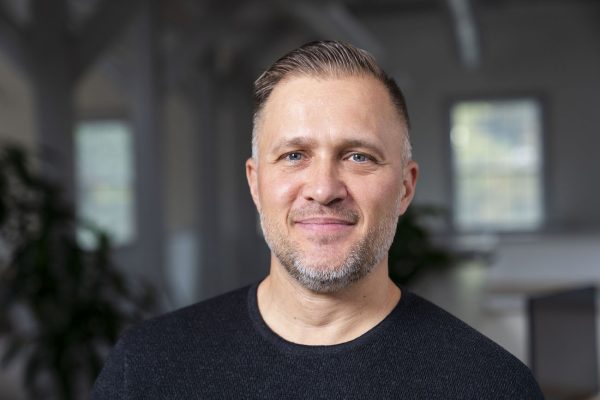
A supermarket dumpster is a supply chain if you look at it right.
Ryan Begin runs a company called Divert out of Concord, Massachusetts, which is the sort of town that has one traffic light and 300 employees at a food-waste startup. Divert works with roughly 7,800 retail locations - Ahold Delhaize, Albertsons, CVS, Kroger, Target, Blue Diamond Growers - and operates 14 facilities that take the food those stores would otherwise throw out and does one of three things with it. It prevents the spoilage before it happens by feeding grocers data. It routes what is still edible to food banks. And what is not edible at all, it liquefies, depackages, and pumps into anaerobic digesters to make renewable natural gas.
This is a boring business on paper and an interesting one in practice. The interesting part is that it works. Divert reports it has processed 2.3 billion pounds of wasted food and donated 9.6 million meals. In 2023 it signed a $1 billion infrastructure agreement with Enbridge, the Canadian pipeline company, and closed $100 million in growth equity led by Ara Partners. Total reported funding sits around $102.7 million. The company employs about 300 people and does around $80 million in annual revenue. Ryan Begin has been the CEO since day one, which was in 2007.
Begin grew up in Maine. He was, by his own telling, the first person in his family to go to college. Before college there was a garage owned by an uncle with tools and large machinery, and there was a father who kept handing him boxes of used electronics and, eventually, an oscilloscope. He went to Clarkson University in northern New York and studied electrical engineering, then stayed for a master's in the same subject. Then he went to work at Proton Energy Systems, now Nel Hydrogen, where he was a lead engineer on hydrogen electrolyzer systems. He shipped a zero-carbon PEM electrolyzer to a fuel cell bus in Barth, Germany. He shipped on-site hydrogen systems to Nikopol, Ukraine. Then he went to Raytheon as a Senior Systems Engineer and Laboratory Manager, which is a job title that suggests he was doing something more interesting than the title admits.
In 2007, he left Raytheon and started Divert with Nick Whitman, who is the company's Chief Operating Officer. This is the point at which most founder profiles insert a story about the pivotal moment, the epiphany in the dumpster, the light bulb. There does not appear to be one. Begin has said publicly that when they started, they "didn't really know what we were doing," but they knew food waste was a problem worth solving. Then they spent about fifteen years figuring out what solving it would look like.
The three verbs
Divert's model has a trademark and it goes: Prevent, Provide, Power. This is the sort of tagline that a marketing team writes and then a CEO has to defend in interviews for the next decade, and Begin has done so without any visible signs of embarrassment. The verbs describe the order of operations in Divert's platform.
The prevention layer is the software layer, and it is the part of the business that would look most familiar to someone who has ever worked at a SaaS company. The provision layer is the logistics layer, and it looks like a food-bank pickup service with better routing. The power layer is capital-intensive infrastructure - proprietary depackaging systems, digesters, liquefaction, pipeline connections - and it is the part of the business that requires a billion-dollar agreement with Enbridge to make sense at scale.
The 100-mile rule
The plan Begin has publicly staked out is straightforward and, on inspection, extremely difficult. Divert intends to scale to roughly 30 facilities positioned within 100 miles of 80% of the U.S. population, over an eight-year horizon. The logic is that food waste is bulky, wet, and heavy, and the further you move it before you process it, the worse your unit economics get. Proximity is the moat. Retailers already have their own logistics. Divert is trying to become the last-mile downstream network for organic matter that would otherwise land in a municipal landfill and off-gas methane for free.
That is not a trivial buildout. Each facility involves depackaging equipment, liquefaction systems, anaerobic digesters, and, ideally, a pipeline connection. The Enbridge partnership - $1 billion in committed infrastructure - is what makes the math possible. Ara Partners' $100 million in growth equity, deployed after acquiring the company, is what makes the corporate stack possible. Divert continues to raise; Apollo records its most recent funding activity in April 2026.
A quiet founder in a loud category
Climate tech has attracted a specific kind of founder over the last decade - someone charismatic, media-friendly, often engineering-adjacent rather than engineering-trained. Begin is not that founder. His LinkedIn handle is /in/divertfounder, which is either the most modest URL in cleantech or the most confident. He does his interviews. He wears the polo shirt. He talks about anaerobic digestion in the same measured tone he presumably once used to talk about PEM electrolyzers. There is a coherence to his career, if you squint: he has spent it turning inputs nobody wants into energy somebody needs. First hydrogen. Now methane from banana peels.
His co-founder Nick Whitman handles operations. Divert's board and leadership team expanded in 2023 as the company grew. Customers include the largest grocery chains in the United States, which is a category of buyer that is famously slow, famously price-sensitive, and famously unwilling to change vendors. Divert winning them is a fact worth pausing on.
Career timeline
The retailers
You can learn a lot about what a company sells by looking at who buys it. Divert's customer roster is a good indicator that this is not a niche pilot. Ahold Delhaize is the parent of Stop & Shop and Food Lion. Albertsons runs Safeway. Kroger runs Kroger. CVS is CVS. Target is Target. Blue Diamond Growers is the almond company. These are companies with immense downstream waste streams and, increasingly, regulatory pressure - state-level organic-waste bans, corporate ESG commitments, and the possibility of federal food-waste reduction targets. Divert positions itself as the compliance-plus-recovery partner.
Fun facts, tucked in the margins
- His father gave him his first boxes of used electronics and an oscilloscope. He was, by his own account, the first in his family to go to college.
- Early in his career he shipped hydrogen systems to Ukraine. It is unclear what has become of them.
- Divert's three-verb tagline - Prevent, Provide, Power - is trademarked. The company uses it in a very sincere way.
- Total funding for Divert is publicly reported around $102.7 million; the company employs about 300 people.
- Begin's LinkedIn URL is /in/divertfounder. There is only one.
- He is a member of the Forbes Technology Council.
Aspiration
Ryan Begin's stated ambition is to cut U.S. wasted food - roughly 63 million tons a year - in half. To do that Divert needs to be within reasonable driving distance of most of the American population, running facilities that a decade ago would have been unbuildable at this cost, plugged into pipelines owned by companies that were until recently in the fossil-fuel business exclusively. The plan is either audacious or the natural next step of a career spent moving unwanted molecules through pipes, depending on how you count.