Richard Schrems has a question for a task that arrives demanding attention: can it wait until Friday? If it can, onto a running list it goes. On Friday afternoon, he works through the list. It is a modest ritual for somebody whose business concerns the organisation of other people’s working lives. Somewhere between the grand ambitions of a software company and the small indignities of an overflowing inbox, a founder still has to decide what to do next.
Schrems calls the habit his Mind Dump. The name has the useful quality of refusing to sound expensive. His public description reserves a few hours for the cleanup, leaving the weekend for family and friends. That preference for giving scattered work a place to live is also a helpful way into palm.hr, the company he co-founded and leads. A collection of employee requests, records, approvals, and payments needs somewhere dependable to go.
The company’s beginning was equally practical. An Austrian working in HR consulting in Riyadh needed a suitable system for his clients. The search exposed a gap. Software existed; a good fit for the work and the region was harder to find. A consultant could recommend another product, make allowances for its shortcomings, and move on. Schrems helped make a company instead.
The consultant stays for the problem
His route into entrepreneurship ran through human resources. His professional biography includes HR consulting and leadership at ILF Consulting Engineers. He had studied at Vienna University of Economics and Business, and his career later took him into Saudi Arabia. By the time he discussed palm.hr in a May 2024 interview, he described a decade in the country. The business emerged from sustained proximity to a problem, rather than a brief encounter with a promising market.
There was an employee-side difficulty as well as a local one. A system could help the HR department manage people while remaining awkward for those people to use. That is a peculiar bargain: buy software to organise a workforce, then ask the workforce to accommodate the software. Anyone who has opened a work portal to complete one small request will recognise the potential comedy. The request is simple. The journey to the correct button has other ambitions.
In 2019, Schrems joined Christoph Czichna and Dragan Nikolić to found palm.hr in Riyadh. Three founders shared the undertaking. Their original roles put Schrems in charge as CEO, Czichna in operations, and Nikolić in product. The problem required more than noticing an inconvenience. Somebody had to build the system, somebody had to sell it, and customers had to believe the people making the promise would remain around to honour it.
Riyadh first, expansion later
Building inside Saudi Arabia brought its own early complications. Schrems has described scepticism towards foreign technology startups and the credibility gained when regional HR professionals became investors and supporters. The company began with bootstrapping. It also received an entrepreneurship licence early in the life of that licensing route. The legal permission to operate and the commercial confidence to buy were separate hurdles.
His account makes the geography significant. At the time, other founders could choose to establish themselves in the Emirates and sell into Saudi Arabia. palm.hr built from Riyadh. By May 2024, Schrems reported roughly 600 paying customers, principally in Saudi Arabia with some in other Gulf countries. That figure belongs to that moment. It marks the distance travelled from a consultant’s search to a product for which organisations were willing to pay.
Paying customers reported in Schrems’s interview, mainly in Saudi Arabia.
A founder’s address rarely makes it onto a software feature list. In this story it helps explain the list. Staying close to customers gives a company repeated opportunities to learn which requests matter, which assumptions fail, and which relationships need attention. The resulting product has a history in a place. Expansion then carries that history into the next conversation.
The cheque comes with a map
In February 2023, palm.hr announced a $5 million pre-Series A round. Speedinvest and RAED Ventures co-led it; Wamda Capital participated. The announcement marked Speedinvest’s entry into Saudi Arabia. Schrems’s company had brought a European investor and regional investors into the same undertaking, a useful reflection of his own cross-border working life.
The stated uses of the money were concrete: develop the product, hire to support customer acquisition, and expand regionally. Egypt and the United Arab Emirates were named destinations, alongside continued work in Saudi Arabia. A funding round opens possibilities, but the itinerary still needs people, customers, and execution. It is easy to print three country names. Serving employers in each is a longer assignment.
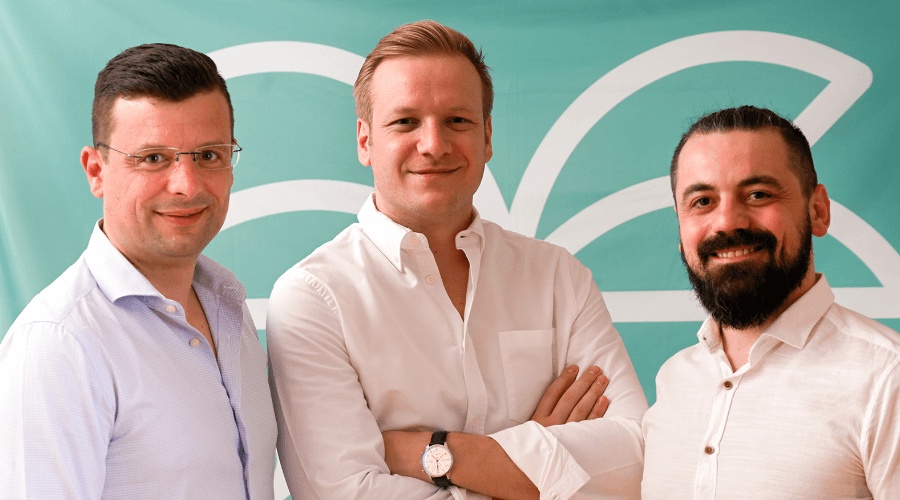
Schrems used his own announcement to thank the team as well as the investors. It is a conventional courtesy, and a necessary one. A founder appears in the headline; colleagues produce the work that makes the headline possible. The photograph of the three co-founders makes that shared authorship visible. It also resists the tidy temptation to turn a company into the biography of a single person.
A request should not need a search party
By April 2023, Schrems said palm.hr was already serving its first customers in Egypt and the UAE. He expected local teams to follow within three months. His explanation of the business centred on flexible software, connected employee data, and communication. Companies, he observed, were spreading work across tools such as WhatsApp, email, calls, Slack, and meetings. A request could travel through several channels without acquiring a clear home.
He wanted information brought together so the organisation could depend on one record of its people. The ambition sounds administrative until something goes missing. Then the employee has to ask again, the manager has to reconstruct what happened, and an ordinary task acquires a supporting cast. The point of bringing records and requests together is to make that reconstruction less necessary.
His emphasis included the employees using the platform alongside HR managers. That choice links the founder back to his original complaint. A product must satisfy the department responsible for it and the person trying to use it during a working day. The two perspectives meet every time a request is submitted. Each is entitled to expect the system to make sense.
The people beyond the employee record
One of Schrems’s more revealing accounts begins with hesitation. Towards the end of 2020, palm.hr was introduced to a Gaza-based NGO helping Palestinians find technology jobs. He said he was initially sceptical. After speaking with fellow founders and investors, he and his co-founders agreed to interview candidates. The conversations changed his view of the opportunity.
They sent Malak Hammad an offer that same day. By the time Schrems recounted the episode in April 2024, the team in Gaza had grown to 13 people. He credited those colleagues with helping build the company and recalled personal milestones, including cars, homes, weddings, and families. His account gives the phrase employee experience a scale that a product demonstration cannot capture.
The same-day offer is the hinge in the story. A founder had a reservation, met people, and revised it. Hiring creates room for that revision when an introduction becomes an actual conversation. The result becomes visible in the work and in the relationships that follow. A distributed team is made of those encounters, however neatly it may later fit into an organisation chart.
In February 2024, Schrems and colleague Christoffer Haraldsson organised a fundraiser for palm.hr’s Gaza team. They asked customers, partners, acquaintances, friends, and family to help colleagues rebuild their lives after losing homes and belongings. The appeal put a responsibility before the same wider network that might otherwise hear a product launch or a funding announcement. Membership of a team carries practical obligations when circumstances become difficult.
A career with room for introductions
palm.hr was not Schrems’s first involvement in connecting people and work. In 2018, he was identified alongside Tarik Solomon as a co-founder of Team2030, a Saudi career platform concerned with discovery, company culture, and connections before the formal application. The idea involved showing candidates the people and workplaces behind a vacancy. A job description could introduce a role; a closer view could help introduce an employer.
That year, the two attended a meeting at the Saudi Al-Diriyah Formula E event with figures from the Saudi Arabian Motor Federation and the FIA. It is an unexpected stop in an HR founder’s story, though it fits a career spent connecting organisations and people. The motorsport setting adds texture without requiring a racing hobby to be invented for him.
In February 2024, another public invitation came from a conference booth. Schrems announced that he and colleagues were at Web Summit Qatar, naming Czichna, Nikolić, and Haraldsson and inviting visitors to booth E226. The particulars are pleasingly ordinary. Regional expansion, at ground level, includes telling people where to find you and standing there to meet them.
Reputation has a local address
When Schrems publicly noted his inclusion in Endeavor Saudi Arabia’s Entrepreneurial Phenomenon 2025 report, he connected business loyalty with personal relationships. His description of Saudi culture stressed its attention to people and the importance of reputation. “The charm of Saudi culture is its focus on people, fostering loyalty and strong relationships,” he wrote.
“The charm of Saudi culture is its focus on people, fostering loyalty and strong relationships.”
Richard Schrems
Read beside the founding story, that observation carries a practical implication. Software can organise a relationship’s paperwork; the people running the business remain answerable for the relationship. A customer remembers whether someone followed up. A colleague remembers whether an offer became an opportunity. A partner remembers whether the founder returned after the introductory meeting.
Schrems has described an ambition for palm.hr to become the digital heartbeat of organisations in the Arab world. The phrase is broad. The episodes behind it are usefully specific: a local software search, three co-founders, a job offer sent after an interview, a booth number, a Friday list. His story gains its shape from those decisions. There is always another market to consider and another task arriving. For the moment, somebody still has to decide what deserves attention, and stay long enough to see it through.
Follow the work, hear the conversation
Explore Schrems’s public posts, his founding interview, and the stories behind the milestones.
- Richard Schrems on LinkedIn ↗
- Visit palm.hr ↗
- Watch the May 2024 founding conversation (German) ↗
- The Austrian founder’s Saudi software venture ↗
- The February 2023 funding announcement ↗
- Schrems on Egypt, the UAE, and connected HR ↗
- His account of building the team in Gaza ↗
- The 2024 appeal for colleagues ↗
- Team2030 at the 2018 Formula E event ↗
- The invitation to Web Summit Qatar ↗