Three hours to solve an airline’s business problem. Thirty minutes to defend the answer. In Hong Kong in April 2012, Christoffer Haraldsson and three fellow students from Lund faced precisely that bargain. The room contained judges, an audience and, presumably, very little appetite for a leisurely explanation. Their team finished joint second. The home team won. A decade before he joined palm.hr, Haraldsson was already practising the awkward passage from having an answer to persuading other people it would work.
Today he is Co-CEO of palm.hr, the Middle East HR and payroll software business. His route there runs through consulting, Careem, property technology and recruitment technology. Viewed as a list of employers, it looks like a product career. Viewed through the problems involved, it becomes a story about handoffs: between an analysis and a decision, a customer and a software team, an employee record and an accounting entry.
That is a useful way to read the career, rather than a philosophy he has given a name. The interesting moments arrive when responsibility crosses a boundary. An elegant recommendation is one thing. Someone agreeing to buy, use or depend on it introduces a rather more demanding audience.
First, persuade the room
The Hong Kong trip began with a question about Google in China. In late 2011, Haraldsson, Niklas Hansson, Olof Nordgren and Camilla Wengholm won the Swedish national round of the KPMG International Case Competition. The four shared a 40,000-krona prize and earned the chance to represent Sweden internationally.
Their recommendation asked Google to preserve its philosophy, challenge the authorities and protect access to information. The jury praised how the students combined their different qualities and built an argument using their chosen analytical model. Even in a student contest, the assignment demanded a position on the world outside the spreadsheet. A strategy had to survive contact with a particular country.
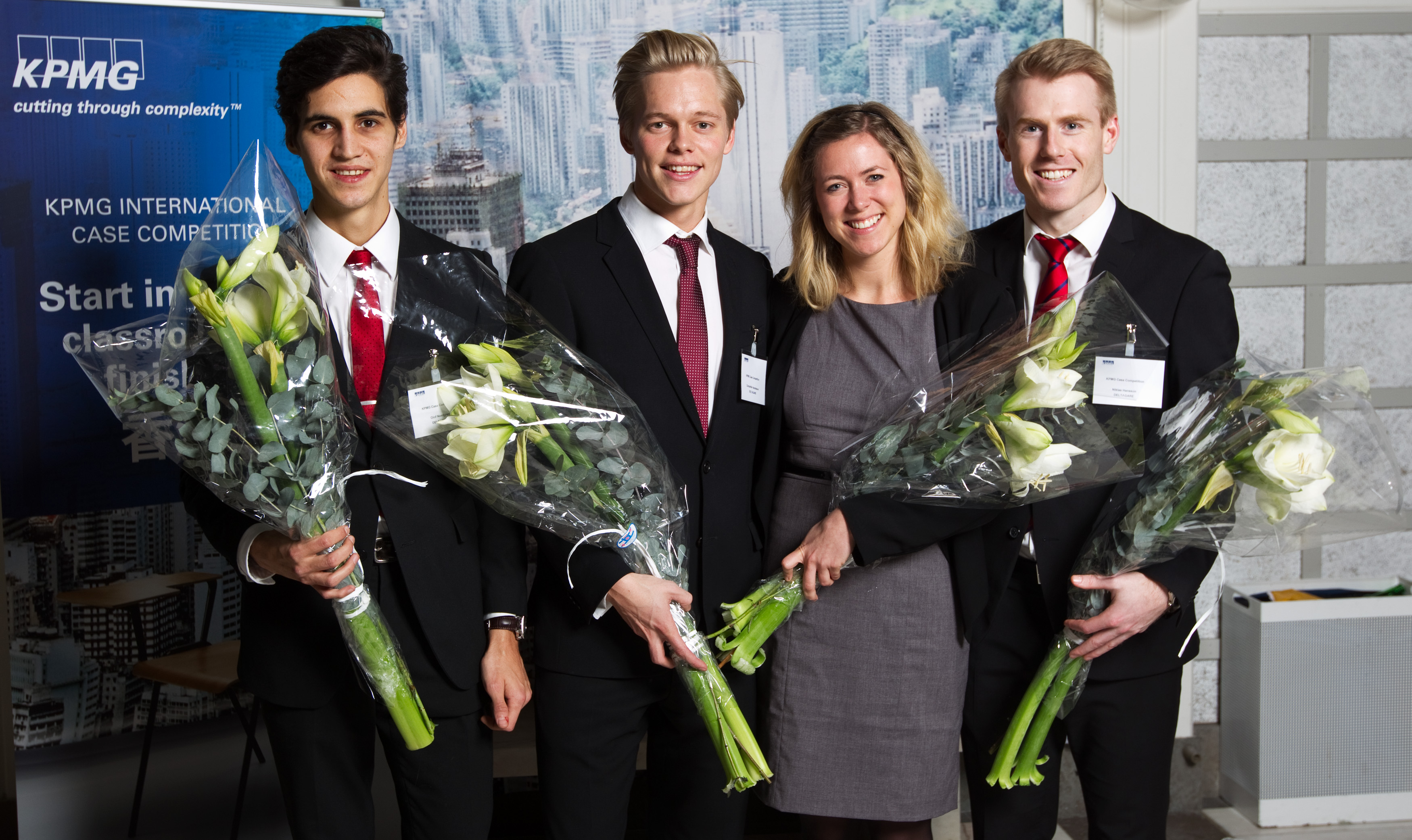
By the international final the following April, the competition involved 24 national teams and 96 students. Four teams reached the last round. The final assignment concerned an international airline confronting changes and competition in its industry. After the Hong Kong team took first place, the other three finalists shared second.
The format is a small machine for exposing weak arguments. There is a deadline for thinking, followed by a deadline for explaining. Every extra slide competes with the audience’s patience. The appeal of this early episode is its specificity: four people, one business problem, an answer that must leave the group and withstand questions.
The unfashionable question in his thesis
In 2013, Haraldsson and Anders Moldén investigated why some Nordic manufacturing companies performed better than others. Their master’s thesis, Success factors of Nordic manufacturing companies - manufacturing for the future, examined businesses in Sweden and Finland through a multiple-case study and qualitative interviews.
Its conclusion gave greater weight to two priorities among the stronger performers: profitability ahead of growth, and concentration on core competencies. The title page identifies Haraldsson’s studies as business administration and technology management. The work sits comfortably between the commercial and technical concerns that would recur in his jobs.
It is tempting to turn an old thesis into a prophecy. The more interesting reading is simpler. Before joining the software businesses on his CV, he had spent time investigating what made operating companies hold together. Factories make a useful counterweight to startup romance. Capacity, costs and competence have an irritating habit of remaining relevant after the presentation ends.
The study’s findings belong to its manufacturing sample. They also provide an interesting question to carry into the rest of his career: what is the part of a business that deserves its attention, and what work is merely consuming it? That question gives payroll software a little more intellectual company than it usually receives.
A product career, with the walls moving outward
Haraldsson joined Capgemini’s consulting business in 2013 and progressed to senior management consultant before moving to Careem in 2016. He worked there as a senior product manager until 2020. Head of product roles at Ajar and Qureos followed, before he joined palm.hr as VP of Product in February 2023.
The sectors changed. Consulting asks for an argument about how an organisation should operate. A product role adds the work of turning decisions into something customers can actually use. Moving between transport, property and recruitment technology also changes whose problem is in front of the team. Familiar job titles can conceal quite different daily realities.
Management consulting
Senior product manager
Head of product roles
VP of Product
Deputy CEO & CPO, then Co-CEO
At palm.hr, his remit expanded through Deputy CEO and Chief Product Officer to Co-CEO. One small admission captures the change better than the titles. After years focused on product, he began taking responsibility for sales. He already knew customer calls as the person brought along to explain the product. Leading the conversation was a different assignment. He discovered he enjoyed it.
There is a recognisable professional threshold here. Expertise supplies answers to questions someone else has framed. Commercial responsibility requires finding out which question matters enough for a customer to act. The product specialist can explain the feature beautifully and still leave the central problem untouched. A sale makes that problem rather difficult to evade.
His work has repeatedly occupied the space between two kinds of expertise. Business administration and technology management meet in his education; product and commercial responsibility meet in his later roles. Neither pairing guarantees an easy translation. People can agree on the desired outcome while using quite different language to describe the problem. The practical achievement is getting enough shared understanding to make the next decision. That gives the career its continuity, even as the names on the office door change.
Where payroll meets the ledger
On October 15, 2025, palm.hr announced an integration partnership with accounting and e-invoicing company Wafeq. Haraldsson was named Co-CEO in the announcement. The proposed connection was practical: move payroll information into accounting automatically, reducing the manual transfer of data between the two systems.
Payroll is a revealing place to work on that problem. The calculation is only part of the job. The result also has to arrive somewhere else, in a form another team can use. Software can make an individual screen feel wonderfully orderly while leaving the journey between departments surprisingly untidy.
“Building modern HR experiences means integrating every part of the employee and business journey.”
Christoffer Haraldsson · palm.hr–Wafeq announcement, 2025
His ambition in that announcement was to connect the employee and business journey and reduce the separation between HR and finance. The partnership covered payroll synchronisation, financial reporting and support for businesses with multiple entities. Those are company plans, rather than a measurement of results already delivered.
There is something quietly satisfying about this kind of ambition. Nobody needs to admire a data transfer. The people doing the work simply need it to happen correctly. The better the connection, the less ceremony it requires. In a business presentation, that can sound modest. At the end of a payroll cycle, modest may be exactly what everybody ordered.
The market has its own instructions
Haraldsson’s appearance on the Future@Work podcast put the regional setting in the foreground. Joining Danielle Blizzard of talentX and Hamza Khan of Letswork, he discussed HR technology and the Saudi market. Blizzard connected the conversation to their shared Careem experience and to his family’s relocation to Dubai.
The episode’s advertised subjects included local HR practices, adoption and the difficulties of expanding in Saudi Arabia. These are useful companions to a product conversation. A feature can travel across a border instantly. The assumptions behind it deserve a slower journey. Who uses it, who approves the work and how an organisation adopts a new process all affect what the software needs to accomplish.
That makes the Google case from his university days an interesting bookend. A country appeared there as a central condition of a business decision. In his later working life, regional context again sits inside the problem itself. The connection is an observation about the two episodes, rather than a claim that one caused the other.
Four hires, and six more openings
The people side of palm.hr also has a concrete example. TAP, a talent training and placement organisation, reported that the company had hired four of its participants across technology and operations. The placement fees helped fund programme places for six more young professionals. Haraldsson publicly encouraged other employers to consider hiring through TAP.
These are deliberately different numbers. Four describes people hired. Six describes additional programme opportunities funded through those hires. Keeping the distinction matters. A useful account of employment should be able to explain what actually happened without asking arithmetic to do public relations.
It is also a pleasingly direct arrangement for a business selling people software. There are jobs within the company, a route for candidates to reach them, and money flowing back into preparation for the next group. The mechanism is easy to understand. Its significance rests in those opportunities rather than in an abstract declaration about talent.
Haraldsson’s career contains a competition result, an academic investigation and a sequence of increasingly broad operating roles. The part that makes them interesting together is the movement from proposing an answer to taking responsibility for its passage into use. Eventually, somebody has to receive the information, accept the recommendation or do the work. His story keeps arriving at that other person.