The interest rate was 19.8 percent. Richard Fairbank kept encountering it as a young consultant studying the credit-card business: different customers, different circumstances, much the same offer. To an industry accustomed to the arrangement, this was ordinary banking. To Fairbank, it looked like an unanswered question. Why charge so many people the same price when their likelihood of repaying was different?
He and fellow consultant Nigel Morris wanted to use information to make finer distinctions. They needed a bank willing to let them try. More than 20 said no. In 1988, Virginia’s Signet Bank took them in. Fairbank’s career would become an extended exercise in persuading established institutions that the familiar way of doing something was still open to revision.
By October 2026, he was chairman and chief executive of Capital One, the company that emerged from that experiment. Its acquisition of Discover had added a payments network; its purchase of Brex had added business-finance software. The young consultant’s question had acquired a very large balance sheet. The attraction, across the decades, remained the possibility that an accepted arrangement could be redesigned.
A swimming school before a bank
There was no straight line from childhood ambition to credit cards. After earning his economics degree at Stanford in 1972, Fairbank founded a school for competitive swimmers. He wanted to work with children. Running a community recreation agency followed, giving him an early encounter with management through a route rather wetter than the usual executive training program.
He returned to Stanford for an MBA, graduating in 1981. Entrepreneurship appealed to him before he had worked out what the enterprise would do. Consulting supplied the missing exposure: seven years at Strategic Planning Associates introduced him to different businesses, their assumptions and their opportunities. Banking eventually gave that general curiosity a specific target.
Both his parents were physicists. His father, William, became a Stanford professor whose work included experiments concerned with relativity. Fairbank has described growing up around ambitious questions pursued patiently. That is a useful background for understanding his business choices, without pretending that a credit offer and an experiment in physics are quite the same undertaking. One comes with rather more direct mail.
His father’s persistence mattered to him. The family example made a long pursuit feel worthwhile even before the result arrived. Fairbank later carried that idea into his own account of building a company: the work needed a purpose beyond a promotion, a title or the approval of the people around him.
The offer that escaped the envelope
At Signet, the theory required people, systems and time. Fairbank recruited graduates with quantitative skills and built a business that could test different offers against different groups of customers. The premise was commercially exacting: better information should allow a lender to price risk more precisely. An attractive offer still had to attract customers who would repay.
The early years were difficult. In a budget meeting he later recalled, Signet’s finance chief challenged the distance between Fairbank’s persuasive explanations and the division’s financial results. It is an uncomfortable scene for any founder: the story is improving, the infrastructure is taking shape, and somebody quite reasonably wants to know where the money is.
The breakthrough was the balance-transfer offer. Customers could move debt from another card to a lower introductory rate, while the bank handled the transfer. The proposition combined price with convenience. It also gave people a practical reason to switch. Data analysis had found something useful to put in an envelope.
A simplified explanation of the information-based strategy, rather than a financial forecast.
Capital One’s November 1994 initial public offering made the growing business a public company. Fairbank has led it as CEO since that IPO and became chairman in February 1995. Morris, his co-founder, was the other central figure in turning the consulting idea into an operating business. A founder story told entirely in the singular would miss the partnership at its beginning.
When the experiment was a telephone
The method invited a tempting thought. If information and testing worked in credit cards, perhaps they could work elsewhere. A Stanford case study describes Fairbank considering data-rich industries large enough to support meaningful growth. Credit cards could become the first application of a broader capability, rather than the boundary of the company.
That possibility produced an instructive wrong turn. Capital One entered mobile-phone service in 1995 through America One, reselling service in a market where larger competitors could cut prices more effectively. The business closed in 2000. Fairbank acknowledged the mistake: “It was a strategic failure on my part.”
There is something refreshing about that sentence. It leaves the responsibility with the person who chose the strategy. The episode also puts a limit around the mythology of data: an effective analytical technique does not erase the economics of the business in which it is used. A clever test cannot make a small reseller control its suppliers or its competitors.
Even success warranted another look. In 2000, Fairbank and Morris brought senior managers together to examine whether their strategy had been optimal, flexible and properly supported by the company’s functions. Competitors were copying their work. Having made a business out of questioning bankers’ habits, they had reasons to question their own.
Ten years to hire one colleague
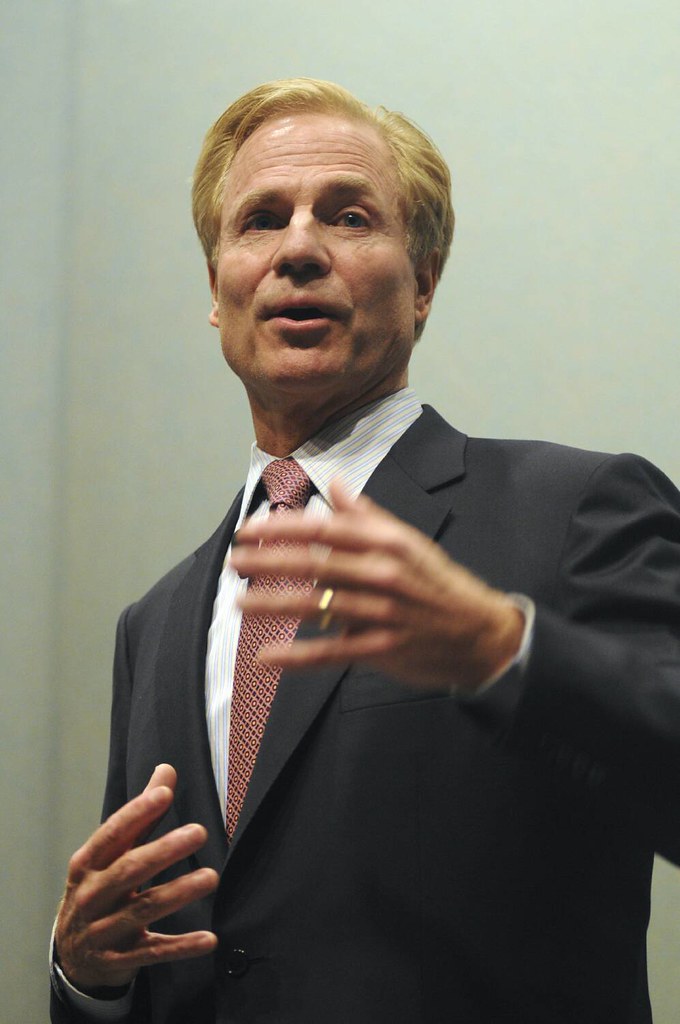
Fairbank’s public talks return repeatedly to the people doing the work. His account of recruiting a finance chief supplies an unusually concrete measure of that commitment. “I chased our CFO for 10 years,” he told a Stanford audience. Plenty of executives describe hiring as a priority. A decade is a fairly demanding interpretation of the word.
The same talk challenged companies that spend little time recruiting and enormous amounts of time dealing with hiring mistakes. His emphasis was on choosing colleagues carefully, then making the enterprise about their contribution. This is a more personal explanation of Capital One than the familiar shorthand about algorithms and credit scoring.
In another Stanford appearance, he explained that he and his wife, Chris, had made a pact when the public-company CEO role arrived: if it changed who he was, she could ask him to quit. The domestic veto is an unusual footnote to a corporate succession. It also gives substance to his insistence that professional advancement should answer to standards chosen at home.
“Nobody wants to work for a phony.”
Richard D. Fairbank, Stanford leadership talk
The couple have eight children. Fairbank has also been an investor in the Washington Capitals, joining the hockey team’s ownership group in 2002. Those details give his life dimensions beyond the bank. His public descriptions of leadership, however, keep returning to a more intimate constituency: family members who can tell when a grand professional ambition is beginning to take over the person pursuing it.
Buying the plumbing
As Capital One grew, Fairbank also changed how it funded itself. The purchase of Hibernia in 2005, followed by other regional-bank acquisitions, brought access to deposits. A card lender dependent on capital markets could be exposed when those markets stopped cooperating. Owning deposit-taking banks addressed a vulnerability in the machinery underneath the business.
The later move into digital banking extended the same concern with how a financial institution should work. By 2011, Capital One had announced its agreement to buy ING Direct’s American business. Fairbank was questioning the need for a branch on every corner as customers did more banking online. Technology was changing distribution as well as underwriting.
Redesign also reached the price of everyday banking. In December 2021, Capital One announced that it would eliminate consumer overdraft and insufficient-funds fees, with the change beginning in early 2022. It was a concrete alteration to a familiar bank charge. For customers, an argument about innovation becomes easier to understand when it changes a line on the statement.
The responsibility attached to information was painfully visible in 2019. A security incident affected approximately 100 million people in the United States and six million in Canada. Fairbank publicly apologized. A career built on the value of customer data also carries an obligation to protect it; the incident belongs in the record of his tenure alongside the products and acquisitions.
The question gets bigger
Discover brought a different kind of infrastructure. Capital One completed the acquisition on May 18, 2025, adding the Discover, PULSE and Diners Club International networks. Issuing a card and owning the network that carries payments are different positions in the same transaction. The deal moved Fairbank’s company further into the system through which other businesses and customers pay one another.
- 1994A public credit-card company
Capital One’s IPO - 2005A move into branch banking
The Hibernia acquisition - 2025A payments network joins the bank
The Discover acquisition closes
Brex followed in April 2026, adding corporate cards, expense-management software and payments tools for businesses. Brex co-founder Pedro Franceschi described an arrangement under which he would continue leading the company within Capital One. Here was another founder relationship, this time with Fairbank providing the larger institution and a younger company supplying capabilities it had built.
The work is still being measured. On October 20, 2026, Capital One reported third-quarter net income of $3.5 billion. Fairbank said Discover integration was progressing and reaffirmed continued investment for long-term growth. Those are current results and management’s assessment of ongoing work, rather than a verdict on everything the acquisitions might eventually deliver.
Fairbank began by wondering why a credit-card offer had to look the same for so many different people. He now presides over a company that lends, takes deposits, supplies business software and runs payments networks. The scale has changed the stakes of his questions. It has also made the answers harder to judge quickly. The next test takes place in customers’ accounts, merchants’ transactions and the daily work of a much larger company.