A payments executive telling you that payments have ceased to be the center of the universe is rather like a restaurateur recommending that you admire the company instead of the cutlery. In 2015, Philip Heasley was prepared to make the recommendation. The shopping experience, he argued, had become the thing that mattered. His own industry would have to adjust its place in the picture.
He was speaking after decades spent inside that industry: Citicorp, Diners Club, U.S. Bancorp, First USA, Visa and, eventually, ACI Worldwide. He had seen payments from the bank, the card organization and the software supplier. By then, the question occupying him was how to give merchants more freedom to accommodate their customers. A purchase should not have to wait for the payment industry to sort out its preferences.
There is a useful way to read Heasley’s career through that observation. Again and again, his work brought him to the connections between institutions: who could transact with whom, through which systems, and under whose control. The job titles changed. The problem kept returning, wearing a more fashionable device each time.
Before the software, the bank
Heasley’s route into technology ran through banking. He spent 13 years at Citicorp, including a period as president and chief operating officer of Diners Club. Another 13 years followed at U.S. Bancorp, where he served in senior leadership and rose to president and chief operating officer. These were businesses in which a payment was both a customer service and an operational undertaking.
His education paired a bachelor’s degree from Marist College with an MBA from the Bernard Baruch Graduate School of Business in New York. Marist’s alumni notes placed him in the class of 1971 and recorded his appointment as U.S. Bancorp president and COO. Long before the software-company chapter, he had already accumulated experience running financial institutions.
From October 2000 to November 2003, he was chairman and CEO of First USA Bank, Bank One’s credit-card subsidiary. He also chaired Visa USA from 1996 until November 2003 and served on Visa International’s board during that period. Those overlapping responsibilities put him in contact with the interests of both individual banks and a network joining them together.
Next came PayPower, an acquisition and consulting firm focused on financial and payment services. He served as chairman and CEO from October 2003 until March 2005. That month, he became president and chief executive of the business that would be known as ACI Worldwide. He arrived with a customer’s understanding of banking software and an operator’s experience of what happens around it.
- BankingCiticorp · U.S. Bancorp · First USA
- NetworksVisa USA · Visa International
- SoftwareACI Worldwide · 2005-2019
- OversightOschadbank · approved 2023
Buying the connections
At ACI, acquisitions became a recurring instrument. The S1 transaction in 2012 expanded the company’s collection of products and customers across financial institutions, processors and merchant retailers. ACI presented the combination as a way to gain broader capabilities and greater scale. The integration plan also involved the prosaic work of bringing businesses into common operating methods.
The decisions were still being tested. When ACI discussed Online Resources in early 2013, Heasley recalled that the company had initially been uncertain whether it would keep S1’s community-bank business. About a year after closing, he said, that business had moved from losing customers on a net basis to growing. He believed ACI could apply a similar approach to Online Resources.
Later in 2013, Official Payments extended ACI’s electronic bill-payment reach. In 2014, Retail Decisions, known as ReD, added e-commerce fraud-prevention capabilities. PAY.ON followed in 2015, bringing payment-gateway technology and connections to alternative payment methods. The deals addressed different portions of the same commercial journey: accepting a payment, assessing its risk, and reaching the organization that could complete it.
Heasley also sold. In 2016, ACI completed the $200 million sale of its Community Financial Services business to Fiserv. He described the decision in terms of concentrating investment and attention on strategic products and growth initiatives. Acquisition was a tool, rather than a vow to keep every business forever. Even a company devoted to connections occasionally needed to unplug something.
The customer has other plans
The 2015 retail conversation exposed the reasoning behind the portfolio. Heasley wanted merchants to offer choice across the ways people shopped, received goods and returned them. He also wanted retailers to be able to make changes themselves instead of depending entirely on suppliers. In that view, a payments system earned its usefulness by allowing the business around it to change.
He was willing to say that payments had lost their place at the center of things. For someone whose working life had revolved around payments, it was a pleasantly deflating admission. The remark made room for the person trying to buy something. A retailer might care deeply about completing a sale while feeling considerably less affection for the machinery required to collect the money.
His concern with the route money took had another dimension. In a 2014 television interview, he argued that each intermediate stop in a payment created another location vulnerable to theft. His preference for more direct clearing linked speed with security. It was an argument about simplifying the path, made by someone whose career had repeatedly crossed the institutions along it.
“I don’t think [payments are] the center of the universe anymore.”Philip Heasley · 2015
The room where the software gets made
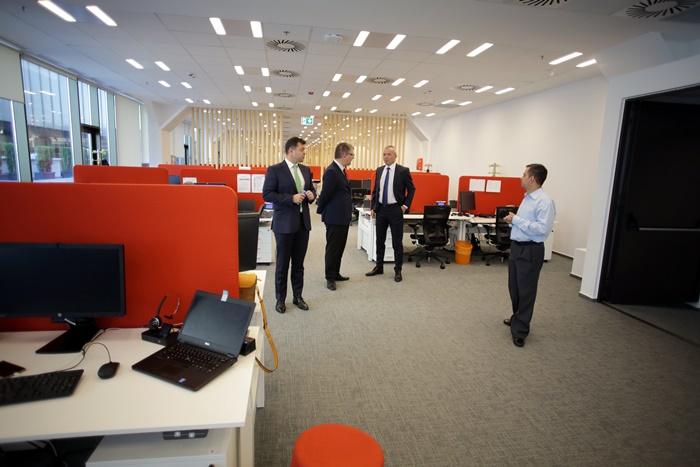
In July 2017, Heasley attended the opening of ACI’s new office in Timișoara, Romania. The company had been in the city for more than a decade. More than 100 employees there had started through university internship programs. The office had more than 200 staff, and the expansion came with plans for 50 additional hires.
Here was a different view of the business from the acquisition announcements. The people making the payments software had desks, colleagues and careers that began with internships. ACI’s collaborations with local technical universities were part of that history. Heasley credited the Timișoara staff’s talent and commitment, connecting their work to customers’ increasing expectations of fast payments and immediate settlement.
During the visit, he described ACI’s annual research and development spending as roughly $200 million, or about 20 cents of every revenue dollar. He also explained the company’s role as providing communication between financial institutions. Having previously run banks, he was now running a supplier whose business depended on helping different financial organizations work together.
By the discussion of ACI’s 2018 results, he was emphasizing the difficulty of joining acquired businesses into one organization. He credited employees for the move toward Linux and cloud-enabled technology. “I’d love to take credit for it myself,” he said. Instead, he gave the credit to the people doing the work. Behind the collection of acquired names was an integration effort that required them to act as colleagues.
A bigger bill, and a qualified result
In May 2019, ACI announced the completion of its purchase of Western Union’s U.S. Speedpay business for $750 million in cash, subject to customary adjustments. The plan was to combine Speedpay with ACI’s bill-payment platform. When the agreement was announced, the two portfolios together were described as serving more than 4,000 U.S. customers.
The rationale went beyond adding customers. Greater scale was intended to support investment in the platform and research and development. ACI expected the combination to help it address digital and real-time bill payments. It was a late-tenure commitment to the infrastructure behind an ordinary household action: paying a bill.
Results require the same attention to detail as transactions. In the second quarter of 2019, ACI reported revenue growth of 27 percent, or 6 percent excluding Speedpay’s contribution. Both numbers belong in the picture. They distinguish the growth produced by purchasing a business from the performance of the business already there.
There had also been a shortfall. Reporting 2018 results, Heasley said new bookings had risen 22 percent and operating cash flow had increased 26 percent, while acknowledging that revenue and EBITDA had missed expectations because certain contracts were delayed. A signed commercial ambition, an operating result and cash arriving in an account are separate events. His business was built around precisely such distinctions.
The job after the job
Heasley retired as ACI president, CEO and director on December 31, 2019, after nearly 15 years leading the company. He agreed to provide consulting support for three months. ACI chairman David Poe singled out the development of a cloud-based business among his contributions. The retirement closed a long executive chapter, though it did not end his work with financial organizations.
In September 2020, Jopari announced that he had joined its board. In April 2023, Ukraine’s Oschadbank named him among the independent members approved for its next supervisory board. The bank continued to list him among its independent members in September 2025. Its current leadership page identifies his expertise as financial-institution management, payments and global commerce.
The change in seat matters. A supervisory-board member brings experience to oversight; the bank’s management board runs its daily operations. Heasley’s place in that arrangement draws on a career spent both managing financial businesses and supplying them. The questions now arrive from another side of the table.
A customer rarely celebrates a payment that works. The receipt goes into a pocket, the screen closes, the day continues. Heasley’s retail argument allowed for that lack of ceremony. After years of running the institutions and systems behind the transaction, he was willing to let the shopping take the applause. The cutlery could do its job quietly.