Michael Mueller had a problem worthy of a banker. He wanted large financial institutions to buy his young company’s payment technology. Some of those institutions wanted to invest in it. Each commitment made the other more attractive, which left a rather delicate question of who would move first. The eventual answer involved three commercial agreements and three investment commitments, negotiated together. An instant payment, it turns out, can require a considerable amount of waiting beforehand.
In 2020, Lloyds, Nationwide and Mastercard became part of that customer-investor story. Mueller later described the combined negotiation as the most complicated undertaking of his career. All three arrived on the same terms. For a founder who had spent much of his working life on the bank’s side of the table, it was an unusually literal demonstration of how selling to banks differs from selling almost anything else.
Form3 was asking to operate machinery at the centre of their businesses. Customers could admire the ambition and still require exhaustive reassurance. Mueller’s concise account of the experience deserves a place above many startup desks: “You get no slack just because you’re small.”
“You get no slack just because you’re small.”
Michael Mueller, on supplying banks
The apprenticeship before the argument
There was an earlier plan. As a child, Mueller wanted to become an architect. Instead, he entered banking through a Deutsche Bank apprenticeship in western Germany. He started working for the bank after finishing school in 1988. His introduction to finance involved learning how transactions worked, dealing with customers and seeing the institution from inside. Before he had a company to run, he had a trade to learn.
His banking career took him through Germany, Singapore, Sydney and London. He later worked at Royal Bank of Scotland and Barclays, becoming Barclays’ Global Head of Cash Management and a member of its Corporate Banking Executive. He also studied at INSEAD, earning an MBA and a qualification in organisational psychology. The combination placed both systems and the people running them within his professional field of view.
At Barclays, he was responsible for payment products and was a buyer of payment technology. That detail matters more to the Form3 story than any romantic idea of a founder suddenly discovering an untouched market. He knew the products already. He had lived with the procurement, implementation and maintenance. His eventual business grew out of an experienced customer’s accumulated impatience.
The frustration was practical. Existing systems consumed money and attention through upkeep and mandatory changes. The budget intended to move a bank forward could disappear into the work required to keep it operating. Mueller’s interest lay in what that arrangement prevented: new services, quicker changes and more useful experiences for customers. After more than a quarter of a century in banking, he went into the business of supplying his former industry.
Four people and a whiteboard
Form3 began in August 2016 with four people, laptops and a whiteboard. Its proposal was to deliver payments as a managed service using technology built for the cloud. Banks had long bought software and operated it in their own data centres. Form3 offered another arrangement: connect to a platform and let a specialist handle the payment infrastructure.
The work happens behind the familiar act of sending money. A bank or financial technology company connects to Form3, which provides processing and access to payment systems. For the person tapping a banking app, the whole exercise ought to be wonderfully uneventful. The money should arrive. The technical and commercial labour required to make that happen can remain backstage.
By July 2017, Barclays had joined Angel Co-Fund and individual investors in a $5 million funding round. Mueller’s former employer was backing the supplier he had helped create. The proposed commercial model allowed customers to begin with a particular payment service rather than launch a large implementation all at once. A small entry point could open a substantial relationship.
That early backing did not remove the need to prove the proposition. Selling infrastructure involves a peculiar test of character for a business: it must persuade customers that it will remain dependable after the presentation is over. A bank buying a payment service is making decisions about tomorrow’s operations as well as today’s product. Mueller had spent enough years in banking to understand the weight on both sides.
Simplified illustration of the service, not a complete settlement diagram.
Trust takes longer than a transaction
The customer-investor negotiations of 2020 belong in this context. An institution’s willingness to own part of Form3 and its willingness to place payment operations on the platform were related judgments. Each carried consequences well beyond an announcement. The commercial contracts provided a form of commitment that an enthusiastic meeting could never supply.
In August that year, Form3 announced a $33 million investment round including Lloyds Banking Group, Nationwide and 83North, with Draper Esprit investing again. Its announcement recorded growth from 50 to 140 people across 14 countries and a regional hub in Amsterdam. These were the dimensions of the business at that moment, when a young supplier was beginning to occupy a more consequential place in established institutions’ plans.
A larger financing followed in September 2021: $160 million led by Goldman Sachs, bringing announced fundraising to $220 million. Mueller was discussing the US as the next area for expansion. Mastercard had also rolled out a cloud-based gateway built by Form3 to help institutions connect to the UK’s Faster Payments network. The proposition was becoming something customers could put to work.
In November 2022, a €23 million venture debt facility from Atempo Growth added financing for product development, new markets and potential acquisitions. The sequence illustrates the patient demands of this kind of company. Engineering, customer implementation and geographic expansion need funding while relationships develop. The payment may be instant; the business built around it has to think in years.
Making room for change
Mueller’s explanations of banking technology often return to the difficulty of moving from an existing system to a new one. A payment service needs to keep operating during the transition. He has argued for introducing new components gradually, by payment type or even by sort code, rather than requiring an institution to change its entire operation over a single weekend.
In a 2022 essay, he described another obstacle: organisational habits can hold back a technology programme as firmly as ageing software. Teams need a clear purpose, agreement about the work and a credible approach to testing. His attention extends beyond buying a new system to how a bank makes decisions around it. Procurement can acquire technology; people still have to make the transition work.
His 2023 writing carried the argument further. Banks should assess existing processes, choose which components to move, plan the sequence and test the results. They should also consider how payments can support services customers value. These are fairly sober instructions from someone working in an industry fond of announcing revolutions. There is something reassuring about an ambition accompanied by a migration plan.
The same period brought a discussion about dependence on cloud providers. By August 2022, Mueller was describing Form3’s move to operate across Amazon, Google and Microsoft’s clouds simultaneously. For a company selling availability, the architecture was part of the promise. It also gave his customers another set of questions to ask, which is generally how progress proceeds in banking.
A company with fewer fixed seats
Form3 also developed a working model that spread colleagues across countries. Its remote approach made recruitment possible beyond the distance someone could reasonably travel to a London office. A March 2020 account of the company described communication through shared online tools, trust in employees and deliberate opportunities to meet in person. Flexibility required its own operating discipline.
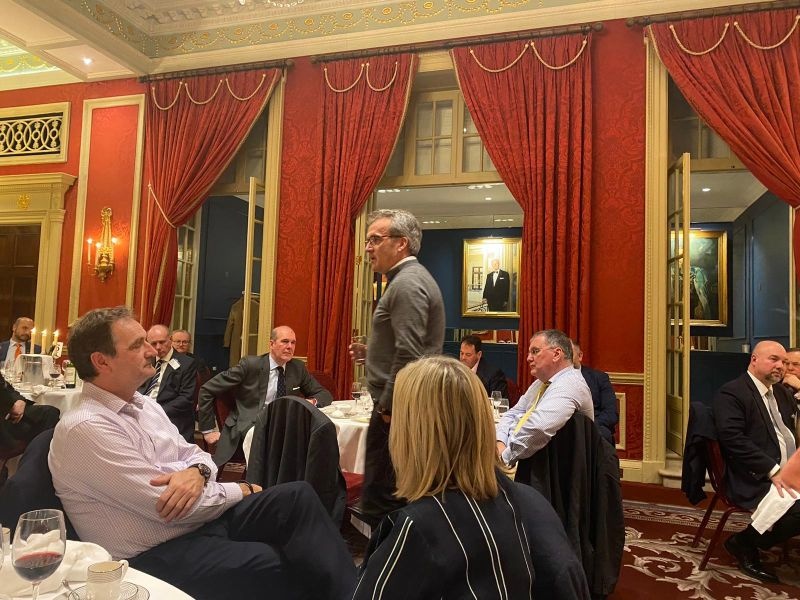
Mueller’s public appearances sometimes reveal how much that discipline matters to him. After he spoke at the Cornhill Club in January 2023, the hosts singled out the company’s culture and investment in the long term. A conversation advertised around a payments business had widened into a discussion of how to build one. The machinery and its makers were difficult to separate.
Outside those discussions, his preferences are pleasingly specific. He has described enjoying time in Italy with his family, Italian food and the inexpensive coffee available in an ordinary bar. For a pint, his preference was a London pub. There is no need to turn this into a management philosophy. Sometimes a founder’s opinion is simply that the coffee is better in Italy.
Changing his own seat
In October 2023, Mueller proposed transferring the chief executive role to co-founder Mike Walters, whom he described as a friend and a central contributor to Form3’s product thinking. Eimear O’Connor moved from Chief Operating Officer to Chief Product Officer. Mueller became Executive Chair, succeeding Tom Kozlowski, with whom he had worked since the business began.
He retained executive responsibilities including customer relationships, industry initiatives and the US rollout. His explanation emphasised governance appropriate to a company processing payments at greater scale. It was an application of the same question he asked of banks: what needs to change as the operation grows? In this case, the answer included his own job.
Form3’s current leadership listing continues to identify Mueller as Executive Chair. In October 2025, Nationwide made a further strategic investment, alongside a debt facility from funds and accounts managed by BlackRock, supporting development and US expansion. The institution that had once been part of the complicated negotiation remained involved years later. For Mueller, that continuing relationship gives a practical shape to the ambition that took him out of banking: build infrastructure that banks are willing to keep relying on, payment after payment.