A financial deal has a closing date. Its paperwork has other plans. The money moves, the announcement goes out, and somebody still has to check the collateral, follow the covenants and explain what changed since the last report. Sumit Gupta has built much of his business around that somebody.
Gupta is the co-founder and CEO of Oxane Partners. Before becoming a founder, he managed structured lending at Deutsche Bank. His subsequent career has stayed close to a practical question: how do people keep control of investments whose details refuse to fit neatly together? It is a question with less theatrical appeal than picking the next winning trade. It has proved capable of sustaining a business.
A credit desk, divided between two cities
In June 2014, Gupta and Vishal Soni announced that they had left Deutsche Bank to start a structured-finance boutique. The offer was concrete. Oxane would help investors analyse, model and investigate complicated transactions, working alongside the people making the deals. By then, it said, it had supported trades totalling more than $500 million in notional since January.
The early menu included loan portfolios, commercial real estate, structured lending and special situations. These are investments with plenty of room for individual terms and awkward questions. A portfolio of loans can contain a great deal more information than its purchase price suggests. Understanding what has been bought is a job in itself.
The partnership had a geographical shape. Soni led the Delhi office, where an early team of seven analysts did much of the credit work. Gupta oversaw the London operation. The arrangement put analytical capacity in India alongside a presence close to clients in London. Their proposition depended on doing demanding work with investors, rather than merely handing over another opinion.
There is a small calendar wrinkle in the origin. The legal company was incorporated in August 2013, initially as IG Analytics Limited; Oxane now dates its founding to 2014. The useful distinction is between the corporate paperwork and the operating story. By mid-2014, the two former bankers were publicly in business together.
The public launch: analysis, modelling and execution support.
Gupta collects a technical advisory award with Yousuf Attarwala.
Oxane announces a strategic growth investment from TA.
Learning both sides of the screen
Gupta arrived at entrepreneurship with experience in both financial transactions and the systems used to handle them. At ICICI Bank, he worked on structured finance and securitisation. At Reuters and BNP Paribas, his fintech responsibilities involved implementing trading and risk-management systems for banks across Asia Pacific. His work took him through Mumbai, Singapore and London.
At Deutsche Bank, he became a senior director in the Principal Investments Group, responsible for the structured lending book. His education joined an MBA in finance from IIM Calcutta with an MS in computational finance from Carnegie Mellon. The combination places financial reasoning and technical implementation in the same professional history. In his later business, those two concerns keep turning up together.
Oxane describes its origins in difficulties the founders encountered during their own investment careers. Its approach combines software with specialists who understand private investments and the processes surrounding them. That matters because making information available and making it useful are different pieces of work. A system can carry a number; someone must understand the agreement that gives the number meaning.
Gupta’s career makes that relationship unusually easy to follow. He had worked on the machinery of trading and risk before managing credit positions himself. Oxane’s operating model brought those experiences into one business, with technology and financial expertise expected to work together on the client’s problem.
“We’ve spent over a decade listening closely to our clients, understanding their evolving needs and speaking the language of credit.”
Sumit Gupta, July 2025
A trophy for the less photogenic work
In November 2018, Gupta stood beside colleague Yousuf Attarwala in Frankfurt to collect an award. Oxane had won Technical Advisory of the Year at the European Property Finance Awards. The photograph supplies a rare moment in this story when the work comes with evening clothes and a prize you can hold.
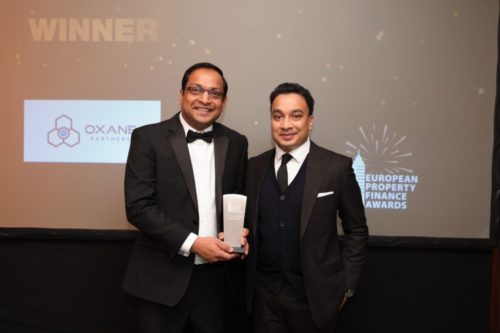
The judges focused on the team’s ability to help clients assess more deals and execute faster while retaining analytical rigour. That tension runs through Gupta’s business. More capacity is useful only if the checks remain worth doing. An investment team able to process additional work still needs confidence in the work it has processed.
Oxane’s relationships were expanding beyond individual mandates. In 2016, CR Investment Management had announced a partnership and an equity stake, with systems and technology supporting asset and loan management. By January 2021, Oxane was announcing three additional global bank clients for its illiquid-credit portfolio-management solution. The early execution partner was developing a wider place in clients’ operations.
The CR relationship covered analytics, reporting and business planning as well as technology. The companies kept their individual client mandates independent. For a young supplier, such an arrangement linked product development to an established investment business without making every client relationship part of the same mandate. The partnership brought the operating model into the practical business of managing assets and loans.
A bank implementation described at the time involved a credit book exceeding €25 billion. The task included moving from Excel-based processes toward a common portfolio and reporting system, with covenant tracking and monitoring across different assets. For Gupta, the familiar transaction problem was acquiring a larger frame: keeping the entire book intelligible.
That implementation included dashboards for portfolio performance and risk, alongside automated reporting. The point was to give the bank’s team time for work requiring their attention, while maintaining a view across different assets. It is a useful example of the division of labour Oxane was developing: the system carries the recurring information, and the investment team examines what it means.
When the lender invites the borrower
One of Gupta’s more revealing business anecdotes concerns a handoff. Writing about fund finance in July 2024, he described Oxane initially helping lenders manage facilities on its platform. Some of those lenders then encouraged their borrowers to adopt the same tools. The person on the other side of the agreement became part of the software conversation.
His explanation was practical. Borrowers must prepare information about the collateral supporting their facilities; lenders must assess and validate it. Different facilities bring different reporting demands. As the number grows, repeated preparation, checking and reconciliation can absorb more attention. A common platform offers a way to reduce duplicated work and make the underlying detail easier to examine.
Reporting obligations
Monitoring · reporting
Risk assessment
The example also explains the appeal of his original proposition. A financing agreement creates a continuing relationship, and that relationship needs usable information. Gupta’s interest lies in the detail of how the parties exchange it. There is entrepreneurial room in a request that arrives repeatedly, especially when answering it requires rebuilding the same analysis.
His article also examined concentration risk: the need to see exposures across underlying borrowers, investors, industries and countries. Bringing facilities together makes those questions easier to ask across a portfolio. A report that satisfies one agreement may still leave the institution wanting a broader view.
Listening as the market changes
In 2024, Oxane celebrated ten years at its Engage client forums in London and New York. The conversations covered fund finance, artificial intelligence and the widening range of strategies grouped under private credit. Gupta marked the anniversary with clients, putting the company’s growth alongside changes in the work those clients needed to perform.
These gatherings offer a useful setting for understanding his public priorities. The subjects are operational as well as financial: how people manage growing books, what they need to monitor and where specialist judgement remains necessary. The 2025 discussions again emphasised collateral oversight, connected information and controlled applications of AI. The expanding market was bringing additional demands for evidence and consistency.
The AI discussions had a similar emphasis on responsibility. At Engage 2025, applications included document intelligence, credit monitoring and scenario modelling, accompanied by attention to governance, explainability and human oversight. Those details place the technology inside a process with people still accountable for decisions.
Gupta has also described banks and private credit managers as increasingly connected. In an August 2025 interview, he discussed banks evolving their role through closer collaboration with private lenders. That observation complicates the familiar picture of one group simply replacing the other. Working together creates its own requirements for transparency and operational readiness.
By December 2025, he was making a related argument about valuations. As institutions faced demands for more frequent portfolio information, valuation work needed to connect with credit monitoring, analytics and funding considerations. The value assigned to an investment belongs in the same conversation as changes in its condition. Keeping those conversations separate can make the whole picture harder to see.
A new investor, a familiar question
On 29 July 2026, Oxane announced a strategic growth investment from TA Associates. The announcement set out plans for technology development, broader AI capabilities and investment in talent and leadership. It described the company’s combination of its Panorama platform and credit specialists as “Platform x People”. The multiplication sign gives a compact name to an idea present much earlier in the business.
Gupta described his continuing belief that “private credit requires purpose-built technology supported by experts who understand the asset class deeply”. The investment announcement anticipated a third-quarter closing and disclosed no financial terms. Its stated priorities point toward building more capacity around the model he and Soni had spent years developing.
For Gupta, the new chapter carries an old question at a different scale. How can investment teams keep their understanding of the deal as the information around it grows? His answer has taken several forms: an analyst team, a technology platform, shared workflows and specialists who can interpret the detail. The agreement gets signed once. Understanding what happens next remains a daily occupation.