Mike Walters made a chessboard out of trees that had fallen in his garden. Yew and pine supplied the playing surface; oak made the border. He milled the timber himself, dried it and turned something destined to rot into something people could use. It is a pleasingly literal answer to the interview question about what an executive does away from work. Some people collect business books. Walters has made somewhere to put the pieces.
The board offers an inviting way into his working life, though the comparison has limits. Timber can wait while it dries. Payments are increasingly expected to arrive immediately. Walters is the co-founder and chief executive of Form3, which builds and operates the infrastructure banks and financial technology companies use to move money between accounts. His customers buy a service whose successful operation generally attracts very little conversation.
That is an unusual bargain for a founder. A customer-facing product can announce itself with a colour, a sound or an ingenious button. Payment processing earns its place farther down the chain. It has to make the button worth pressing. Walters has spent years in the business of getting those underlying connections to work, first inside established banks and then inside a company built to offer them a different approach.
Before the cloud, the corporate bank
His route into Form3 ran through Barclays. Earlier in his career, Walters managed client relationship teams serving North American financial institutions and British corporate clients. He subsequently became head of UK corporate payments at Barclays Corporate Bank, with responsibility for the payment, receipting and reporting products delivered to its corporate customers. Those are functions that tend to appear on an organisation chart in small type and occupy an extraordinary amount of everyone’s working day.
The role included defining the corporate bank’s mobile payments strategy and initiating, building and scaling mobile payment services. Later, as product director at Barclaycard Payment Acceptance, he sat on the executive committee. His remit covered product management, commercial performance, strategy, suppliers, digital transformation and acquisitions. In other words, he had worked on the customer problem, the product response and the machinery required to make the response commercially viable.
That background matters to the story of Form3. Walters approached payment infrastructure with experience of the institution that would eventually have to buy it. A bank has customers to serve, existing technology to manage and obligations that survive every software release. An attractive demonstration is only the beginning of that conversation. The product must also make sense to the people responsible for running it after the demonstration ends.
A new company underneath the old problem
Form3 began in 2016. Walters joined as a co-founder and chief product officer. The proposition was to provide an always-on payment service using cloud-native technology, giving financial institutions access to payment schemes through an API. Instead of each customer assembling and maintaining the entire supporting stack, Form3 would build and operate a platform they could consume.
In his account of the company’s beginnings, Walters points to developments outside banking. Streaming and large-scale e-commerce had shown what cloud technology could support. Meanwhile, payments faced a growing volume of regulatory change. The founding question was practical: could technology already operating at scale elsewhere simplify the choices facing financial institutions? It was a question about an industry’s habits as much as its software.
An API is a defined way for software systems to communicate. In Form3’s case, the significance is the work behind that connection. Different payment schemes have different requirements; customers need the service to remain usable as those requirements and transaction volumes change. A simple connection is valuable precisely because the underlying arrangements are complicated. The restaurant menu may be short. Someone still has to run the kitchen.
Walters spent the company’s first seven years as CPO. His responsibilities extended beyond product development and management to strategy, funding activity and important client relationships. That combination placed him at the meeting point between what the company intended to build, what customers would trust and what investors were willing to support. The position called for more than a view about which feature should come next.
The product officer takes the chair
In October 2023, Walters became chief executive. Fellow founder Michael Mueller moved from CEO to executive chair, while Eimear O’Connor moved from chief operating officer to chief product officer. The handover kept the leadership connected to people who had been building the business since its early years. Walters took responsibility for the company after helping shape its product from the start.
The change also gives his career an intelligible shape. Corporate banking had put him close to the demands of large institutions. Product leadership at Form3 required him to translate those demands into something other institutions could use. The CEO role widened the responsibility to the business carrying that promise. There is continuity here, even if the title on the meeting invitation changed.
By February 2026, Form3 was processing more than five billion transactions annually, with clients including GoCardless, Klarna and SumUp. A global team of roughly 200 supported the business. The figures describe the company he helped build, rather than an individual production record. They also explain why a founder’s conviction must eventually be matched by an organisation’s capacity to deliver, repeatedly, for other people’s customers.
Speed gives mistakes less room
As chief executive, Walters has been concerned with what happens when faster money encounters familiar risks. In March 2024, Form3 announced an authorised push payment fraud prevention service with Feedzai. Such scams persuade someone to send a payment to a criminal. The partnership combined Form3’s payment processing with Feedzai’s analytics, considering both the sending and receiving sides of a transaction.
The design reflected an argument Walters made for collaborative intelligence: financial institutions could make better decisions by seeing more than one side of a payment. Moving the money quickly and understanding where it is going belong in the same operational conversation. A faster transfer offers little comfort to a customer who has been persuaded to send it to the wrong place.
His April 2026 writing on Pay by Bank returns to the infrastructure behind an apparently straightforward purchase. Paying directly from an account can shorten the distance between shopper and merchant. But when a payment must authenticate, process and settle within seconds, the supporting system has little room for hesitation. Walters’s emphasis is on dependable operation around the clock, and on capacity that can grow with retail demand.
It is a useful corrective to the way payment innovation is often presented. At checkout, the customer sees an option and a confirmation. The institution sees authentication, protection of data, operational continuity and a transaction that must reach its destination. Walters’s working territory sits between those two views. The easier the experience appears, the more exacting the supporting work becomes.
The easier the experience appears, the more exacting the supporting work becomes.On the work behind the checkout
A company distributed, a responsibility shared
Form3 operates with a flexible working model, trusting people to take ownership of their work. Its stated values include transparency, care and high standards. Walters puts the relationship between the company and its product succinctly: “Resilience is not just in our product; it’s built into our culture.” That is a substantial expectation to set for a team responsible for other organisations’ payment operations.
The company’s tenth anniversary in 2026 brought colleagues together for an offsite. Walters has described Form3 as remote first from the beginning and stressed the value of meeting in person. The point of the gathering was connection across a business whose normal working arrangements allow people to be dispersed. A distributed company still needs people who understand one another when the work becomes difficult.
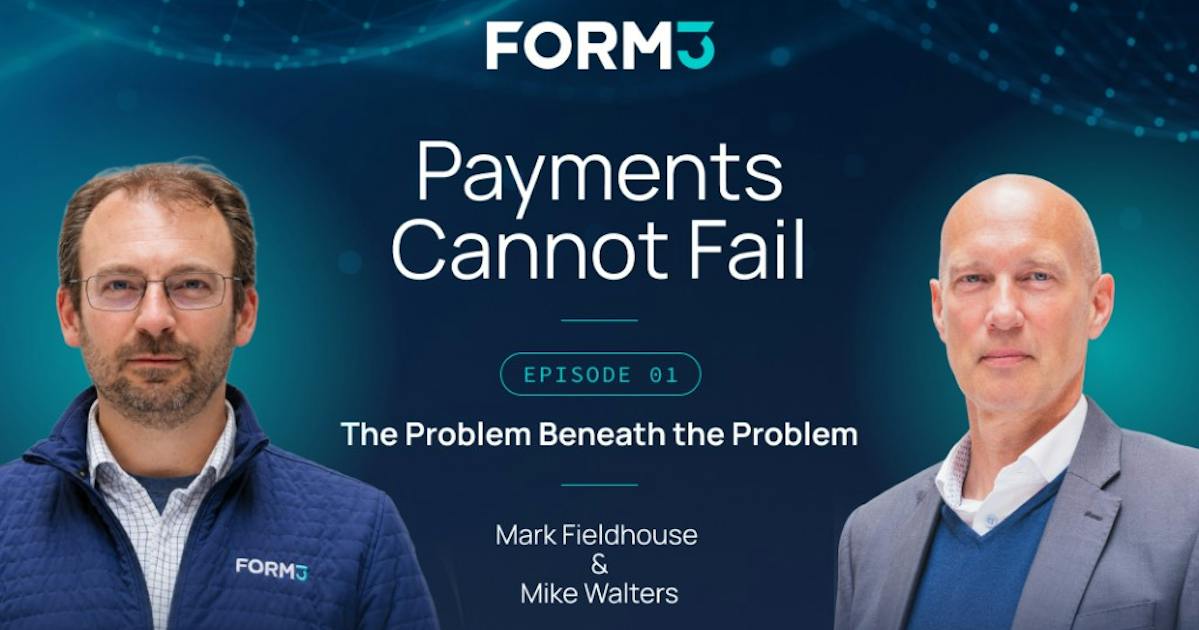
In March 2026, he joined chief revenue officer Mark Fieldhouse for the opening episode of Payments Cannot Fail. Their conversation returned to why Form3 exists and the problems facing banks handling large volumes of payments. The title gives the company’s ambition unusually little hiding space. There is no leisurely interpretation of the final word, and no customer likely to applaud a philosophical explanation of it.
New kinds of money, the same practical question
At Money20/20 Europe in 2026, Walters discussed cloud adoption, agentic commerce, stablecoins and tokenised deposits. He put Form3’s annual transaction volume at around 5.5 billion. His description of the next phase stayed close to the company’s existing role: keep the infrastructure ready as customers develop new experiences and payment types. The business of operating the service remains central even when the vocabulary around it changes.
He also acknowledged open questions about stablecoins in high-volume consumer and business payments. That qualification matters. An infrastructure provider has to consider emerging demand without treating every forecast as an implementation plan. For Walters, the future involves supporting financial institutions as they explore those models, including reliable connections between newer forms of money and existing payment arrangements.
The scale can make his work sound abstract. Five and a half billion is too large a number to picture comfortably. Yet the commercial promise rests on individual events: a payment instruction accepted, a system available, a transaction completed. An annual total is assembled from those small obligations. For the person making the payment, their own instruction is quite enough to be getting on with.
Walters’s career has moved from managing banking products to helping banks obtain the infrastructure beneath them. The distinction is easy to lose in a conversation full of acronyms. His contribution is easier to understand as a sequence of responsibilities: learn what institutions need, build something they can use, and organise a company capable of continuing to provide it. The last part keeps the story open. Customers will need the service again tomorrow.