Before there were AI agents to train, there were candy machines to fill. In Zotapay’s Tel Aviv reception in 2017, three of them offered chewing gum and sweets. It was an agreeable introduction to a business occupied with less delicious things: applications, banking connections, payment processing. Money might move through complicated machinery. Visitors could at least begin with something they understood.
Avner Ziv, known professionally as Abe, was running the company from that office. The contrast suits his public story. There is an appetite for reaching people, coupled with considerable attention to the systems required to serve them. Follow his career through China, online businesses, a Spanish football partnership and the arrival of AI, and the recurring question is practical: how do you make the next interaction easier?
First, learn the language
In 2008 and 2009, Ziv studied at Yunnan Normal University in Kunming. His studies covered Chinese listening, reading, speaking and culture, supported by an annual full scholarship from the Chinese Scholarship Council. These were advanced language studies, an education in understanding what somebody else means before trying to do business with them.
His professional language list includes Chinese, English, Spanish and Hebrew. By 2017, his working history included SafeCharge, eToro, Betfred and MARKETS.com. It placed him among businesses where an international audience, an online interface and the ability to move money meet. A customer may arrive from anywhere. The financial arrangements behind the screen remain stubbornly particular.
The language background offers a useful way to read the business that followed. A translation succeeds when the recipient understands it. The same test applies to a checkout: does the customer recognize a way to pay? A site can welcome the world in its advertising and still lose a buyer at the last step. Local habits do not disappear because a browser crosses a border.
The software arrived before the staff
The business took shape in late 2015 with Mabsut Payments Group, which Ziv co-founded; Zota’s operating history begins in 2016. Over time, Zotapay became Zota. One early decision explains more about its founder than the shorter name does. He says he bought Salesforce licenses and established the methodology before hiring his first employee.
Most founding stories reserve this sort of place for a first customer or an office improvised from unsuitable furniture. Ziv gives the operating system a speaking part. Before a team accumulated its own habits, he wanted a common place for the work. A shared record would connect the customer relationship with what happened next.
“It’s crucial that we follow up quickly.”
Avner Ziv, on responding to prospective customers
That decision had a long afterlife. By January 2021, the company was describing how it tracked payment partners from agreement through integration and testing. Bringing a provider aboard could involve extended due diligence. The value of a shared system was the ability to see each stage, rather than repeatedly asking where a document or decision had gone.
Merchant applications received similar treatment. At the time, Ziv described an average of 14 days for approval by a first payment provider, dependent on responsiveness and due diligence. It was a figure about process, with conditions attached. The ambition was to keep the application moving while respecting the requirements of the institution on the other end.
The ambition inside a single form
By July 2024, Zota was still expressing its proposition through one application and one integration. A merchant supplied information once; the company coordinated connections across its network. Ziv’s explanation put location, language, currency and market behavior together. Each could determine whether a payment option was useful to the person trying to buy something.
There is a substantial amount of work concealed inside that small word, “one.” Payment partners have their own requirements. A business entering a new country encounters different methods and different expectations. The interface can become simpler only if someone accepts responsibility for arranging those differences behind it. Simplicity gives the customer fewer things to manage and the intermediary more things to understand.
One entrance. Many connections.
The rebrand made this work more explicit. In its January 2024 account, Zota described a marketplace connecting businesses and consumers across payment languages. The revised website included a payment-method search engine, regional information, integration details and payouts. Shortening the name gave the company room to describe more of what sat around a transaction.
Its operating history adds concrete milestones: a development center in Bulgaria and offices in Hong Kong in 2019, the MetaGate gateway in 2020, and a developer portal and software development kit in 2022. These are useful details because a promise to make things easy eventually needs tools, people and somewhere for the difficult work to happen.
A challenger in a football shirt
For a less administrative glimpse of Ziv, consider Deportivo Alavés. In January 2019, Zotapay agreed to sponsor the Spanish football club. The arrangement covered branding on player and coach shirts as well as other advertising opportunities. Payment technology had found a place in a setting where the audience was unlikely to applaud an orderly onboarding process.
Ziv put the value in the hundreds of thousands of euros without disclosing the exact sum. His explanation was revealing. He saw a resemblance between a relatively young payments business and a club challenging established football names. The sponsorship gave that comparison a visible form: the company could put its sense of itself on a shirt.
A football partnership cannot establish whether a payments platform works. It does show a founder choosing a public expression for the business. Alongside the early reception sweets, it supplies some welcome color to a career whose recurring subjects include documentation and connectivity. Even a company devoted to reducing friction is allowed a little theatre.
Teaching the company to answer
By March 2025, another kind of interaction was occupying Zota: the customer question. Its first Agentforce deployment focused on FAQs, with an expected reduction in support costs. Ziv was working with Salesforce account executive Yaniv Lakunishok on a program that joined customer information, support tools and automated responses. The aim was to reserve more staff attention for complex conversations.
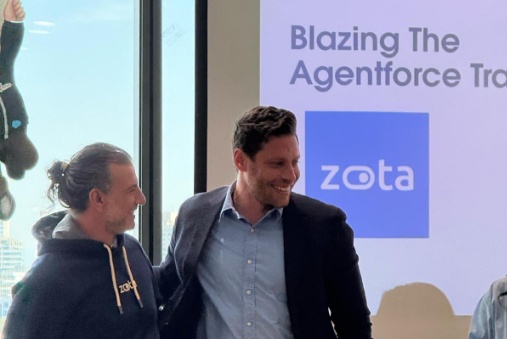
The introduction of agents required the company to collect knowledge from its departments and agree on terminology. That work matters before a machine composes a sentence. If different teams explain the same service differently, an automated answer inherits their confusion. Organizing information is an unglamorous prerequisite for sounding helpful.
Testing made the problem tangible. An early agent incorrectly told a questioner that Zota did not support cryptocurrency payments. The missing ingredient was an article covering the subject. Adding it corrected the response. The lesson was wonderfully ordinary: the company had to supply the information it wanted the agent to use.
Zota also adjusted retrieval and prompts when responses proved slower than expected. Confidentiality needed boundaries: the FAQ agent was restricted to appropriate public material. These details make the project easier to understand than a general promise of automation. A useful answer needs relevant information, permission to use it and a sensible response time.
Fifty agents, and a CEO with homework
In October 2025, Ziv took Zota’s approach to Dreamforce. The presentation followed an earlier Salesforce event in Tel Aviv. His subject had grown from the merchant application to the organization behind it: how unified information and AI agents could change the way work was handled. The software purchased before the first hire now had a much larger cast.
Zota’s stated roadmap called for 50 AI agents. Its ambition was to expand the business tenfold while keeping the number of people constant. Those are plans, with all the execution they imply still to be earned. They reveal the scale of the next problem Ziv wants the company to solve, rather than a completed transformation to celebrate.
Company targets, not achieved results.
His longer vision extends to agents identifying market changes and eventually carrying out financial transfers and currency conversions without human intervention. That aspiration goes well beyond answering an FAQ. It also raises the stakes for the old disciplines of clear information, dependable connections and knowing exactly what a system has been asked to do.
For now, learning is part of the job description. Ziv personally takes Agentforce Trailhead courses, and employees are required to learn too. The founder who established the methodology before the first hire is taking homework alongside the people who must use the next version. A title does not exempt anyone from understanding the tools.
There is a pleasing continuity between the student in Kunming and the executive preparing an organization for agents. Different vocabularies, different audiences, the same practical demand for comprehension. Ziv’s business has accumulated more connections and more software. Its everyday test remains intimate: a merchant asks a question, a buyer reaches a checkout, and somebody needs to understand what comes next.