Peter Burridge once found something faintly absurd in the business of sending money abroad. At Travelex, he learned that a payment could require sending money to an intermediary, who would then send it to the intended recipient. One payment, two journeys. For the customer, the instruction was simple. The machinery had other ideas.
That small irritation offers a useful way into his career. Burridge has worked at Oracle, Siebel, Travelex, Hyperwallet and PayPal. He now runs NomuPay. The businesses differ, but a recurring question connects them: how much work should a customer have to do before the service actually works?
In payments, the answer can become surprisingly elaborate. A business wants to sell in another country. Someone wants to buy. Between those two perfectly reasonable ambitions sit licences, payment methods, contracts and systems that have never agreed on a common language. The shopping basket is ready. The paperwork would like a word.
Before the checkout, the software
Burridge’s education at Massey University combined business studies with accounting, finance and information technology. It is an apt combination for a career spent moving between the commercial case for a product and the systems required to deliver it. The money and the machinery were present early.
His executive career in enterprise software preceded his move into payments. In January 2005, Siebel Systems announced his arrival as senior vice president and general manager for Asia Pacific and Japan, reporting to the chief executive. He came from Oracle with more than 12 years of experience there.
Those details matter more than a parade of job titles. Asia was already part of his working geography well before NomuPay. So were large organisations buying complex technology. Selling enterprise software means making a promise that other people must eventually implement. The signature is a milestone; the customer still expects the thing to function.
There is a useful continuity here. Payments also involve a sale followed by a considerable amount of implementation. A compelling demonstration cannot make a local licence materialise. Nor can it reconcile a transaction after the customer has gone home. Burridge’s subsequent career puts those less theatrical requirements near the centre of the story.
A small payment with a large lesson
In 2006, Burridge moved into financial services at Travelex Global Business Payments. His work took him between London and Washington, DC. The international payments business gave the software executive a close view of what happens when a seemingly straightforward service crosses a border.
His later account of intermediary payments contains a dry sense of disbelief. The arrangement could be perfectly established and still strike the person trying to use it as unnecessarily roundabout. That distinction is fertile territory for a business: a process can be familiar to its operators while remaining awkward for everyone else.
By May 2010, Burridge had joined Hyperwallet’s board. His explanation of its appeal was concrete: “Finding a company who can send $30 around the world for $1”. He went on to emphasise the ability to make money while doing so. The small amount was the point. A service that works economically for modest transfers has answered a demanding question.
It is also a revealing choice of example. He could have spoken in abstractions about international finance. Instead, there was a sum someone might actually need to receive. Take too much out of a small payment and the service begins to defeat its own purpose. Commercial discipline and usefulness meet in the same arithmetic.
“Finding a company who can send $30 around the world for $1”
Peter Burridge, on Hyperwallet, 2010
Learning both ends of the transaction
At Hyperwallet, Burridge held senior operating and commercial roles, including president and chief operating officer. He helped guide its recapitalisation and international expansion. The business specialised in payouts: getting money to the people and businesses entitled to receive it.
In June 2018, PayPal agreed to acquire Hyperwallet for $400 million in cash, subject to adjustments. The acquisition closed that November. PayPal described the deal as an expansion of its ability to serve ecommerce platforms and marketplaces. Burridge subsequently worked as head of operations payouts at PayPal.
Accepting a payment and distributing the proceeds are connected tasks, but they are different tasks. A marketplace may collect money from a buyer and then need to pay a seller. Looking only at the checkout leaves the second half of the job unfinished. His work in payouts helps explain the breadth of the problem NomuPay would later take on.
Burridge has also argued for a regulatory framework that distinguishes transactional money movement from lending and deposits. That is a practical concern as much as a policy argument. A company can assemble useful services and still have to resolve who is responsible for moving, holding and checking the money. The architecture includes obligations as well as code.
PayPal’s announced cash consideration for Hyperwallet, subject to adjustments.
July 2021: a collection of doors
NomuPay appointed Burridge group chief executive on 21 July 2021. The announcement arrived alongside completed acquisitions of Wirecard Payment Solutions businesses in Malaysia and Hong Kong. Further transactions involving the Philippines, Thailand and Turkey were then in progress.
The beginnings were unusual. A payments company could be assembled around operating businesses and local market access. The immediate task was to turn those pieces into a service a customer could use across countries. Ownership provided a starting position; it still required a coherent product and a reason for customers to choose it.
Burridge’s remit included business development, market entry, operations, licensing and compliance. Read together, those responsibilities describe the work behind an international launch rather well. Somebody has to sell the service. Somebody has to establish where it can operate. Somebody has to make the first transaction and the ten-thousandth equally manageable.
The question facing him was therefore unusually specific. Why add another payments company when businesses already had providers? NomuPay’s answer centred on access to markets where local requirements made expansion difficult. A merchant’s wish to enter a country was the beginning of the conversation, rather than proof that its existing provider could follow.
A schematic of the proposition, not a transaction-flow specification.
The customer should keep the customer
Burridge’s argument about Southeast Asian payments starts with local habits. Cards are part of the picture; wallets and other local payment methods also matter. Each additional connection can bring its own maintenance, reporting and contractual work. A checkout may look tidy while its back office resembles a cupboard of incompatible chargers.
NomuPay’s proposition combines acceptance, reconciliation and payouts through a single integration. The company also works with payment providers that already have merchant relationships. For those providers, entering a new market creates a delicate commercial question: how do you supply the missing capability while continuing to serve your own customer?
This makes partnership part of the product. A provider can offer wider coverage without asking the merchant to rebuild the whole relationship around somebody else. The attraction is easy to understand. Businesses spend time earning trust; an expansion plan should give that trust somewhere to go.
In November 2023, NomuPay acquired Total Processing. Its emphasis on merchant service appealed to Burridge. The deal brought another set of people and capabilities into the group. It also underlined a recurring choice in his career: the commercial relationship deserves attention alongside the infrastructure supporting it.
A handshake with a destination
In January 2025, NomuPay announced $37 million in funding for its Asian expansion. The financing included a final $12 million tranche led by Endeit Capital, with participation from Uneti Ventures, alongside $25 million contributed by existing investors over the preceding 18 months. The detail matters: the headline amount described a funding sequence, rather than one cheque.
Another development followed in June. SB Payment Service, a SoftBank Corp. group company, made a strategic investment worth $40 million. Its president and chief executive, Jun Shimba, appears alongside Burridge in the partnership photograph. Two executives, two flags and a handshake: the conventional furniture of an announcement, with a specific destination attached.
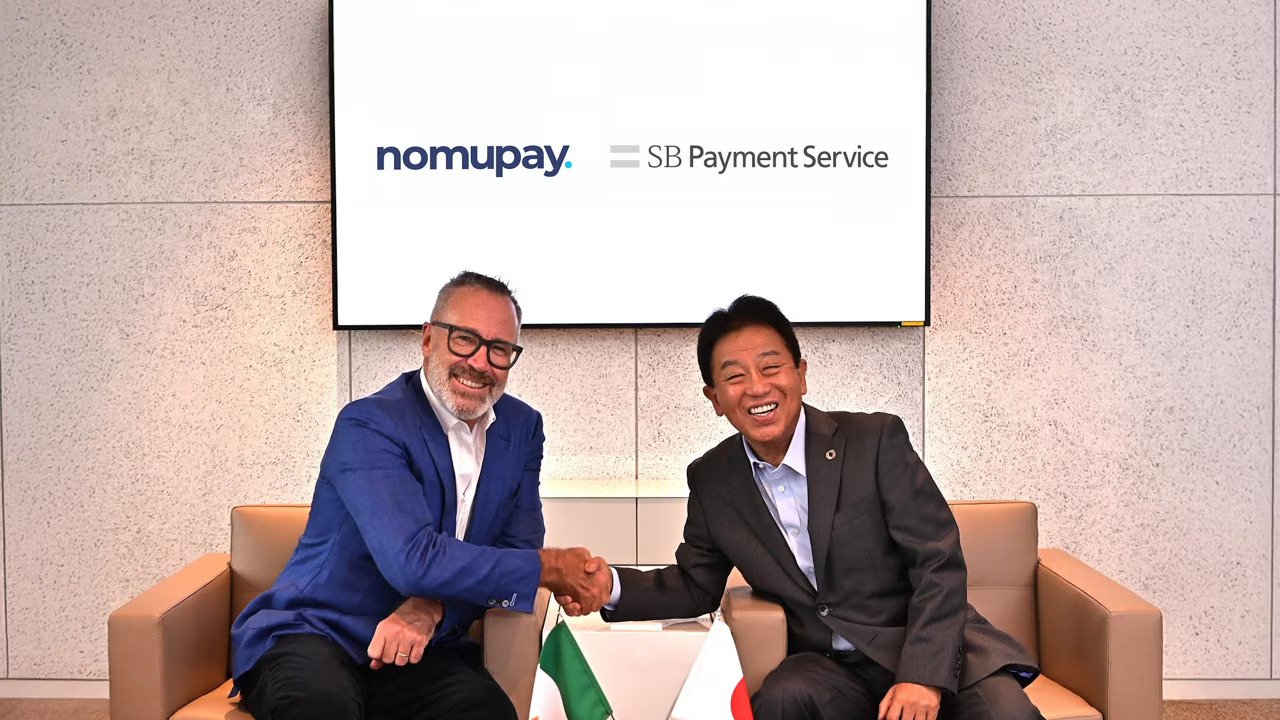
The partnership was designed to open access in both directions: helping international businesses reach Japan and helping Japanese merchants expand abroad. SBPS brought domestic relationships and payment capabilities. NomuPay brought its wider network. Capital and commercial access arrived together, making the arrangement more consequential than a funding number alone.
Japan also gives the career a pleasing circularity. Burridge had responsibility for Asia Pacific and Japan at Siebel two decades earlier. He returned to the region’s commercial possibilities through a different layer of technology. The customer’s problem had changed; the need to understand local conditions remained.
People who can turn the plan into service
There is an organisational thread alongside the geographic one. When NomuPay announced its global board in December 2022, the group included Lisa Shields, Hyperwallet’s former chief executive, as well as Finch Capital’s Radboud Vlaar and payments executive Jeff Parker. Juan Benitez joined in an advisory capacity. Burridge’s next chapter included a connection to an earlier one.
That connection offers a more grounded picture of leadership than the solitary executive portrait. A payments business needs people who know different parts of the transaction and can challenge one another’s assumptions. The company’s remit stretches from software to operations. No single job title neatly contains it.
Former colleagues have described Burridge as an executive who connects strategy with implementation. One recommendation from Kerry Agiasotis, who reported to him at Travelex, emphasises his willingness to enter the details while setting direction. It is a colleague’s assessment, but it fits the operating responsibilities that recur across the career.

The attraction of an ordinary result
Burridge’s ambitions remain commercial. He has described the SoftBank round as basecamp and identified a longer-term summit of €100 million in revenue run rate, 40 percent annual growth and an EBITDA margin above 40 percent. These are targets, rather than reported results. His advice to founders is shorter: “Get to profitability fast.”
Look back at the small Hyperwallet payment and the same question returns. Can a service do something useful, across a difficult boundary, at a price that allows the business to continue? The scale changes. The arithmetic keeps its vote.
For a customer, the desirable ending is often wonderfully ordinary. A buyer pays in a familiar way. A merchant can account for the sale. The right recipient receives the money. Burridge’s career has increasingly concerned the work required to make that sequence possible across borders. When it succeeds, nobody at the checkout needs to applaud. They can simply get on with the purchase.