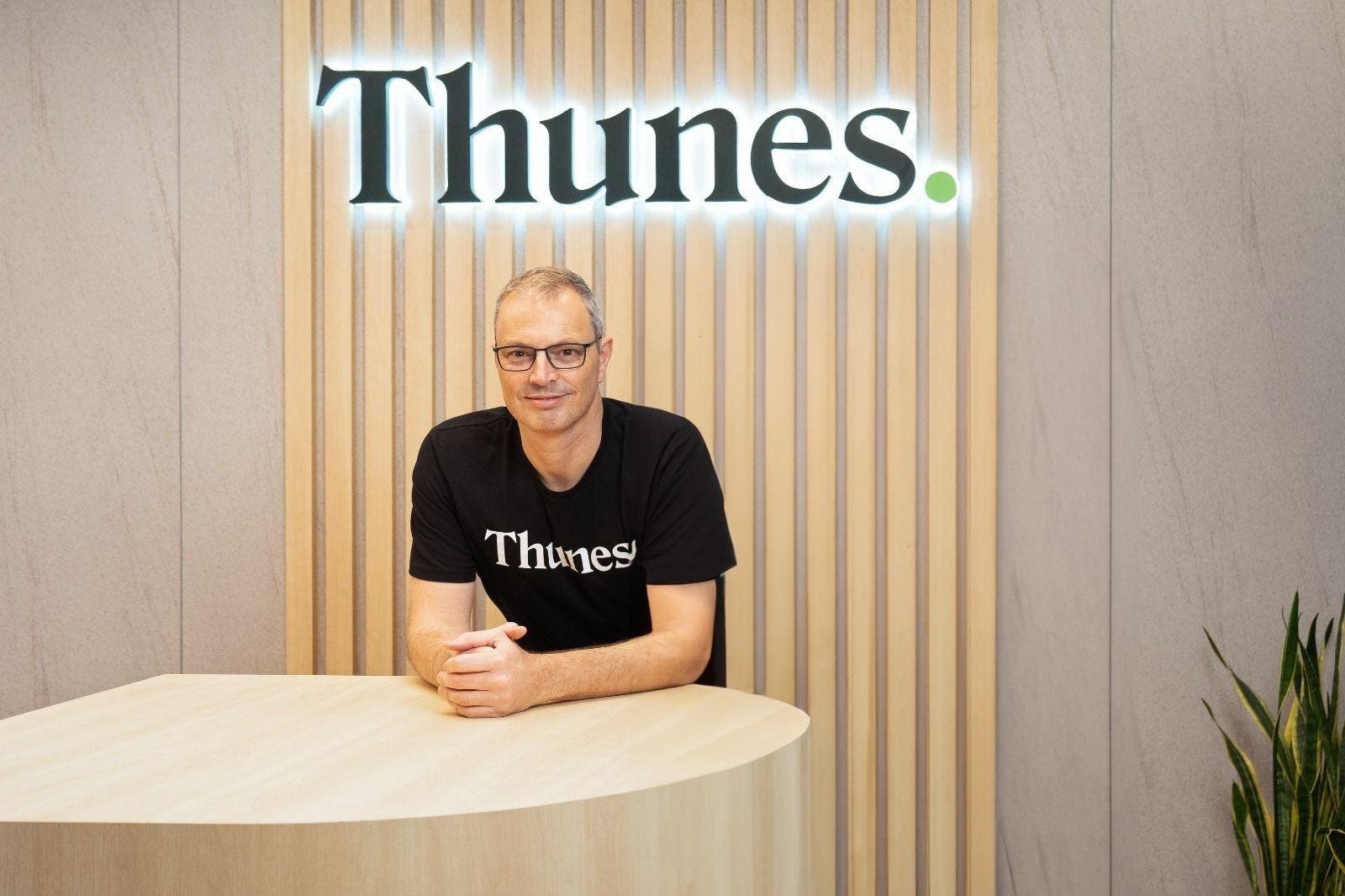
Peter De Caluwe has a small complaint about the way the world works. You can send a message across a border, watch two ticks appear, and know it reached the other person. Send money, and the experience can involve rather more suspense. Somewhere between the sender and the recipient, certainty takes a holiday. For someone waiting to be paid, that is an expensive little vacation.
His comparison is disarmingly ordinary. “We think that payments should be just like a WhatsApp message: global, immediate, and transparent.” The co-founder and CEO of Thunes has spent years applying that expectation to an industry with different currencies, different regulators and an abundance of systems that developed independently. The modest-looking ticks are the demanding part: delivery, and proof of delivery, across all those differences.
In September 2026, that argument acquired another practical expression. J.P. Morgan Payments selected Thunes to expand its Xpedite Remit offering, connecting its capabilities with the company’s network for payouts to local bank accounts and mobile wallets. De Caluwe was back in the CEO’s chair, having returned in August 2025. A career spent examining how people actually pay had brought him to a meeting point between a global bank and the local accounts people use every day.
Before the wallet, there was the checkout
The career began close to the transaction itself. De Caluwe worked at Tyco, selling payment terminals, then moved to a Visa and Mastercard acquirer, taking responsibility for major customers and the product portfolio. He joined Ogone in 2003 as chief operating officer and later became CEO. Ingenico acquired the online payments business in 2013. Each step kept him near the practical question a merchant needs answered: can this customer complete the purchase?
By April 2014, he was leading Naspers’ newly created payments segment, PayU. His remit took the problem into markets whose consumers had their own preferences and constraints. A checkout that seemed perfectly sensible in one country could be an invitation to abandon the basket in another. Expansion required attention to the payment methods already in use, and to the confidence people needed before parting with their money.
Discussing PayU in 2015, he picked examples with the specificity of someone who had spent time on the details. Brazilian buyers could benefit from escrow-based purchase protection. Turkish card payments often involved instalments. In South Africa, loyalty points were becoming part of online transactions. He also described consumers moving towards mobile payments. The examples belonged to that moment; the habit of looking closely at local behaviour would outlast them.
That early chapter helps explain the later one. A payment method is also a habit, and sometimes a source of reassurance. A company seeking customers abroad cannot simply arrive with its favourite checkout and expect everyone to adapt. De Caluwe’s work kept bringing him back to the receiving end of a transaction, where a globally ambitious business meets a very particular customer.
The network hiding inside a phone top-up
He joined DT One in 2017, taking charge of a network specialising in mobile top-ups and data. This was a useful vantage point for observing economies in which a phone account could be much more central to daily life than a conventional bank branch. Connections to telecom operators brought the business into contact with local systems that international banking did not always reach conveniently.
Thunes grew out of that world. Its payment activity dates to 2016, with the business spun off from TransferTo in 2019. De Caluwe helped incubate and build it while leading DT One. The opportunity was to connect payment methods that had become useful within their own markets but remained awkward to reach from elsewhere. People already had places to keep and receive money. Those places needed connections.
The result was a business selling infrastructure to other businesses. Its customers could put the service to work inside remittance products, payroll operations, marketplaces or banks. A recipient would use a familiar account or wallet while Thunes handled part of the journey behind the scenes. There is a certain professional satisfaction in making complicated work disappear from somebody else’s afternoon.
In his 2023 Couchonomics conversation, De Caluwe discussed the needs of remittance companies, payroll providers and the travel industry, alongside the regulatory demands of operating across borders. Those customers have different products, but share a rather unromantic requirement: the payment has to reach the right place. For a worker receiving earnings or a company paying a supplier, an elegant interface offers limited comfort while the money is still travelling.
Keep the destination familiar
Growing a network takes more than a connection
By June 2023, Thunes had processed a cumulative $50 billion in transactions since its beginnings in 2016. That number describes money moved over several years, rather than annual revenue or a valuation. It offers a concrete measure of how far the proposition had travelled from its starting point. The same month, the company announced a Series C round of a little over $60 million.
The network was built through work in individual markets, including negotiations over access and compliance with regulators and central banks. Those details explain why this kind of expansion takes time. The service must work within the rules of each destination, and the relationships behind it have to hold when a customer relies on them. A line drawn across a map is the easy part.
De Caluwe’s language about growth could be brisk, but his description of execution was cautious: “there is no cutting corners in this business.” That is a useful sentence to place beside the funding announcements. His ambition depended on a network that businesses could trust with real payments. Speed made the service attractive; dependable processes made it usable.
By August 2023, the Series C had reached $72 million, with investors including Visa, EDBI, Endeavor Catalyst and Marshall Wace. Thunes supported payouts to 132 countries and reported connections to four billion bank accounts and three billion mobile wallets. These were measures of network reach, not a census of individual customers. A person can hold several accounts; an available destination is different from an active user.
At that stage, De Caluwe also described plans to strengthen the company’s presence in China, following its partnership with Tencent for transfers to WeChat users. The interest was consistent with the rest of his career. Find a payment method that matters locally, then work through the conditions for connecting it internationally. The scale changes considerably. The underlying question remains recognisable.
Cumulative transactions processed since 2016. Money moved through the network, rather than revenue earned by Thunes.
A return with continuity on the agenda
In January 2024, De Caluwe moved from CEO to deputy chairman, with Floris de Kort taking the executive role. Eighteen months later, the co-founder returned. His announcement thanked de Kort for the progress made during that period and described a company expanding its footprint, advancing in the United States and working across bank accounts, mobile wallets, cards and digital assets.
He also described Thunes as profitable. That was his public account of its position on returning, rather than a licence to retrofit profitability onto earlier years. His stated priorities were continuity for network members, growth and enabling the next billion users to participate in the global economy. The word continuity is revealing here: his return was framed around carrying forward the work of colleagues and partners.
His activities extend beyond Thunes. De Caluwe is involved with DT One and Ezra, and mentors entrepreneurs through Singapore Management University’s innovation and entrepreneurship community. He is based in Singapore and speaks Dutch, English, French and German. The languages are a pleasing detail for a career spent dealing with local differences. Payments, too, require a fair amount of translation before everyone understands what has arrived.
In September 2026, he explained the J.P. Morgan collaboration in a television interview using the example of a supplier paid into a local wallet. His attention went to the consequences of waiting: working capital and stock management. Arrival confirmation could let the supplier ship the goods. The discussion gave his two-ticks analogy a business setting, where knowing the payment has landed can change what happens next.
Another rail, the same destination
His public writing in 2026 shows how he applies that thinking to newer technology. In January, he argued for connecting banks, mobile wallets and stablecoin wallets, with stablecoins serving as a way to move value between existing systems. He stressed backing, transparency and regulation. The attraction was practical utility for payments, paired with the trust needed for broader use.
In February, after attending his first World Economic Forum annual meeting in Davos, he returned to the problem in an essay about AI and financial infrastructure. Companies might reach customers internationally at great speed while their payments took much longer. He discussed the effect on working capital and the need for payment systems that could support automated transactions. The theme was familiar: new possibilities depend on the connections beneath them.
The September agreement put another such connection into view. The announced Xpedite Remit expansion covered more than 100 payment corridors, with access to bank accounts and mobile wallets through Thunes. The initial use cases included supplier settlements, bill payments and remittances. Those are ordinary tasks, which is precisely their appeal. They give the network’s ambitions something concrete to do on a Tuesday.
Look across De Caluwe’s career and the recurring interest is in the last part of the journey. At Ogone and PayU, the customer needed a workable checkout. At DT One, the phone already occupied an important place in daily life. At Thunes, the receiving account must be reachable from abroad. His ambition can sound vast when expressed in billions of endpoints. Bring it down to one payment, and the request becomes almost polite: tell us when it gets there.
“It’s arrived at the supplier, products can be shipped.”
Peter De Caluwe · NYSE Live, September 2026