A passport gets a traveler into a country. It does remarkably little at the checkout. Walid Mah'd encountered the distinction while backpacking through Asia: people around him could pay with a scan, while he and his fellow traveler worked through cards and cash. For someone who had worked in payments, that was a particularly instructive inconvenience. Knowing the industry did not spare him the experience of being an awkward customer.
There is something pleasantly deflating about this beginning. The future chief executive of a payments company was subject to the same question as any other visitor: how do I pay for this? Expertise had traveled with him. Access to the local routine had not. Moreta, the company he co-founded with Sam Yu, grew from paying attention to the people whose purchases looked easier.
The wallet that needed a passport
Mah'd's professional background includes payments consulting at Mastercard Advisors. His education includes an HBA from Ivey Business School at Western University. His travel history spans more than 30 countries. Put those experiences together and the origin becomes understandable: he knew something about moving money, and he also knew the irritation of trying to spend it somewhere unfamiliar.
The interesting detail is the direction of his attention. A visitor's first instinct might be to hunt for a place that accepts the visitor's preferred card. Moreta's founding question concerned the payment methods already working around him. The merchant and the local customer had a routine. The traveler needed a way into it.
That is a useful distinction when thinking about invention. Sometimes the visible technology is already doing its job. The difficulty sits in who can use it. A QR code on a counter is small enough to look trivial; the ability to participate in the system behind it can determine whether a purchase stays trivial, too.
Two friends, one checkout problem
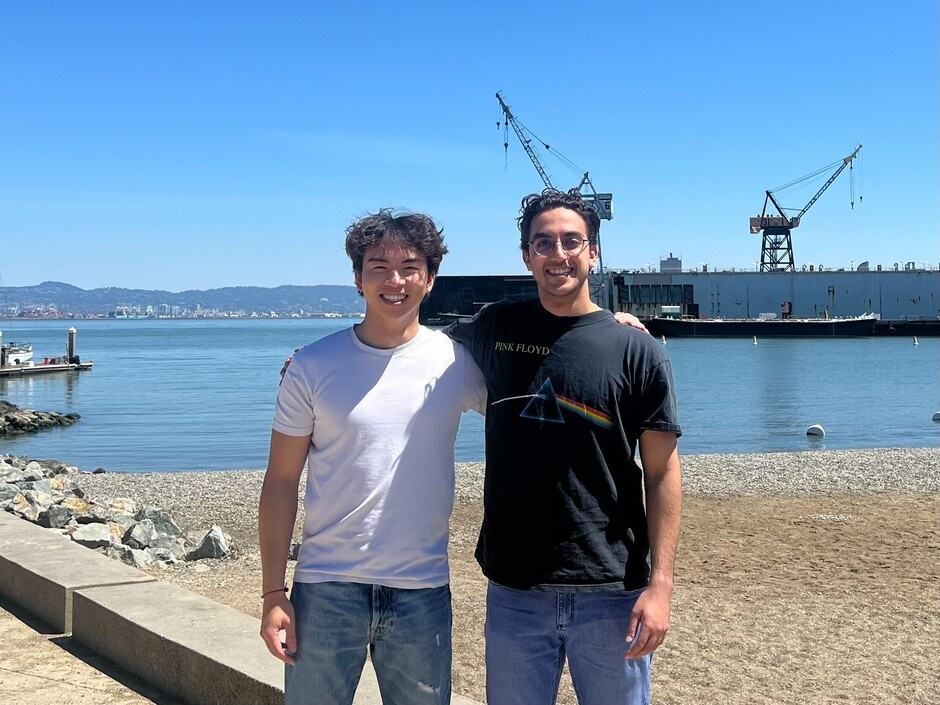
Mah'd and Yu had been friends since high school. By the time of Moreta's 2024 launch, that friendship was about a decade old. Mah'd became CEO; Yu became CTO. The company entered Y Combinator's Summer 2024 batch, and Mah'd announced its Launch YC appearance that August.
A friendship does not settle the practical questions of running a company. It does give this partnership a history that extends beyond its pitch. The two had known each other before the business existed, before job titles supplied a convenient introduction. Their shared travel experience also gave them a problem they could discuss as customers, rather than only as builders.
Yu brought experience making consumer software. He had studied computer science at the University of Waterloo and led research and development at Stems. Mah'd's payments background addressed another part of the assignment. The resulting product had to be understandable on a phone while also connecting the traveler to the machinery that makes a local payment possible.
For the customer, those are inseparable demands. An elegant interface that cannot complete the purchase is decoration. A working payment system that is baffling to operate is another chore on a trip. Moreta's premise put both founders' areas of experience under the judgment of an everyday transaction.
A routine worth borrowing
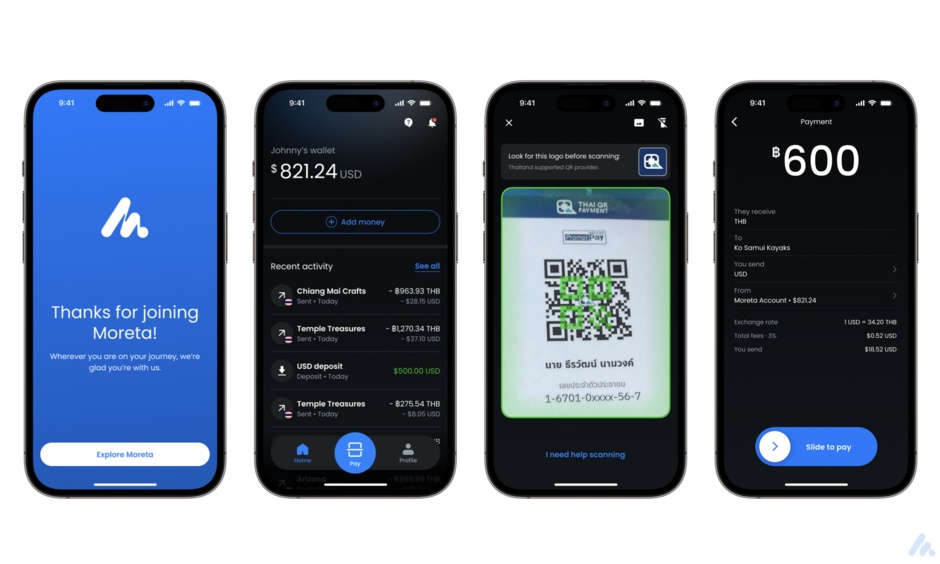
The launch workflow was straightforward to describe: download the app, verify identity, connect a bank account, load funds, then scan an existing merchant QR code. The promise was access to local payments without opening a bank account in every country. The first intended markets were in Southeast and East Asia.
The merchant's existing code matters. It makes the product's starting point the counter as it already exists. A traveler does not arrive with much authority to reorganize a shop's payment habits. Nor should buying lunch require a diplomatic negotiation. A useful travel wallet has to accommodate the place where the traveler is standing.
- 01 Verify identity
- 02 Load funds
- 03 Scan local QR
- 04 Confirm payment
A conceptual sequence, not a promise about speed or availability.
There are two ways to look at that sequence. From a product perspective, it is a set of steps. From a traveler's perspective, it is a way to return attention to the trip. The less thought a routine purchase requires, the more room there is for whatever brought the person abroad in the first place.
That makes ordinary use a demanding standard. A transaction has an amount, a currency, a recipient and a moment when the customer must trust the result. Each detail needs to be clear. The glamour of international travel offers no useful exemption from getting the mundane parts right.
The founder on the other end
Mah'd later described giving a fifth of his day to customer support. The number offers a more revealing view of the job than the chief executive title does. It places him near the point where the company's promise meets a customer's attempt to use it.
“I spend 20% of my day on customer support.”Walid Mah'd, founder update
For a payments founder, the support conversation has particular weight. A question can arrive precisely when someone needs the product to work. The customer may be trying to understand a balance, a payment or a step in the process. The conversation is an opportunity to see which parts of the experience deserve more attention.
This makes support a form of observation with consequences. A complaint can ask for reassurance, reveal confusing language or expose a product problem. Listening does not mean treating every request as an instruction to build another feature. It means taking the experience seriously enough to understand what produced the request.
A useful feature must survive the move from its designer's explanation to a stranger's use. That journey can be less forgiving than the product meeting in which it was approved. The stranger has other things to do. A traveler's patience is a resource, and a payments company is well advised to spend it carefully.
Mah'd has also acknowledged an unsuccessful tiered subscription experiment. Such admissions are useful precisely because they are unglamorous. Work can be completed, a feature can be launched, and the customer can still decline the proposition. A company's effort does not oblige anyone to appreciate the result.
The subscription experiment cost the team weeks of work, he said. In the same account, he described taking practical steps to help users, including advancing part of an ACH deposit and issuing refunds for customer or merchant errors. Those decisions show the operational questions behind an app's simple surface: when to make funds available, how to respond when something goes wrong, and who bears the immediate inconvenience.
In August 2025, he reported a 20-fold increase over four months in daily users, transactions and payment volume. Those were his own growth figures. Alongside them came the admission that the team had built things people did not want. The two statements belong together: a growing business can still contain expensive mistakes.
A business conducted in person
His account of building partnerships includes a preference for getting together over dinner or drinks. It is an unusually sociable sentence in a story about payment networks. Behind the scan on a screen are working relationships, and those relationships have to be maintained by people.
There is an understandable appeal to conducting an international business from a convenient distance. Yet a relationship also involves the attention someone gives when a question is inconvenient or a decision needs to move. Meeting in person offers another setting for that work, with fewer opportunities to confuse attendance with engagement.
Mah'd described spending an extended period in Southeast Asia to be closer to users and partners. The choice follows the company's original problem. If the difficulty appears in daily life abroad, proximity gives the founder more chances to encounter that daily life.
Proximity is not a guarantee of good judgment. It does change what can be noticed. A founder can see how people explain a purchase, which routines they regard as obvious, and where a visitor hesitates. Those observations have a practical use when the product's purpose is to make participation easier.
That partnership work also appeared in public in November 2025, when payment provider 9Pay welcomed Moreta to its booth at the Singapore FinTech Festival. Mah'd responded with enthusiasm about continuing their work together. It was a small, concrete glimpse of the relationships behind the product.
A longer itinerary
In January 2026, Mah'd joined Mark Kreitzman on the Efani Features Podcast for a 13-minute conversation about paying in Southeast Asia. The episode addressed the banking-access and payment difficulties faced by tourists, expats and other people spending time abroad. It also returned to his direct involvement in customer feedback.
The audience matters to this story. A short visit and an extended stay create different routines, even when both involve paying the same local merchant. Someone passing through wants a purchase to be simple. Someone living abroad may need an approach that remains useful through many ordinary days.
By October 2026, Moreta advertised service across 14 countries in Asia and Latin America. Its stated offering had expanded beyond QR checkout to include sending money, bills and online payments. The list gives the original travel observation a wider setting, while the practical question remains recognizably the same.
Across Asia and Latin America, as listed by Moreta. Availability varies by destination and payment method.
A longer country list can make an ambition easier to describe. The customer will still judge it one purchase at a time. That is the pleasingly stubborn quality of this business: all the cross-border language eventually arrives at a person trying to pay someone else.
Mah'd's origin gives him a direct connection to that person. He has been the traveler watching a smoother transaction happen nearby. The company he now runs asks whether that visitor can be included in the same routine. A passport may continue to be useless at the checkout. His wallet is intended to be rather more helpful.