The first Netwrix product had already been sold when its founders sat down to write it. In 2006, Mike Walters and Alex Vovk pitched a plain piece of enterprise software: compare today’s Active Directory configuration with yesterday’s, then tell the administrator what changed. A customer said yes. The pair spent the next two nights building Change Reporter and delivered it. No grand platform. No theatrical threat map. Just a tedious, consequential job turned into a report.
That narrow wedge explains the company better than its current catalog does. Netwrix now sells more than a dozen named products across data discovery, access governance, endpoint data-loss prevention, privileged access, identity management, Active Directory security, threat detection and recovery. Its newest pitch, the SaaS platform 1Secure, tries to fold the sprawl into one view of sensitive data and the identities allowed near it. But the old logic remains: make an invisible change visible, put it in language a person can use, and save the security team from spelunking through raw logs.
The product was boring on purpose
Active Directory is the backstage pass for a Microsoft-heavy company. It decides who belongs, which groups they inhabit and what they can reach. The first thing that failed in many shops was not the directory itself. It was the human process around it: changes happened, logs accumulated, and someone had to reconstruct who did what, when and where. Manual audit work was slow enough to become a control weakness of its own.
Netwrix Auditor translated that exhaust into searchable activity records, alerts and compliance reports. At Medical Center Clinic in Florida, the security team said audit preparation fell from roughly a month to 10 days. Christchurch Airport reported saving about five hours every week on manual auditing. Those are modest numbers compared with breach-cost headlines, which is precisely why they are useful. They are believable units a buyer can put into a staffing model.
“We sold the first copy before we even had the actual software written.”Mike Walters, co-founder, recalling the company’s start
The founders bootstrapped the company, kept it profitable and eventually changed their minds about outside capital. In 2017, Updata Partners led a Series A reported at $51 million. TA Associates took a majority position in 2020. Centerbridge joined in 2023 while TA remained the majority shareholder. The capital did not merely fund a larger sales team. It changed the shape of the product.
Then Netwrix bought the missing pieces
The acquisition run reads like a security architecture sketched in installments. Concept Searching added classification. Stealthbits brought deeper data access and identity threat capabilities. ANIXIS covered password policy; PolicyPak, Windows endpoint control; USERCUBE, identity governance; MATESO, password management; Imanami, directory groups; Remediant, zero-standing privilege. CoSoSys supplied endpoint DLP, and PingCastle brought a respected Active Directory assessment tool with an open-source edition.
This is Netwrix’s difference and its burden. A buyer can start with a specific problem instead of swallowing an all-or-nothing suite. The company supports cloud and on-premises deployment across a large portfolio, which matters in regulated environments where “move everything to SaaS” is not a serious plan. Yet every acquired product carries its own history, interface and deployment assumptions. The test is not how many boxes Netwrix can tick. It is whether the context flows cleanly between them.
One question, three layers
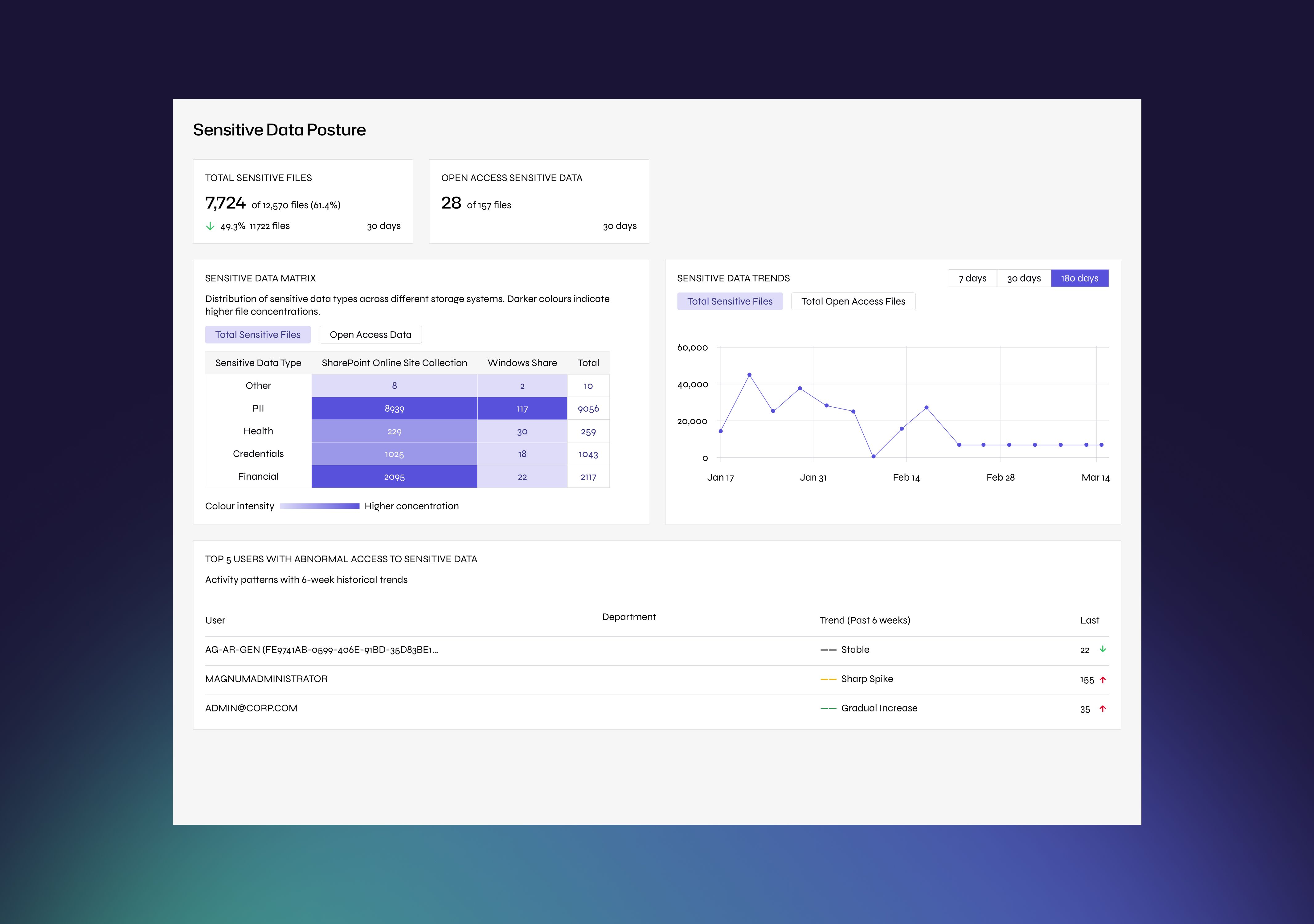
Netwrix’s market thesis is that data security and identity security are the same story viewed from opposite ends. Data security posture management finds sensitive files, classifies them and identifies exposure. Identity security measures risky permissions, privileged accounts and directory weaknesses. Monitoring catches suspicious behavior between the two. The useful question is not simply, “Where is the payroll file?” It is, “Who can reach it, what did they do, and is that access normal?”
In 1Secure, that model is concentrated on Microsoft 365, Active Directory, Entra ID, Windows file servers and SQL Server. The platform can surface open access, risky sharing and identity misconfigurations, then suggest remediation. For managed service providers it adds tenant provisioning, multi-tenant dashboards and operational integrations. For larger environments, the broader portfolio reaches into PAM, identity governance, endpoint DLP, configuration tracking and recovery.
Its AI story is notably practical. Netwrix has connected several products through Model Context Protocol servers, allowing an operator to ask questions in plain language. It also generates environment-specific remediation steps and scripts. The guardrail matters: the company says recommendations are anchored in facts observed by its products, customer data is not used to train models, and sensitive content can remain in the customer environment while metadata moves to the cloud. In a field addicted to autonomous-agent demos, auditable assistance is a sensible constraint.
What it costs - and what that number leaves out
Netwrix has opened a small self-service door into an enterprise market that usually hides prices. For teams of up to 250 identities, 1Secure starts at $24 per identity and Auditor Essentials starts at $20 per enabled Active Directory user plus cloud-only Entra ID users. The minimum commitment is one year. Self-service includes community help, but not support tickets; full support and complex terms go through Netwrix or a partner.
At enterprise scale, pricing returns to the familiar “request a quote” model and can vary by product, identity count, device count, deployment and support. Buyers should calculate more than license cost. Deployment labor, product overlap, integration maturity and the time saved during investigations or audits belong in the same spreadsheet. A cheap alert nobody trusts is expensive. A report that removes three weeks of audit preparation can earn its keep quickly.
The suite works best in the messy middle
Netwrix sits between narrow administration utilities and giant security platforms. Varonis competes in data visibility and governance. Semperis and Quest are strong alternatives around Active Directory protection and recovery. CyberArk, BeyondTrust and Delinea lead many PAM shortlists. Microsoft Purview, Forcepoint and others cover DLP. Splunk and Microsoft Sentinel operate at the broader SIEM layer. Netwrix’s pitch is that a Microsoft-heavy organization can cover several of those jobs without assembling quite so many vendors.
Where the fit is clean
- Hybrid Microsoft estates with AD and Entra ID
- Lean teams that need usable reports quickly
- Compliance-heavy organizations with recurring evidence work
- Buyers who want to start with one control and expand
Where to be skeptical
- A buyer seeking a full SIEM replacement
- A narrow problem where a specialist has more depth
- Teams unwilling to validate integration across acquired products
- Small self-service buyers who require ticketed support
What can another company copy? Start narrower than feels comfortable. Sell the pain before polishing the platform. Attach the product to a number the customer already cares about - five hours a week, 20 minutes to first insight, 20 days removed from audit prep. Preserve deployment choices when customer reality demands them. And when acquisitions broaden the story, make the integration itself a product with measurable milestones.
The approach will not work everywhere. A portfolio is not automatically a platform, and a unified dashboard cannot erase uneven data models or overlapping workflows. Organizations with a mature SOC may prefer best-of-breed tools feeding a central SIEM. Cloud-native companies outside the Microsoft orbit may find the center of gravity less relevant. Procurement should also compare renewal terms, support entitlements and the operational cost of running hybrid collectors. The buyer’s job is to test the exact workflow, not admire the category list: discover a real exposure, trace the identity behind it, remediate it and prove the fix.
The next comparison is today versus yesterday
Netwrix’s first product compared two snapshots and made the difference legible. Twenty years later, the company is attempting the same trick at a much larger scale. The snapshots now contain sensitive data, human and machine identities, cloud permissions, privileged sessions and AI agents. The simple report has become a portfolio, then a platform.
That expansion is credible because the original job never disappeared. Administrators still need to know what changed. Auditors still want evidence. Security teams still lose time translating technical events into decisions. Netwrix does not need to make cybersecurity magical. It needs to make a sprawling set of controls feel as direct as that first promise: show me what is different, tell me why it matters, and help me fix it before tomorrow.