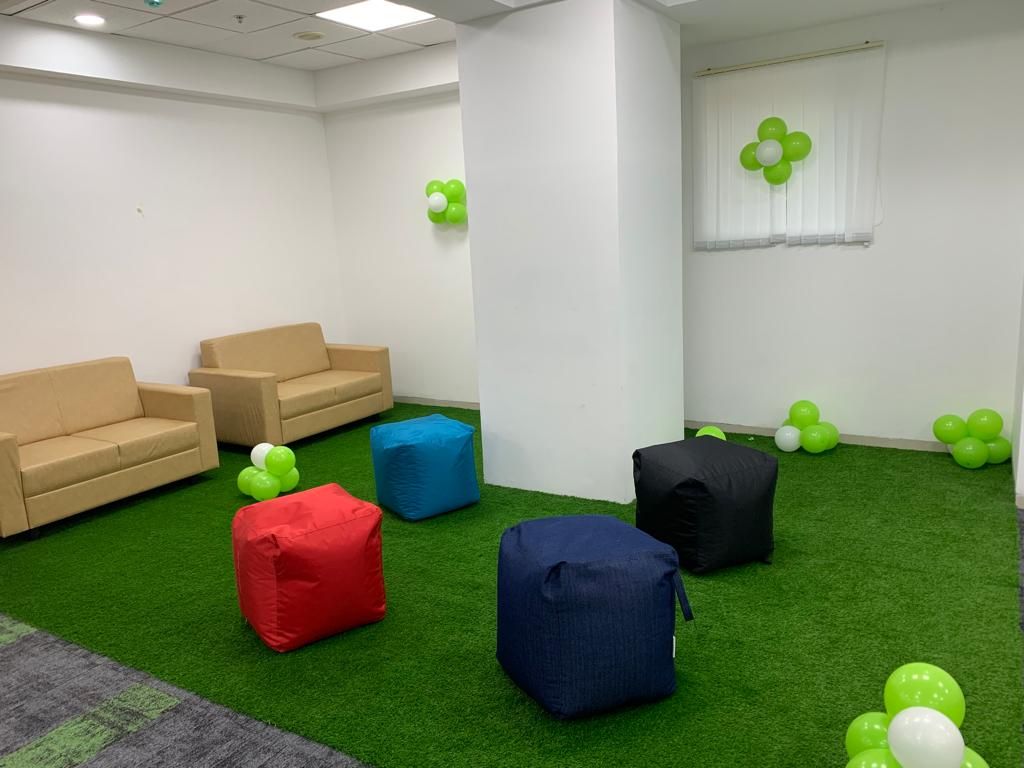
When Securden opened a larger office in 2022, the people invited to inaugurate it were the parents of its employees. There is something pleasingly awkward about that guest list. A software company can spend years learning to impress buyers, investors and analysts. Parents tend to have a different question: so this is where you work?
For Balasubramanian Venkatramani, known professionally as Bala, the occasion reached back to an apartment that he and his friend Kumaran Balan had called an office. His father had been the company’s first investor. During a prolonged stretch of research, development, pivots and rejection, he had kept encouraging the founders. A former schoolteacher and journalist, he had also insisted on a plain standard: failure was preferable to dishonesty.
By the time of the move, Venkatramani said Securden’s products were used in more than 60 countries. The invitation to employees’ parents gave the milestone a scale that a funding announcement could not. It recognized the people who had backed a working life before there was much evidence that it would work.
A customer finishes before the call begins
There is another episode that helps explain the business Venkatramani built. In October 2021, he described an inquiry from a large American government agency. Its employees lacked administrator rights on their computers. Requests to install or run software were piling up at the help desk. The agency wanted controlled exceptions: approved applications could run, new ones could be elevated when necessary, and the activity would remain visible.
Securden sent evaluation instructions. About an hour later, a presales engineer called to discuss getting started. According to Venkatramani’s account, the customer had already finished the proof of concept. The specialist had installed the software, deployed endpoint agents, discovered applications, created policies and tested them. Two other vendors had spent more than two weeks preparing to begin.
The story has the satisfaction of a meeting that cancels itself. It is also a vendor’s account of one evaluation, rather than a promise that every deployment will take an hour. What makes it revealing is the outcome Venkatramani chose to celebrate: a customer had understood the instructions and completed the work without waiting for permission from the people selling the software.
That is a rather exacting idea of convenience. A simpler screen is pleasant. A buyer who can make progress before the introductory phone call arrives is a more substantial achievement.
“Securden stands for simplicity, and affordability in cybersecurity.”
Balasubramanian Venkatramani · 2020
Learning to explain the lock
Before Securden, Venkatramani worked at Zoho. His career there crossed engineering, marketing and product management, including work on ManageEngine security products and Zoho Vault. He also served as visiting faculty at Zoho University. His education crossed a similar divide: mechanical engineering at Annamalai University, followed by study at the Indian Institute of Management Calcutta.
Those jobs involve different sorts of explanation. An engineer must make a system behave. A marketer must explain why its behavior matters. A teacher must notice where understanding breaks down. A product manager inherits the disagreements among all three. A security product adds a particularly difficult customer: the person who needs to finish an ordinary task while the product carefully asks them to stop.
For a security company, those perspectives meet in the same customer conversation. A buyer wants protection, an administrator wants a workable installation, and an employee wants to run an application. The product has to accommodate all three. Each restriction needs a reason, and each exception needs a boundary that somebody can explain after the work is done.
Venkatramani’s writing makes that tension concrete. In a 2021 essay on credential security, he returned to reused passwords, credentials stored in code, shared spreadsheets and weak storage practices. The problems were familiar and, for that reason, easy to overlook. His concern was the distance between buying advanced protection and attending to routine access.
There is little glamour in asking who still has a password. There is considerable work in producing a dependable answer. His chosen field is full of things people would rather assume have already been settled.
The permission to do one thing
Privileged access management, usually abbreviated to PAM, deals with accounts and permissions that can make consequential changes. The administrator who maintains a server needs power that an ordinary user does not. An outside technician may need entry to one system for one job. Software may need a secret credential to connect to another service. Each creates a practical question about scope, duration and responsibility.
At an Accel cybersecurity summit interview with Neelu Tripathy, Venkatramani described privilege management as beginning with identity management, then moving through temporary access, limited access and continued observation. It is an orderly sequence. Establish who is acting. Decide what the job requires. Give access for the necessary period. Keep track of what happens.
Consider an illustrative maintenance task. A technician needs to update an application. Granting permanent control over the whole computer makes future work convenient, but leaves more authority available than the task requires. Refusing every exception sends the work back to the help desk. A controlled, temporary elevation tries to preserve the ability to do the job while narrowing the permission around it.
This is why usability belongs in Venkatramani’s security argument. The controls have to survive contact with a working day. A procedure that is comprehensible only to its designer will have a difficult career outside the design meeting.
- 01Who?Identify the person or system.
- 02What?Allow the work the task requires.
- 03How long?Limit the permission in time.
- 04What happened?Monitor activity and keep a record.
Two rounds, a longer list of responsibilities
Securden was incorporated in 2018. Its founders arrived with experience in the category, rather than a discovery that enterprise software needed passwords. Their stated opening was the difficulty of deploying, using and paying for the available security tools. They wanted to make the machinery easier to operate.
In July 2020, Accel led a $1.2 million seed round. Participants included Freshworks founder Girish Mathrubootham, Axilor Ventures, Manav Garg and Mithun Sacheti. The money was intended for marketing, research and development, and customer success. The allocation says something about the job ahead: writing software was only part of getting that software into sustained use.
In April 2022, Tiger Global led a $10.5 million Series A, joined by Accel and Together Fund. Securden planned to expand its team, product portfolio, research, sales and marketing. These two disclosed rounds add up to $11.7 million. The capital supported plans to grow the business on several fronts at once.
The same year, Venkatramani argued that separate products left gaps in privilege and access security. His preference was a unified approach. That choice gives a founder a demanding obligation: every additional capability has to fit into a system whose original attraction was that customers could understand it.
The room responds
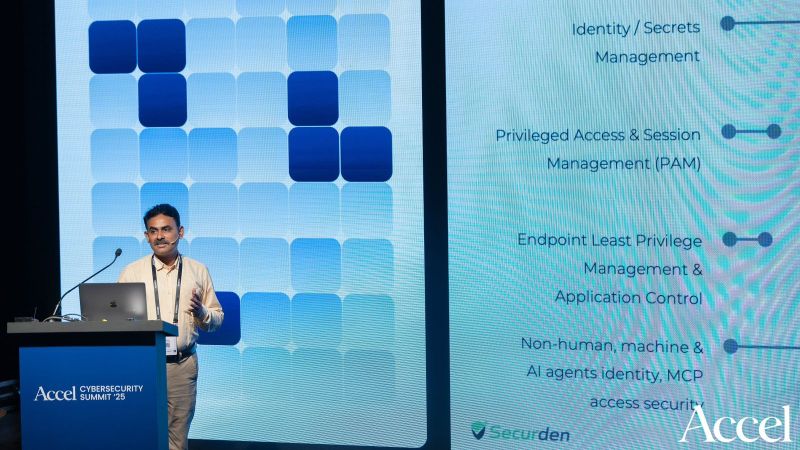
Venkatramani’s public posts repeatedly return to other people: his co-founder, colleagues, investors and customers. At the Accel Cybersecurity Summit in 2025, Securden demonstrated Unified PAM to security leaders and fellow founders. He later recounted that Anurana Saluja, a CISO at Sutherland, praised the product during a panel discussion. Venkatramani described hearing that recognition as surreal, then thanked the organizers and people who made the event possible.
A live demonstration provides a useful test of a product leader’s explanation. The audience can see the workflow. Someone can ask an inconvenient question. A description of simplicity has to become a sequence of actions on a screen. For a founder whose career includes both marketing and engineering, that is familiar territory, with fewer places to hide.
His approach to hiring also allows a small glimpse of the working atmosphere. A 2022 call for junior Python developers asked for programming knowledge, familiarity with software development and interest in machine learning. It also asked candidates to enjoy the disorder of a startup. The selection process still included screening, a programming test and an interview. Enthusiasm had to turn up with evidence.
Now the software wants a key
In March 2026, Securden introduced its Unified Identity Security Platform at RSA Conference in San Francisco. The announced scope included privileged accounts, endpoint permissions, identity governance, cloud entitlements, machine identities and AI agents. In June, it launched an AI Agent Security and Governance Platform within that broader architecture.
The June announcement described discovery, runtime controls, credential protection and testing for risks such as prompt injection. Venkatramani’s point was that agents can act across several environments with privileges that are difficult to see and govern. The company’s response was to bring them into the identity system already used for people and machines.
An agent that calls a tool or accesses a database introduces another actor into a familiar administrative problem. Someone must own its credentials. Someone must decide what it can reach. Its activity needs a record. A useful new assistant can otherwise acquire the permissions of an old employee who never clocks out.
Recognition followed the wider scope. In June 2026, Securden announced its placement as a Leader in Frost & Sullivan’s PAM evaluation. On September 28, it announced Leader status in GigaOm’s Enterprise Password Management Radar, which assessed 23 platforms. These are dated evaluations of the company’s products, milestones in the work rather than guarantees about every customer’s experience.
For Venkatramani, the interesting continuity runs from an apartment office to a screen full of identities. People supplied the early confidence. His products now try to make powerful access accountable. As the list of actors grows, his original promise becomes harder to keep and more useful to test: can the person responsible understand the system well enough to get on with the job?