The most dangerous file in a large company is rarely marked “most dangerous file.” It may be a forgotten export of customer records in an open bucket, a spreadsheet copied into a collaboration tool, or a database that an eager new AI agent can read because nobody revisited its permissions. Cyera was built around this plain, expensive fact: enterprises cannot protect data they cannot locate, classify or connect to the people and machines using it.
The company’s original product did not begin with a firewall. It began with a map. Give Cyera cloud access through an identity-and-access role and its software inventories stores, samples and classifies their contents, adds business context, then flags the combinations that create risk - sensitive records in plaintext, stale copies, public exposure or an identity with more access than its job requires. The pitch is quick connection, results in days and no fleet of heavyweight agents to install.
The founders had already met the mess
Yotam Segev and Tamar Bar-Ilan met in Talpiot, Israel’s selective military technology program, and served together in Unit 8200, where they helped establish and run a cloud-security division. Yonatan Itai became Cyera’s third co-founder and leads research and development. Their founding observation was earned at uncomfortable scale: cloud infrastructure made it wonderfully easy to create and copy data, while the security stack kept looking at the boxes around it.
Cyera was founded in 2021 and emerged from stealth in March 2022 with $60 million from Sequoia, Accel and Cyberstarts. Its useful trick was contextual classification. A regular expression can spot a nine-digit number; context can help decide whether it is an employee identifier, an American Social Security number, a test value or noise. Cyera combines patterns, machine learning and language models, then learns customer-specific classes. The company now claims better than 95 percent precision at exabyte scale.
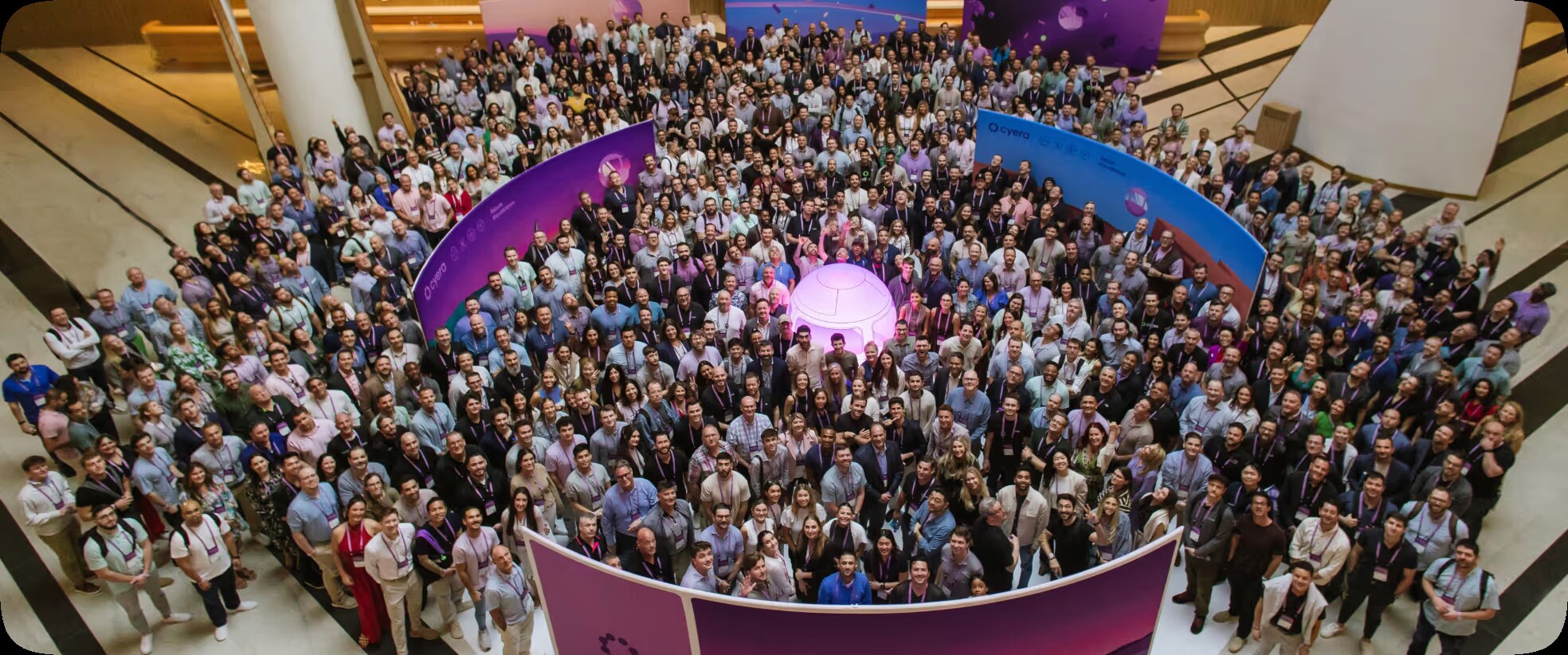
That context is the heart of the product. The dashboard is only the visible part. Underneath, Cyera tries to keep a live graph of data, owner, location, sensitivity, identity, access and behavior. That shared graph can power a privacy request, tell an incident responder what was actually exposed, or explain why an AI tool should not retrieve a particular table.
What failed first was the old classifier
Traditional data-loss prevention had a reputation problem before Cyera arrived. Rules were brittle, classification produced false alarms and teams spent their time tuning policies or dismissing alerts without knowing which events threatened something valuable. Cloud migration made that worse. Data moved among infrastructure, databases and software services that had different owners and permission models. A tool that watched an endpoint or inspected a network boundary no longer saw the whole trip.
Cyera’s first answer - data security posture management, or DSPM - fixed visibility before enforcement. But a map does not stop a leak. Customers eventually pushed the company toward the action layer. In October 2024, Cyera paid $162 million in cash and shares for the young DLP company Trail Security. Trail had raised more than $35 million and was still in stealth. Why sell? Co-founder Zohar Vittenberg gave the revealing answer: buyers wanted DLP and DSPM as one platform.
That changed the shape of Cyera. Trail’s 40-person team became the foundation of Omni DLP. Otterize added controls for non-human identities and runtime data flows. Shape AI, Genie and Ryft brought more AI and data infrastructure expertise. On September 1, 2026, Cyera completed its acquisition of Oasis Security, tying non-human identity management to the data those identities can reach. The acquisitions are not random ornaments. They fill the spaces around the original map.
The product follows the data, not the org chart
Today the platform spans DSPM, Omni DLP, privacy operations, data-subject requests, identity analysis, incident response and remediation. AI Guardian inventories models, applications and data exposure. The newer Agent Guardian goes further: it monitors an agent’s tool calls and database queries, applies policy in the execution path, blocks risky transfers and tests defenses against prompt injection or privilege escalation. Cyera Endpoint puts related controls on employee devices, where local tools such as Claude Code or Cursor can operate beyond a company gateway.
This is where Cyera differs from a broad cloud-security suite. Microsoft, Palo Alto Networks, Wiz and others can bundle adjacent capabilities; Varonis, BigID, Securiti, Sentra, Rubrik and Symmetry attack parts of the same data problem. Cyera’s argument is that one classification and context layer should inform every control. A buyer should test that argument, not simply admire the diagram. Precision, recall, scan impact, on-premises reach, remediation depth and the time required to tune customer-specific data are the consequential measures.
The evidence supplied by customers is unusually concrete, though it remains vendor-published. One fast-growing fintech rebuilt visibility in under 30 days and said it found three times as many potential sensitive-log exposures. A Fortune 100 customer said it scanned more in six weeks than it had in six years. Genuine Parts Company reported mapping 532 billion sensitive records and resolving 98 percent of high-risk cloud-data issues after comparing nine DSPM vendors. These are not promises that every estate will reproduce. They do show what a sensible proof of value should measure.
What does that map cost?
Cyera is enterprise software, sold mostly by custom quote. Its pricing page offers DSPM and DLP plans with optional modules, but no calculator. A public AWS Marketplace listing is more candid: a 12-month standard package for up to 25 terabytes was listed at $50,000, a business package for up to 100TB at $100,000, and an enterprise package for up to 250TB at $250,000. Additional infrastructure costs can apply, and large negotiated deployments can differ.
The business is subscription SaaS, expanded by data volume, scope and modules. That makes the ideal customer easy to picture: a regulated or data-heavy enterprise with enough cloud, SaaS and on-premises sprawl that manual inventory is already failing. Public names include Paramount, AT&T, Chipotle, Valvoline, Mercury Financial, GoPuff, Carmoola and ChenMed. The users are usually security, privacy, governance, cloud and data teams, not consumers.
Investors have funded the expansion with remarkable enthusiasm. After the $60 million launch financing came a $100 million Series B, two $300 million rounds in 2024, a $540 million Series E in 2025, $400 million in January 2026 and another $600 million in June. The last round, led by Evolution Equity Partners, valued Cyera at $12 billion. The company said annual recurring revenue had tripled three years in a row. TechCrunch reported ARR above $150 million in June while noting the business remained far from profitable. The valuation is therefore a bet on future platform dominance, not present-day earnings.
Out of stealth with an agentless cloud-data map.
Trail turns DSPM into a broader data-security platform.
AI Guardian, Shape AI and Otterize extend the map into AI and runtime.
Agent Guardian, Endpoint, Ryft and Oasis push into agentic security.
The useful part of the playbook
There is a pattern here worth copying, even outside cybersecurity. Start with an inventory problem whose answer arrives fast. Build the first product on a reusable intelligence layer rather than a single workflow. Let customers reveal the next adjacency. Then expand from seeing to deciding to acting. Cyera did not begin by claiming it could secure every AI agent. It began by showing a security team a piece of sensitive data it had forgotten.
Make the first proof visible
Count stores found, sensitive records classified, risky access paths and time to first usable result.
Sell the context, not the alert
An owner, purpose and exposure path turn a finding into a decision someone can make.
Follow buyer consolidation
Trail sold because customers preferred DSPM and DLP together. Product architecture followed purchasing behavior.
Know the poor-fit customer
A small, simple estate or narrow endpoint need may not justify a six-figure data platform.
The model also has conditions. Cyera needs sufficient access to inspect metadata and samples; an organization unwilling to grant it will get a weaker map. Classification performance depends on language, formats and the customer’s unusual data. Findings do not remediate themselves unless teams authorize automation or owners actually act. Inline agent controls create a different operational burden from passive discovery. And a company already committed to a large Microsoft, Palo Alto or Wiz bundle may value procurement simplicity over specialist depth.
That is the tension beneath Cyera’s tidy “trust layer” phrase. The company is trying to turn a precise map into an authority that sits between enterprise data and a swelling population of software actors. If the map is accurate and the controls are well placed, AI adoption can move with fewer nasty surprises. If either is wrong, the platform becomes another expensive source of alerts - exactly the failure it was created to replace.