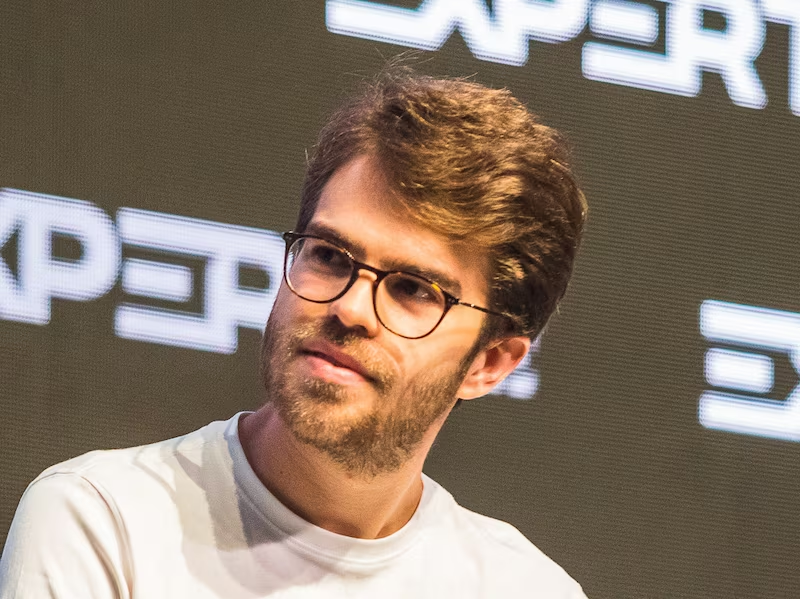
At 12, Pedro Franceschi was receiving legal notices from Apple. Not for pirating music. Not for some teenage prank. For jailbreaking their iPhone 3G - the first person in Brazil to crack it open. Most kids that age collect Pokemon cards. Pedro collected cease-and-desist letters.
Two years later, he was making hundreds of thousands of dollars selling software. At 16, he co-founded a payments company. At 20, he sold it for enough to never work again. At 22, he built a unicorn. At 30, he sold his second company to Capital One for $5.15 billion.
This is not a story about another Silicon Valley wunderkind who got lucky. This is about a kid from Rio de Janeiro who started a Twitter argument that became a business partnership that became the largest bank-fintech acquisition in history.
"It definitely took a while to develop our business skills - we were just kids. I remember when Henrique and I raised our first round of funding for Pagar.me, we were concerned we got tricked into a bad deal."
- Pedro Franceschi on early entrepreneurshipThe Twitter Fight That Changed Everything
In 2012, two Brazilian teenagers got into a heated argument on Twitter. Pedro Franceschi and Henrique Dubugras didn't know each other. They just had opinions about code and neither would back down. The argument escalated. Then it moved to Skype. Then it became a friendship.
One year later, at 16, they founded Pagar.me - Brazil's answer to Stripe. Not a clone. Not a copy. A payments processor built for Brazilian small businesses navigating a financial system that seemed designed to keep them out. They understood the problem because they lived it. They built the solution because no one else would.
By the time they sold Pagar.me in 2016, it had 150 employees and processed $1.5 billion in transactions. Microsoft named it Startup of the Year. They won $25,000 at Harvard. And they were both 20 years old.
Stanford (Briefly)
They got into Stanford. Of course they did. Computer science majors, both of them. They showed up in 2016, fresh off their exit, ready to learn from the best.
They lasted less than a year.
Not because they failed. Not because they couldn't handle it. Because they had an idea that wouldn't wait. Startups can't get corporate credit cards. Banks see early-stage companies as radioactive. Founders end up using personal cards, mixing business and personal expenses, building companies on their own credit scores.
Pedro and Henrique knew this pain personally. They'd lived it at Pagar.me. So they dropped out, joined Y Combinator's Winter 2017 batch, and built Brex.
Building Brex: The Second Act
January 2017. Brex is founded. The pitch: corporate credit cards for startups. No credit history required. Instant approval. Built for companies that move fast and break things.
It wasn't revolutionary. Pedro himself admitted it. "We knew Brex wasn't a revolutionary idea - it was just tough to execute." But execution is everything. And execution is where most ideas die.
Eighteen months later, Brex hit unicorn status. $1 billion valuation at age 22. Not because they had a better idea than everyone else. Because they understood the pain better. Because they'd built payments infrastructure before. Because they knew what founders needed before founders knew they needed it.
By 2022, Brex was valued at $12.3 billion. Pedro Franceschi became a billionaire. The youngest in Latin America. The only self-made one in Brazil's top 10 richest under 30.
Then reality hit.
Burnout at the Top
Twice before turning 26, Pedro burned out. Not the "I need a vacation" kind. The real kind. The kind where your body stops cooperating and your mind stops making sense.
He talks about it openly now. "Everyone thinks they are irreplaceable, and in the end, they are not. Things are teachable, they are not unique to one person, that's true for everyone."
So he restructured. Hired better. Delegated more. Built systems that didn't require him to be the bottleneck. Started living like an athlete instead of a startup founder - which meant treating his body and mind like assets that needed maintenance, not resources to be mined until exhausted.
In 2024, he made another shift. He called it "founder mode." One company roadmap. Pedro as editor-in-chief of everything that ships. Not micromanagement. Clarity. "Switching to founder mode is the best thing I've done at Brex in many years."
"Switching to founder mode is the best thing I've done at Brex in many years. Having a single roadmap for the entire company, where I'm the editor of what ships in each release."
- Pedro Franceschi, 2024The $5.15 Billion Exit
January 2026. Capital One announces it will acquire Brex for $5.15 billion. Half cash, half stock. The largest bank-fintech acquisition in history.
Pedro stays on as CEO. Not as a requirement. As a choice. Brex becomes a standalone division within Capital One's commercial banking arm. Same mission. Bigger scale. Faster growth.
"Joining forces with Capital One means we can deliver on our promise for more businesses faster and at a scale that would have taken years to build independently," Pedro said. Not a sellout. A scale-up.
The deal closed in April 2026. Pedro is 30. He's built two unicorns, sold both, serves on the boards of Coupang (a $50B South Korean e-commerce giant) and previously Stone. He's married - describing it as "the biggest life hack" in a 2024 tweet. He maintains an active GitHub with projects ranging from blog engines to 6502 CPU emulators.
And he's still building.
What's Next
AI-powered finance. That's the bet. Brex is building tools that don't just process payments but understand business patterns, predict cash flow needs, automate financial decisions that currently require humans.
Pedro isn't trying to replace accountants. He's trying to give every startup the financial infrastructure that only giants like Apple and Google currently have. Level the playing field. Make sophisticated financial management accessible to the 22-year-old founders who are exactly where he was a decade ago.
Will it work? Ask again in five years. But betting against someone who jailbroke iPhones at 13, built a payments processor at 16, and created two unicorns before 30 seems like a losing proposition.
The Pattern
Look at Pedro's career and you see a pattern. Not luck. Not genius. Pattern recognition and execution.
He sees a problem he's personally experienced. He has the technical skills to solve it. He has a co-founder who complements his abilities. He builds for users who look like his younger self. He doesn't reinvent wheels - he makes existing wheels work for people they've been failing.
Pagar.me: payments for Brazilian small businesses that big banks ignored.
Brex: corporate cards for startups that traditional banks rejected.
Next: AI-powered finance for companies that can't afford full finance teams.
Same pattern. Different scale. Better execution each time.
Pedro Franceschi didn't get lucky twice. He got good at seeing what others missed and building what others wouldn't. That's not luck. That's a system.
The Advice
When asked what advice he'd give aspiring entrepreneurs, Pedro doesn't talk about disruption or innovation or thinking big. He says: "Make sure that you build something that leverages your previous experience."
Boring? Maybe. But he's built two unicorns before 30 following that exact advice. Meanwhile, how many people chasing "revolutionary ideas" are still chasing?
The revolutionary part isn't the idea. It's the execution. It's understanding the problem so deeply that the solution seems obvious in hindsight. It's building teams that can turn that obvious-in-hindsight solution into reality while everyone else is still arguing about whether the problem exists.
Pedro Franceschi jailbroke an iPhone at 13 because he wanted to see how it worked. He built Pagar.me at 16 because Brazilian businesses needed better payments. He created Brex at 22 because startups needed better credit access. He's building AI finance tools at 30 because companies need better financial infrastructure.
See the pattern? It's not about the next big thing. It's about the next necessary thing. And then building it before anyone else does.