The first thing Capital One built was not really a credit card. It was a way of thinking about one. In the late 1980s, Richard Fairbank and Nigel Morris carried an unfashionably analytical idea into Signet Bank: instead of mailing essentially the same offer to everyone, a lender could divide customers into small groups, vary the price and terms, then let the results decide what to do next. The card was the visible object. The experiment was the product.
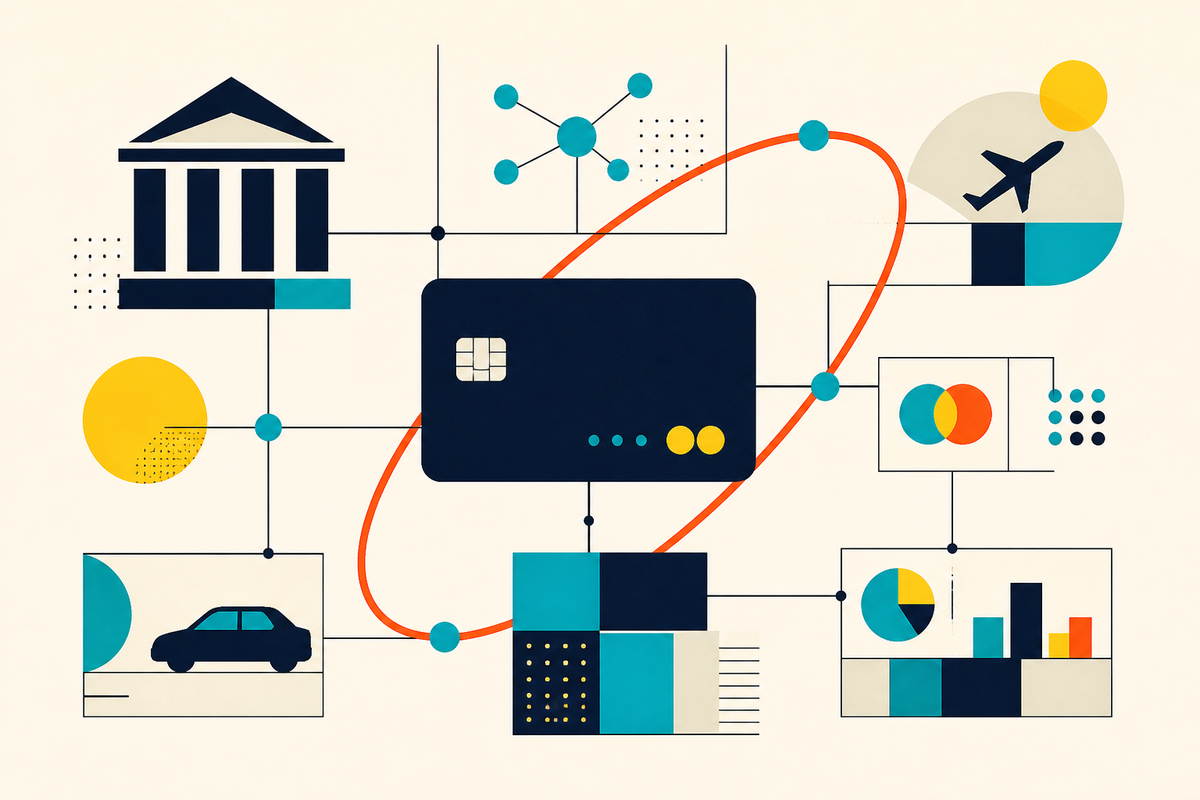
That habit - test, measure, adjust - became the spine of an independent company in 1994. It also explains the odd shape Capital One has taken since. A monoline card issuer became a retail bank, an auto lender, a commercial financier, a travel booker, a shopping assistant and, after buying Discover in 2025, the owner of a global payment network. In April 2026 it added Brex, the corporate-card and spend-management company. Capital One now looks less like a collection of bank departments than a financial stack assembled from both directions.
The bank that kept its lab coat
The original information-based strategy did two jobs at once. It helped Capital One find borrowers overlooked by blunt, one-size-fits-all underwriting, and it helped the company price risk more precisely. That did not make lending safe or frictionless - credit losses remain part of the economics - but it created a feedback loop competitors built around branches and product silos found difficult to copy. Marketing, credit, risk, operations and technology could all meet inside the same experiment.
The modern version runs on a much larger machine. Capital One says it became the first major American bank to close its legacy data centers and move fully into the public cloud, completing that migration in 2020 with Amazon Web Services. The point was not fashionable infrastructure. Cloud systems let teams deploy software more frequently, recover services more reliably and work with real-time data across products. In a regulated bank, where every new feature also touches privacy, fraud, compliance and credit risk, that operating speed is a competitive asset only when the controls move with it.
“We were founded on the belief that the banking industry would be revolutionized by information and technology, beginning with credit cards.”Capital One, on its founding idea
This is where Capital One differs from a neobank with a neat interface but no large lending book, and from an incumbent bank whose technology estate grew through decades of mergers. It combines deposits, proprietary underwriting and regulatory infrastructure with the instincts of a software organization. The advantage is not guaranteed. A full cloud stack still has outages; a better model still makes bad loans; a good app does not erase the cost of rewards. But the pieces can learn from one another.
A product for nearly every money moment
For consumers, the catalog begins with familiar bank furniture: checking, savings, certificates of deposit and credit cards for cash back, travel, students, small businesses and people building credit. Capital One eliminated overdraft fees in 2021 and sells core 360 accounts without maintenance fees or minimum balances. CreditWise offers free credit monitoring, including to people without a Capital One account. The mobile app handles the ordinary work - payments, deposits, alerts, locks and virtual card numbers - where a bank either earns trust quietly or spends it all at once.
Then the products wander into customers' lives. Auto Navigator lets a shopper search dealer inventory, estimate payments and seek pre-qualification before entering a showroom. Capital One Shopping hunts for coupon codes and price comparisons. Capital One Dining and Entertainment turn card eligibility into reservations, tickets and experiences. The cafés - coffee shops with bank ambassadors but without the choreography of a traditional branch - give a national digital bank a human address in selected cities.
Travel is the clearest example of the strategy moving beyond finance. Launched with Hopper technology in 2021, Capital One Travel combined booking with price predictions, rewards redemption and protections. By March 2026, Capital One said booking volume had increased more than tenfold. Its new dedicated app added flight alerts, trip management and live lounge capacity. Airport lounges and Capital One Landing dining spaces make a digital rewards system physical: points become a chair, a meal and a shorter wait.
Businesses enter through another door. Small companies can use Spark cards, checking, lending and payment tools. Larger clients buy treasury management, commercial lending, capital-markets and industry services. Brex now contributes corporate cards, automated expense controls, real-time payments and AI agents designed to handle finance workflows. Capital One brings a large balance sheet and underwriting engine; Brex brings software built around how a modern finance team actually spends a Tuesday afternoon. The integration gives Capital One a credible answer to newer platforms such as Ramp while pushing it closer to American Express in business payments.
How the machine makes money
The core model remains banking, not app subscriptions. Capital One gathers deposits, pays depositors interest, and lends that money through card balances, auto loans and commercial credit at higher rates. The difference between the yield on earning assets and funding costs drives net interest income. Interchange, service charges and, now, payment-network activity contribute non-interest revenue. Rewards, marketing, credit losses, operations and compliance consume a meaningful share of what comes in.
The three major reporting businesses show where the weight sits. At June 2026, period-end credit-card loans were $275.4 billion, compared with $90.5 billion in Consumer Banking loans and $91.3 billion in Commercial Banking loans. Cards therefore remain the largest loan engine. Deposits totaled $484.3 billion. In the second quarter Capital One reported $15.9 billion in net revenue and $3 billion in net income, while noting that integration costs from both Discover and Brex were still moving through the accounts.
Discover changes the map
Before Discover, Capital One issued cards that generally traveled over networks operated by Visa and Mastercard. Discover brought something structurally different: Discover, PULSE and Diners Club International, with acceptance cited at roughly 70 million merchant locations in more than 200 countries and territories when the deal was announced. The combined franchise was described as serving more than 100 million customers. Capital One can now participate deeper in a transaction - not only as the lender and card issuer, but as a network owner connecting issuers, merchants and processors.
That creates a long, delicate opportunity. Moving volume toward an owned network can add economics and useful data, but acceptance and customer habit matter. Visa and Mastercard possess enormous reach. American Express already combines issuing and network advantages with a premium brand. JPMorgan Chase, Bank of America, Citi and Wells Fargo compete across cards and deposits. SoFi and Chime compete for digital-first relationships. Capital One's difference is the particular combination: mass-market and premium cards, a national deposit base, heavy auto exposure, cloud-native operations, lifestyle products and now proprietary rails.
Its physical model is equally hybrid. Branches remain concentrated in a handful of markets, while cafés, more than 70,000 fee-free ATMs and retail partners extend reach. The company must serve a student checking a balance, a family buying a car, a traveler redeeming miles, a merchant accepting a payment and a corporate treasurer moving liquidity. Each customer sees a different Capital One. The organizational trick is ensuring they are all using the same capable institution underneath.
The Discover deal is not merely a bigger card portfolio. It moves Capital One from riding the rails to helping operate them.
The human clause in a data company
Capital One's stated mission promises “ingenuity, simplicity and humanity” in banking. Those last two words are the check on the first. More data can make an offer relevant, or merely make a sales pitch harder to escape. Faster credit can widen access, or accelerate a bad decision. Capital One says its culture revolves around Excellence and Do the Right Thing, with engineers, designers and data scientists working side by side. Its 2026 ranking on Fortune's Best Companies to Work For list was its fifteenth consecutive appearance.
The public commitments are also unusually large. A five-year, $265 billion Community Benefits Plan, developed around the Discover acquisition, covers lending, investment and services for low- and moderate-income consumers and communities, small businesses, affordable housing and local infrastructure. Capital One published its first interim progress report in June 2026. The number is eye-catching; the useful story will be in the outcomes - affordable units financed, businesses sustained, consumers reached and whether products remain affordable after the announcement fades.
What the next experiment measures
Capital One no longer has the luxury of being a clever card company. It is integrating Discover's people, accounts, brands and network while absorbing Brex's 1,200 associates and software sensibility. It must keep fraud low, credit disciplined and services calm while combining systems measured in hundreds of billions of dollars. In July 2026, Fairbank said the Discover integration was going well, fourteen months after closing. Customers will ultimately grade that claim in mundane moments: a payment that clears, a dispute resolved, a reward that arrives, a trip that can be changed without a phone call.
The opportunity is a financial institution whose parts reinforce one another. Deposits fund lending. Underwriting shapes offers. Cards create transactions. The network carries more of them. Travel, shopping and entertainment give rewards somewhere to go. Brex brings the loop into the finance office. The risk is that integration turns the clean diagram into a crowded drawer.
Capital One's history offers a useful clue. The company grew by treating strategy as a series of measurable bets rather than a single grand reveal. Its canvas is now much larger, and the regulators, competitors and customers are watching more closely. But the question has barely changed since the Signet days: can better information produce a better financial product for a particular person? Everything else - the cafés, clouds, lounges, networks and orange arcs - is machinery built around the answer.
Keep exploring