Before there was a ticker symbol, there was a neighbor with a conviction. Joe Sonneborn, a retired Boy Scouts leader in his late sixties, watched Chris Britt after school in Mount Vernon, New York. He also helped with tuition: first the part of Rye Country Day that a scholarship did not cover, then tens of thousands of dollars toward Tulane University. Neither of Britt's parents had finished college. Sonneborn's assistance did more than close a bill. It widened the map.
Britt would spend his career around another kind of map, the one showing how money moves and where somebody charges a toll. At Accenture, then Flycast, Comscore, Visa and Green Dot, he learned consulting, internet distribution, measurement, payments and prepaid cards. His route was not the customary financial-services pilgrimage through an investment bank. He arrived through products and the people who use them.
That distinction matters. Chime, the company Britt co-founded with Ryan King in 2012, has always carried an argument inside its business model: a consumer financial company ought to do better when its customers do better. The phrase Britt settled on was “profit with our members rather than from them.” It is a neat line. The hard part is building the machinery beneath it.
The useful customer hiding in plain sight
At Green Dot, where Britt became chief product officer in 2007 and later senior vice president of corporate development, prepaid debit cards sat on racks at retailers such as CVS and Walmart. The cards reached customers who were often ignored by traditional banking, but the shelf space was expensive. Retail distribution added costs. Costs had a habit of returning as fees.
Britt noticed something else. Customers who sent their paychecks into the account by direct deposit behaved differently. They did not use it as a temporary card. They used it for life: groceries, rent, bills, the small arithmetic of getting from Thursday to Friday. Direct deposit made the account primary, and a primary account created regular card transactions. The company could earn interchange revenue when the card was used instead of depending on monthly maintenance and overdraft charges.
By 2012, the opening was obvious enough to be uncomfortable. Big banks were attaching new conditions to free checking. A person who could not keep a four-figure minimum balance received the message clearly, whatever the footnotes said. Britt wanted to build for that person. A recruiter introduced him to King, a Stanford-trained software engineer who had spent years at Plaxo and Comcast. One understood the customer economics; the other knew how to make an internet product hold together. It was a useful pairing, which is business-school language for two people who could prevent each other from doing something foolish alone.
Britt studies prepaid cards, retail costs and direct-deposit behavior.
Britt and Ryan King start with partner-bank infrastructure.
Chime lists on Nasdaq under the ticker CHYM.
A $590 million agreement would bring Stride Bank inside Chime, pending approval.
The first pitch did not survive the evidence
Chime's debit card launched in April 2014 with shopping rewards and coupons as the attraction. The company forecast 150,000 cardholders by the end of the following year. There was one hitch: the customers Chime attracted were not setting up direct deposit. Many did not even understand that direct deposit was part of the product.
Melissa Alvarado, then a new analytics hire and later Chime's chief marketing officer, found the problem in the data. Customers were more interested in basic banking without fees than in a digital coupon book. Chime changed the emphasis. Direct deposit came forward. Rewards moved back. The mission stayed put while the product admitted it had been wearing the wrong hat.
That correction is the more instructive founder story. Britt had conviction about whom Chime should serve, but the company did not confuse conviction with a sacred first draft. The distinction helped it through years when some venture investors had little personal familiarity with a household living from paycheck to paycheck. Early skepticism was not irrational. It was simply produced by a room whose occupants were not the customer.
A bell, a correction and the morning after
Growth did not proceed in a tastefully rising line. Chime became a beneficiary of the pandemic-era turn to digital finance and raised money at a $25 billion private valuation in 2021. Then the market cooled. In 2022 the company cut 12 percent of its staff. The valuation implied by private-market enthusiasm no longer looked like an eternal law of physics. Britt and King still had to make the business work.
On June 12, 2025, Chime began trading on Nasdaq. Britt stood at the MarketSite in Times Square, the company name glowing green behind him. It was the ceremonial answer to thirteen years of investor meetings, product revisions and regulatory verbs. Chime priced its offering at $27 a share. The stock opened higher, confetti fell, and the cameras collected their proof of arrival.
Britt's own advice after going public was less glamorous than the photograph. Lead with conviction and execute. Build the right team. Choose investors who believe in the mission instead of a hype cycle. He has called entrepreneurship a team sport, a description that leaves room for King, Alvarado, early backers, later executives and Britt's wife, Alex, whom he thanked when Tulane honored him in 2024. Founder mythology usually needs a lone genius. Operating companies have payroll systems and colleagues.
One percent, compounded
The education story returned before the stock-market one was complete. Britt launched the Chime Scholars Foundation in 2023, explicitly linking it to the help Sonneborn had given him. Its remit extends beyond a conventional four-year college. The foundation supports college, apprenticeships, trade schools and technical programs, with an emphasis on first-generation and nontraditional students. Chime pledged 1 percent of its equity to fund the work.
By the 2024-25 academic year, 438 scholars had received more than $2 million in support. By August 2026, the foundation said it had awarded nearly $10 million to almost 1,500 scholars since 2022. Those figures are company-reported, but the structure is the notable part: not a founder's occasional cheque, but equity allocated to an institution intended to outlast the news release.
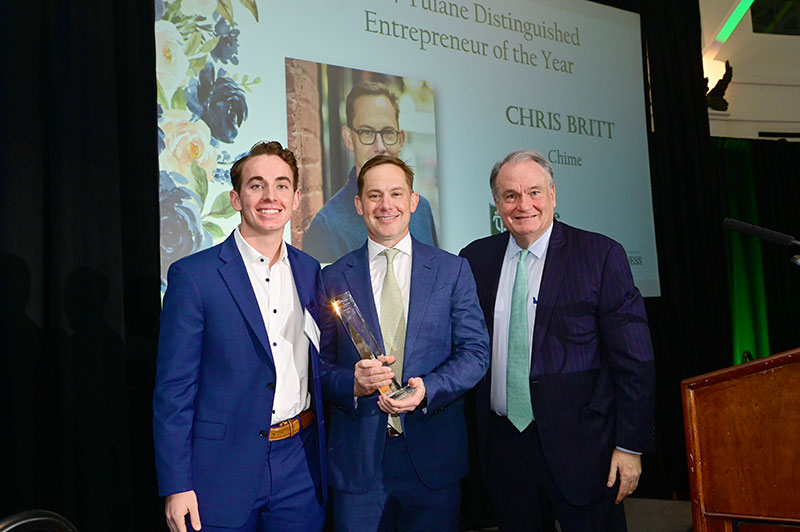
The circle became almost suspiciously tidy. In March 2024, Britt received Tulane's Distinguished Entrepreneur of the Year award from his nephew Clayton, then a Tulane student, and university president Michael Fitts. A year later, Britt joined Tulane's board. The student whose tuition gap was covered by a neighbor had become a trustee. Life does occasionally permit an editor.
Private help changed Britt's available choices. Chime applies the same logic twice: remove a financial obstacle now, then let the resulting participation compound.
When a fintech buys the bank
For years, every careful description of Chime carried the same caveat: it is a financial technology company, not a bank. Banking services came from partners, including Stride Bank. The arrangement let Chime concentrate on software, brand and the member experience while regulated institutions held the charter and accounts.
In September 2026, Chime agreed to acquire Stride for $590 million in cash, subject to regulatory approval. If the transaction closes, Stride will become Chime Bank, N.A. Britt described the deal as a faster, proven route to full-stack ownership. The company expects to save partner-bank fees, lower funding costs and move products from idea to release with fewer handoffs. In prosaic terms, the tenant wants to buy the building.
The plan also sharpens the test of Britt's founding promise. More control can mean faster products and stronger economics. It can also mean owning more of the risk, compliance and public trust that come with taking deposits and extending credit. Chime has expanded from spending and saving into credit building, short-term liquidity, premium rewards and investing. Each product makes the relationship more useful; each also adds another place where “profit with” must be demonstrated rather than printed.
Britt's stated ambition is to make Chime the leading primary-account provider for mainstream America. The language is deliberately ordinary. The customer is a teacher, retail worker, first responder or corporate employee, not a demographic invention wearing expensive trainers. The aspiration now includes an AI assistant called Jade, designed to understand a member's financial picture and eventually act with permission. The old mission has acquired very new machinery.
The account beneath the account
It is tempting to make Britt's biography too symmetrical: a boy receives help, builds a company to help others, rings a bell and pays the gift forward. Real stories resist this polish. Chime is a large public financial company, not an act of charity. Its products produce revenue. Its lending must be collected. Its acquisition must satisfy regulators. Its promises will be judged in customer support queues as often as in speeches.
Still, the early gift matters because it explains what Britt recognizes as progress. Sonneborn did not hand him a finished life. He removed an obstacle and trusted what might follow. Direct deposit does something less romantic but structurally similar: it makes an account the place from which the rest of a financial life can proceed. A scholarship and a primary account are both forms of access. Their value lies in what the holder can do next.
The Nasdaq bell was loud. The more revealing sound in Britt's story is quieter: one person telling another, through time and tuition, that the future is worth underwriting. Britt has turned that memory into a foundation and a company doctrine. Now, as Chime prepares to own more of the financial rails it once rented, he has to prove that an act of faith can survive scale.