The cashier wanted to know how much Arad Levertov earned, whether he rented or owned, and other facts that sound especially intimate when delivered within earshot of a checkout line. His three children were with him. The family was buying groceries at Costco. Levertov had a good job in consumer lending, but he was a recent arrival to the United States and his American credit file was thin. After roughly ten minutes, the answer came back: declined.
He understood the machinery. That was almost the insult. A model could not see the person standing at the counter, and the process made its ignorance public. Levertov has repeatedly described the moment as humiliating. Plenty of founders retrofit a neat origin myth after the cap table becomes interesting. This episode had a stubbornly useful shape from the start: personal friction met professional fluency.
The rejection did not immediately produce a logo, a pitch deck, and a tasteful launch party. It stayed with him while his experience accumulated. He had already learned how teams behave under pressure, how factories expose waste, and how lending businesses balance speed with risk. The checkout supplied the missing ingredient - a problem he could feel.
The education of an operator
Levertov grew up in Israel. At 17, he spent three months at a summer camp in the United States, an encounter with a larger world that he later said helped stir his ambition to study there. First came five years in Israeli naval special forces, where he served as a major. In one account, he remembered barely completing an early five-mile training run while carrying 30 pounds and leaning on his teammates for help. Months later, the group completed a far longer team run with heavier loads, followed by a swim.
“We can accomplish much more than we can imagine possible when we get out of our comfort zones, especially when you’re working as a team.”Arad Levertov
The point he drew from the story was not personal toughness polished to a shine. It was dependence. The team made the distance possible. That distinction matters in a founder’s biography, a genre forever trying to turn companies into solo acts.
After the military, Levertov studied industrial engineering and management at Ben-Gurion University and joined Intel. He managed manufacturing teams and worked in operations and systems development. The factory gave him a durable question: are people adding value or merely being busy? It is an unfashionably blunt test. It also survives every business cycle.
Duke’s Fuqua School of Business brought him to the United States for an MBA from 2008 to 2010. Through that route he joined Enova International as an intern in 2009. The internship became a remarkable ascent. By the time he left at the end of 2015, he was chief operating officer, responsible for teams across product, marketing, strategy, human resources, and operations in a business described at the time as roughly $800 million.
Five years in naval special forces, followed by manufacturing leadership and systems work at Intel.
From Duke MBA intern to chief operating officer at Enova International.
Sunbit founded with Ornit Maizel, Tal Riesenfeld, and Tamir Hazan.
A unicorn financing round, wider merchant distribution, new card products, and an EY regional entrepreneurship award.
Enova taught him the less cinematic parts of credit: regulation, marketing, operations, and the arithmetic of loss. The Costco rejection taught him what the arithmetic feels like when you are the row in somebody else’s table.
A company designed around the counter
Levertov co-founded Sunbit in 2016 with Ornit Maizel, Tal Riesenfeld, and Tamir Hazan. The four brought together leadership, product, sales, technology, and machine-learning expertise. Their strategic choice was unfashionable enough to be useful. While much of fintech raced toward online checkout, Sunbit focused on physical merchants, especially auto dealership service departments and other everyday points of sale.
The counter imposed discipline. A customer could not be left completing a financial autobiography while a line formed. A merchant employee needed to explain the option without becoming a loan officer. The decision had to arrive quickly, the interface had to tolerate a busy workplace, and the economics had to work without buying every customer through an advertisement.
This distribution model is the useful bit other builders can steal. The merchant is not simply a pipe that delivers the product. The merchant changes the product’s required speed, language, training, and unit economics. Sunbit avoided some of the consumer-acquisition expense that burdens direct lenders because partners introduced the service at the moment of need. Distribution did not follow product design. It disciplined it.
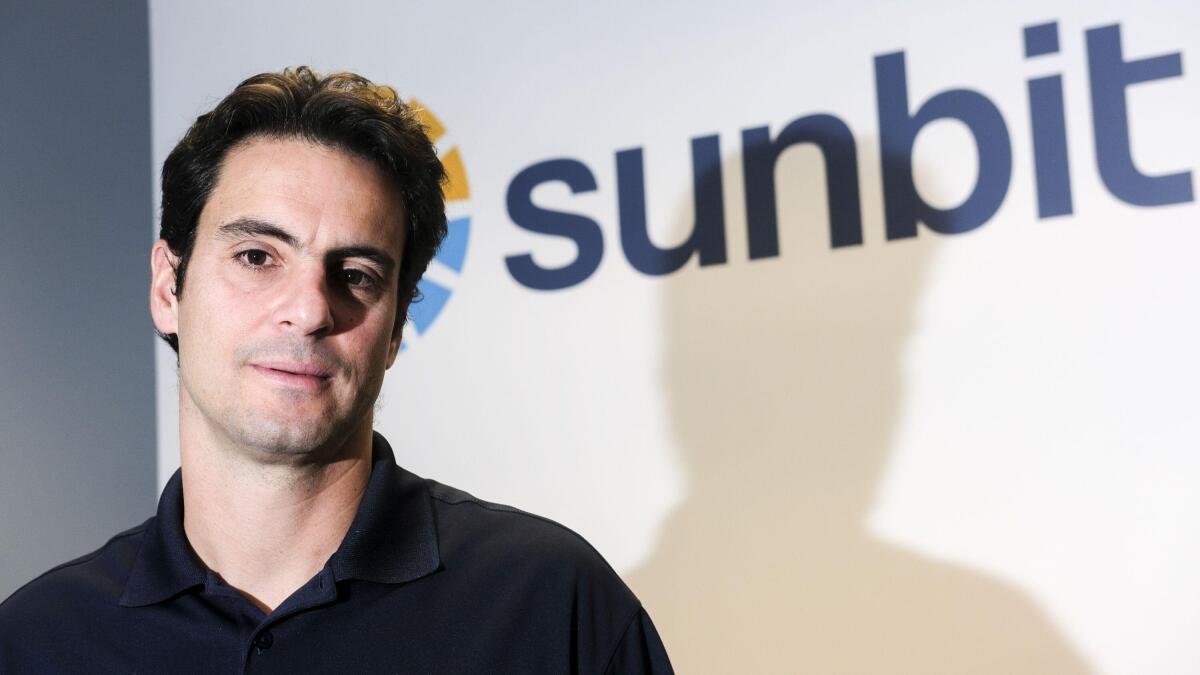
By 2019, Levertov was publicly describing a process designed to take about 30 seconds and serve people across the credit spectrum. In 2021, Sunbit raised a $130 million Series D at a reported $1.1 billion valuation. By June 2025, an EY award announcement said the company had processed $3.2 billion across 4.2 million buy-now-pay-later originations and was present in more than 60 percent of U.S. auto dealership service centers. A 2026 company-promoted podcast appearance put its reach at 5.5 million loan customers and 40,000 merchant locations.
The figures are scale markers, not the heart of the idea. Levertov’s public language keeps returning to the person behind the account number, someone “just trying to get something done.” It is a revealing phrase. He does not cast the customer as a lifestyle demographic or a conversion event. The customer has an errand.
No bathrooms, no mythology
Early Sunbit had the usual appetite and the usual budget. On one Bay Area trip, Levertov and co-founder Tal Riesenfeld combined investor meetings with client activation and training. They booked one room to save money. After arriving, Riesenfeld started laughing. The bargain room had no private bathroom; the facilities were at the end of the hall.
Levertov had spent the previous five years as an executive at a public company, accustomed to business-class flights and proper hotels. Now he was making his own arrangements and discovering the footnotes. He later told the story as a lesson in accepting small, honest mistakes while keeping focus on what matters. It is a better founder anecdote than the customary tale of sleeping under a desk. The discomfort is human-sized. The punchline lands on the ego.
A passing frustration becomes valuable when lived experience meets the skills to redesign it.
Distribution creates product constraints. The counter demanded speed, clarity, and simple training.
Intel’s factory lesson endured: activity earns no credit merely for looking industrious.
His military story celebrates collective endurance, not the romance of the solitary commander.
His most portable advice is even shorter: “Talk less and do more.” It risks becoming a coffee mug unless paired with his Intel question. Doing more of what? The answer, in Levertov’s telling, is work that improves the customer’s experience and removes waste. Action needs a filter or it becomes merely athletic.
“Behind every transaction and account number is a person who is just trying to get something done.”Arad Levertov, 2025
The discipline after the yes
Credit businesses do not become responsible merely by using friendlier typography. They must make quick decisions, price risk, satisfy regulation, explain terms, collect payments, support merchants, and resist the temptation to turn customer confusion into revenue. Levertov’s stated mission is to eliminate financial waste and pass value back to customers and merchants. The harder achievement is keeping that sentence useful as the company grows.
In a 2026 conversation about mission and scale, he discussed reinforcing values through hiring, performance reviews, and daily decisions. He also acknowledged the cost of hiring too quickly during rapid expansion. This is where an operator’s story becomes more interesting than a visionary’s. Vision supplies the direction. Operations decides whether the direction survives contact with payroll, product deadlines, and quarterly targets.
Sunbit has expanded beyond its original installment product into credit cards and software integrations. Levertov’s recent public appearances have focused on differentiated distribution, personalization, and staying close to the customer as the organization matures. In 2025, EY named him a Greater Los Angeles Entrepreneur Of The Year award winner. His response returned to fortitude, service, and the person behind the transaction rather than the trophy.
The neat ending would be to say the checkout rejection became a yes. Reality is more demanding. It became millions of decisions, each requiring data, capital, regulation, software, and somebody at a merchant location who knows what to say. The original insult was a system that made a person feel small. Levertov’s work has been to make the system notice more, ask less, and finish before embarrassment has time to settle in.