Ray C. Anderson needed something to say. In 1994, the founder of Interface had been asked to address a company task force about its environmental vision. This presented a small difficulty: he did not have one. He had built an international carpet business, understood manufacturing, and knew how to compete. The environmental question had arrived from customers. Now it required an answer from the boss.
He picked up Paul Hawken’s The Ecology of Commerce while preparing. The reading did not supply the reassuring speech he might have expected. It made the business he had spent two decades building look troublingly different. Petroleum went in. Carpet came out. Eventually, much of that carpet went into the ground. A successful system, viewed through another set of accounts, could become a very expensive habit.
Anderson called the experience a “spear in the chest.” He was 60. He could have treated the discovery as an interesting idea for retirement. Instead, he brought it back to work. The resulting project would require his employees to reconsider materials, energy, waste, design, and the useful life of the thing they sold. A book had become a factory problem.
A floor worth leaving a job for
Ray Christie Anderson was born on July 28, 1934, in West Point, Georgia. His father worked in the postal service; his mother had been a schoolteacher. He grew up in a family of modest means, with two older brothers, and earned a football scholarship to Georgia Tech. He graduated with honors in industrial engineering in 1956. The future environmental campaigner began with a practical education in how systems work.
His working apprenticeship took place in the carpet trade, at Callaway Mills and Deering-Milliken. He saw a commercial opportunity in modular flooring: squares of carpet that could be installed and replaced individually. Offices were changing. Furniture systems and wiring made access to the floor more useful. A carpet that could come up in pieces had advantages over one that behaved like a single enormous possession.
In 1973, he left employment to establish the business that became Interface. He had two daughters and considerable reason to appreciate a dependable salary. Recalling the decision later, he described the fear of stepping into an uncertain future. His environmental turn sometimes overshadows this earlier gamble. Long before he asked industry to change, he had risked his own career on an unglamorous improvement to the office floor.
The company grew from LaGrange, Georgia. It became publicly traded in 1983 and expanded internationally. By 1994, Anderson had built the sort of enterprise that gives a founder’s opinions weight. That made his change of mind consequential. He could carry the question into purchasing decisions, product development, and production meetings. His authority came with machinery attached.
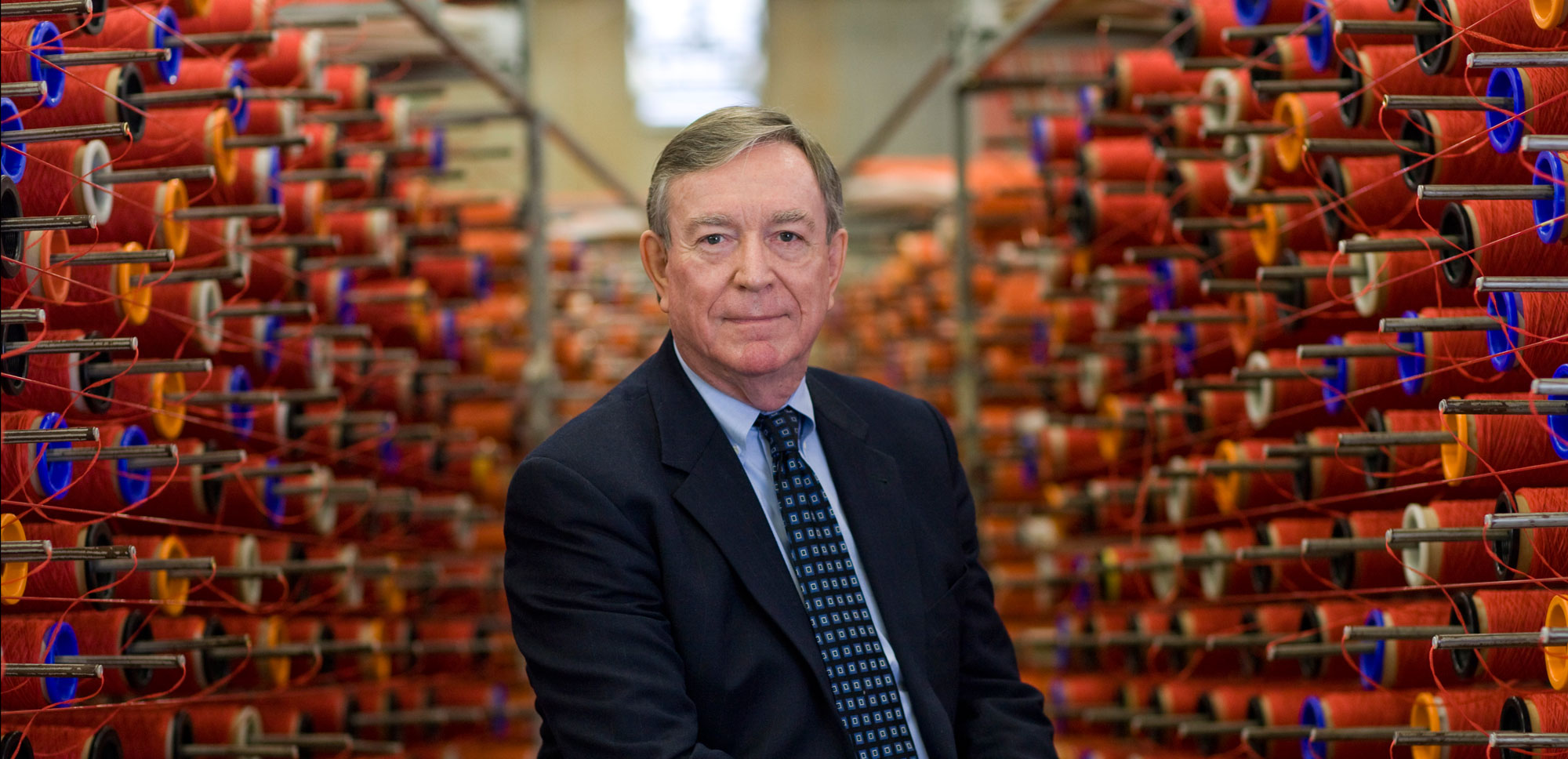
The mountain on the factory floor
Anderson’s new ambition was to eliminate Interface’s negative environmental impact. The program became known as Mission Zero, with a target year of 2020. Consider the awkwardness of announcing such a goal in a business dependent on petroleum-derived materials. The destination was easy to state. Some of the necessary technology was still missing.
He gave the undertaking a geographic shape. At a 1997 sales gathering in Hawaii, he described a climb up Mount Sustainability. There were different faces to tackle, including waste, emissions, energy, materials, transport, people, and commerce. The metaphor let a complicated industrial program become something employees could picture. A person could work on one face without pretending to have scaled the whole mountain.
Waste offered a particularly persuasive starting point. Material thrown away had already been bought, moved, and processed. Paying to dispose of it added another insult to the invoice. Cutting waste could finance further changes. Anderson’s argument appealed to an accountant’s sense of injury as well as an environmentalist’s: the factory had been purchasing things it would later pay to lose.
He also sought help beyond the carpet business. His circle of advisers brought environmental knowledge into an organization built around manufacturing. The task was broader than finding a tidier production line. Interface had to consider where materials originated and where they went after a customer had finished with them. Selling the product could no longer mark the end of its story.
office floor
the floor costs
original deadline
The forest had a suggestion
One answer emerged from looking at an untidy floor. Designer David Oakey and his team studied nature’s design principles, including the apparent disorder of forest floors. Leaves, stones, and branches differed from one another, yet belonged in the same scene. Variation could be a useful property. A factory usually works very hard to prevent it.
Interface’s Entropy carpet tiles applied that idea. Instead of insisting on visual sameness, the design accommodated differences. A replacement tile could sit among older tiles without advertising its arrival. Installers had more freedom, and customers could replace worn sections without treating the entire floor as a casualty. The forest had supplied a practical answer to a familiar maintenance nuisance.
For Anderson, this was a rewarding connection between environmental intention and commercial appeal. Longer use and easier replacement gave a customer reasons to buy that could survive an ordinary purchasing meeting. The idea did not depend on the buyer arriving with a speech about the planet. It had to work under desks, rolling chairs, and people carrying coffee.
There is something pleasing about an industrial engineer accepting a lesson from scattered leaves. Anderson had spent a career learning to make things reliably. Here was a design in which carefully managed variation made the product more forgiving. The discipline remained. The model had changed.
A lease that refused to cooperate
Anderson could be candid about the resistance. In a 2004 interview, he identified the Evergreen Lease as a disappointment. The idea was to offer floor covering as a service, retaining a relationship with the material rather than simply selling it and saying goodbye. It fitted his interest in recovering resources. Customers, however, had budgets and habits of their own.
Capital spending and operating spending often belonged to different people. A proposal requiring those budgets to work together introduced a negotiation inside the customer’s organization before a carpet order could be placed. Salespeople could find it easier to complete a conventional sale. The lease also depended on collection, disassembly, and recycling systems that were still being developed.
That difficulty belongs in his story. A compelling principle could run into an entirely ordinary accounting arrangement and get stuck. Anderson’s work involved persuading people with responsibilities, incentives, and limited time. The mountain contained procurement departments.
“Brighten the Corner Where You Are.”
The childhood hymn Anderson turned into practical advice
A Southern voice, carrying further
He took his argument well beyond Interface. He co-chaired President Bill Clinton’s Council on Sustainable Development, wrote Mid-Course Correction in 1998, and published Confessions of a Radical Industrialist in 2009. The titles trace an interesting progression: first an adjustment to the route, then a frank admission that the destination required more substantial changes.
His public manner helped. He spoke with a Georgia drawl, used stories, and brought an industrialist’s familiarity with costs to audiences that might otherwise have dismissed the message. His 2009 TED talk presented sustainability as a business proposition. He also appeared in films including The Corporation and The 11th Hour. Carpet manufacturing had found an unexpectedly cinematic spokesman.
His private choices joined the argument. He drove a Prius and built an off-grid home. Yet his ambitions extended beyond the example of one household. He wanted the organization he had created to change its habits and demonstrate that other businesses could do the same. His engineer’s interest in a working model survived his expanding public life.
There was room for poetry, too. Glenn Thomas’s Tomorrow’s Child became an important part of Anderson’s way of talking about responsibility to future generations. The people who would inherit industrial decisions could not attend the meeting. The poem gave them a place in it. For someone accustomed to measurable results, he understood the usefulness of making an absent person feel present.
The work outlives the founder
Anderson died on August 8, 2011. Interface continued the work. In 2019, it announced that it had achieved Mission Zero. Its reported progress included substantial reductions in factory waste and water use. Those measures describe changes in manufacturing; the company’s broader environmental accounting continued to develop, including a fuller treatment of supply-chain emissions.
His family relaunched the Ray C. Anderson Foundation in 2012. Its work has supported sustainable business education at Georgia Tech, nature-inspired innovation, Drawdown Georgia, and The Ray, an infrastructure initiative with an 18-mile stretch of Interstate 85 as a testing ground. His daughter Harriet Langford helped take the family’s environmental work onto the highway. Flooring was becoming a rather expansive inheritance.
In March 2025, the foundation announced plans to sunset by the end of 2030. By that announcement, it had awarded more than $36 million in grants since 2012. The family chose to concentrate its resources within a defined period. His grandchildren and their spouses were taking a larger role in the decisions. The next generation in his speeches had become people sitting around the table.
Anderson’s papers are preserved at the Georgia Historical Society. The books, correspondence, speeches, and working records offer a less polished companion to the familiar conversion story. An epiphany makes a satisfying opening. The years of decisions that follow determine whether it amounts to anything.
He left a particularly usable example of changing your mind: a founder could examine a company he loved, find serious faults, and stay to work on them. At 60, he had acquired enough experience to defend the familiar arrangement quite convincingly. He used that experience to question it. Then he went back to the floor.
Keep following the thread
Watch: The business logic of sustainability · TED, 2009 ↗The TED talk on YouTube ↗Read the 2004 conversation with Joel Makower ↗Explore Anderson’s speeches and life archive ↗Interface company profile ↗The foundation continues his legacy