A green business still needs someone to buy what it makes. That rather ordinary fact sits beneath the ambitious vocabulary of Cámara Verde de Comercio, a Latin American network whose work ranges from mentoring entrepreneurs to convening conversations about biodiversity. The organization wants a more humane, sustainable and regenerative economy. Its daily proposition is easier to picture: help the right people meet, then help them do something useful together.
The chamber occupies a familiar commercial institution and gives it an environmental brief. It connects enterprises and organizations building sustainable value chains, with particular attention to startups and smaller companies. For an entrepreneur, that can mean finding a consultant, preparing for a pitch or meeting a prospective business partner. For an established company, it can mean bringing sustainability expertise into decisions that affect suppliers, staff and customers.
There is something refreshingly prosaic about the approach. The green economy, viewed through this chamber, includes mailing lists, appointment calendars and follow-up conversations. An introduction may lack the glamour of a breakthrough technology. It is also one of the things a business cannot manufacture by itself.
An email before there was a chapter
Cámara Verde began in Colombia in 2012 with support from the U.S. Green Chamber of Commerce. Mexico followed in 2020. Its current regional description names chapters in Colombia, Mexico, Chile, Peru, Costa Rica and Brazil, with additional relationships extending into other countries. Mauricio Cárdenas Piñeros is identified as a regional cofounder and board president. This is a network assembled across borders, with local people doing the assembling.
The Chilean beginning supplies a particularly human illustration. In a September 2024 interview with the Marketing Sostenible podcast, lawyer Verónica Prado recalled contacting U.S. Green Chamber leader Michelle Thatcher and Cárdenas after a forum stirred her interest. She introduced herself, explained her background and proposed bringing Cámara Verde to Chile. A lengthy meeting followed; she received their support.
“Sin dinero, sin equipo.”
Verónica Prado on beginning the Chilean effort: without money, without a team.
Prado dated the start of that effort to May 2022. The regional organization dates its Chilean expansion to 2023. Those are different stages of the same kind of work: first somebody volunteers to build the room, then other people begin entering it. In its second-anniversary account, the Chile chapter reported 25 founding companies and more than 300 connected businesses and professionals. Its named alliances included agricultural cooperation body IICA, Sistema B Chile and Chapter Zero Chile.
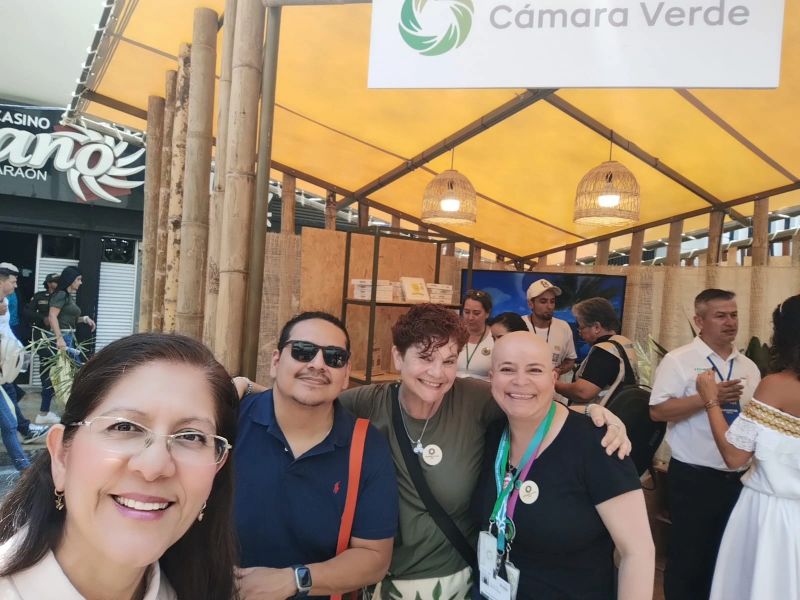
Sixteen signatures in Mexico City
Mexico’s chapter offers a different view of how the network develops. On March 5, 2025, sixteen cofounders met at Notaría 35 in Mexico City to sign founding documents, statutes and internal rules for Asociación de Negocios e Industria Verde de México A.C. The announcement described the new association as administrator of the Cámara Verde México and Green Chamber México brands.
The administrative detail matters. The chapter described a transition from roughly five years as an international mission into a local civil association, with a status comparable to the nonprofit operating in Colombia. Regional reach and local organization grow together here. A common name creates recognition; a local association gives the people using that name a structure for decisions and responsibilities.
That makes the chamber easier to understand than a list of countries does. Its expansion is also the work of forming groups, recruiting collaborators and maintaining a local presence. For another business network considering a new country, the example suggests a practical sequence: establish relationships, find committed organizers and formalize the institution that will sustain them.
What the annual fee actually buys
The membership menu separates consultants, entrepreneurs and progressively larger employers. Green Startup costs $300 a year plus VAT and includes two mentoring sessions, community access and selected promotional benefits. Green Pro, aimed at consultants, costs $175 plus VAT. Green Scale is $600; Green Growth is $1,000. Pricing for the largest-company tier, Green Leader, is negotiated.
Public prices checked September 2026. Green Leader: negotiated.
There are boundaries to the bundle. The Scale tier lists a four-session mentoring or advisory package as an optional $400 addition. Some promotional opportunities are subject to availability. Membership is therefore a starting relationship with defined benefits; deeper work can require a separate purchase.
The sensible way to approach those two startup sessions is with a decision already on the table. Consider a hypothetical founder choosing between selling directly and supplying another business. A useful session could examine the target buyer, the offer and the evidence needed to win an order. That is an editorial reading of how to use the benefit, rather than a promised outcome. The distinction matters when time is as scarce as money.
The investor pitch has an entrance exam
The chamber’s startup and scaleup accelerator makes its priorities explicit. Applicants should demonstrate sales or customer interest, incorporate technology, have a defined business model and use a method for measuring positive impact. Its listed themes include climate action, biodiversity, circularity, nature tourism, health and wellbeing. Registration through the application form is described as free.
The program outlines a progression through identification, strengthening, evaluation, accompaniment and investor connection. Group mentoring and expert feedback prepare ventures for a pitch. The organization evaluates factors including traction and team capability before presenting suitable businesses to investors. An aspiring founder with a worthy idea but no evidence of demand would need to develop that evidence before matching the stated profile.
- 01Show demand
- 02Measure impact
- 03Strengthen the pitch
- 04Meet investors
Readers can borrow the application’s logic without applying. Put the business model, customer evidence and impact method beside one another. They should describe the same enterprise. A compelling environmental claim cannot answer a question about who pays; a promising revenue forecast cannot establish an environmental benefit. The chamber’s entry requirements bring both conversations into the room.
A chamber, a classroom and a consulting desk
The broader offer extends beyond founders seeking investment. The July 2025 brochure describes training, mentoring, consulting, commercial intermediation and financial intermediation. Its technical subjects include emissions assessment, ESG strategy, supply-chain sustainability, biodiversity and reporting. These services explain how an organization centered on relationships can also undertake work inside a client’s business.
The same brochure reports more than 950 affiliated and founding enterprises and organizations across the regional network. That is the chamber’s own measure of its community. It describes organizational reach, rather than a tally of contracts won or investment raised. The business model combines annual memberships with services for clients and sponsorship opportunities around programs and events.
The market position follows from that combination. A conventional chamber can be an alternative for commercial contacts; a specialist consultancy can take on a technical assignment; an accelerator can prepare a venture for investors. Cámara Verde brings these functions together around sustainability. Which route fits a business depends on the actual problem: an introduction, an analytical project and an investment process require different kinds of work.
Its public culture also reaches beyond technical services. Member testimonials emphasize women’s leadership, peer connections and cooperation. The impact page includes voices associated with circular-fashion business La Beltrana and forest-learning initiative Amazonía Emprende. The range gives substance to the chamber’s social emphasis: sustainable enterprise includes the people running businesses and the communities around them.
Water, money and the work after the webinar
A 2024 collaboration with GreenNetwork Chile shows the chamber turning expertise into an accessible conversation. An episode on water use and efficiency brought together Prado, Mattia Carenini, Technologies Values Corporation’s Gonzalo Varela and Ainwater cofounder Camilo Huneeus. The subject was specific enough to bring business and environmental concerns into direct contact. Water is both an ecological issue and something an enterprise has to manage.
In September 2025, the organization announced its Centro de Excelencia en Finanzas Sostenibles, or CeFS. The center’s brief links specialist education with technical advice for projects that need financial viability and measurable impact. Its announced subjects include blended finance, environmental accounting and green taxonomy, alongside work on financial instruments. It addresses a recognizable problem: an environmental project needs an intelligible financial structure before a potential funder can seriously assess it.
The public-policy strand continued in March 2026 with a circular-economy forum at the Secretariat of Economy auditorium in Mexico City. Organized by Cámara Verde LATAM and its Mexican chapter, the event used three panels to consider governance, international experience and business challenges. That is the chamber’s convening function operating at a different scale: bringing enterprise questions into a discussion about implementation.
For a prospective member, the practical opportunity is to enter this network with a precise request. Name the buyer you want to understand, the operating problem you want to solve or the capability your team needs. Then use the meetings, mentoring and specialist contacts to pursue it. Cámara Verde supplies places for those conversations to happen. The business still has to make the next call.