A cancer startup can have a compelling idea and still be missing something painfully ordinary: the right person to ask. A clinician who understands the intended use. A laboratory that can run the next experiment. Someone who knows what an investor will need to see. The Paris Saclay Cancer Cluster has organised itself around these gaps. Its proposition begins with a place: Villejuif, beside Gustave Roussy, where the distance between an experiment and its next useful conversation can become smaller.
- PSCC helps oncology innovators reach experts, facilities, data and funding.
- France committed €100 million over ten years, with conditions.
- Its 2026 grants fund specific milestones, with awards up to €250,000.
The useful neighbour
The name suggests a place on the Saclay plateau. The physical centre of gravity is elsewhere: Campus Grand Parc in Villejuif. PSCC’s founders joined a cancer hospital, a pharmaceutical company and three research institutions: Gustave Roussy, Sanofi, Inserm, Université Paris-Saclay and Institut Polytechnique de Paris. The project was announced in 2021, organised in 2022 and publicly launched with government backing in 2023. Today it describes itself as a nonprofit scientific cooperation foundation.
That combination explains the design. A university can produce an insight. A hospital can understand its clinical relevance. An industrial partner can recognise the work required to develop it. PSCC tries to make those capabilities easier to combine. Its ambition extends to patients worldwide, but the practical work involves particular projects, particular teams and the awkward steps between discovery and an industrial product.
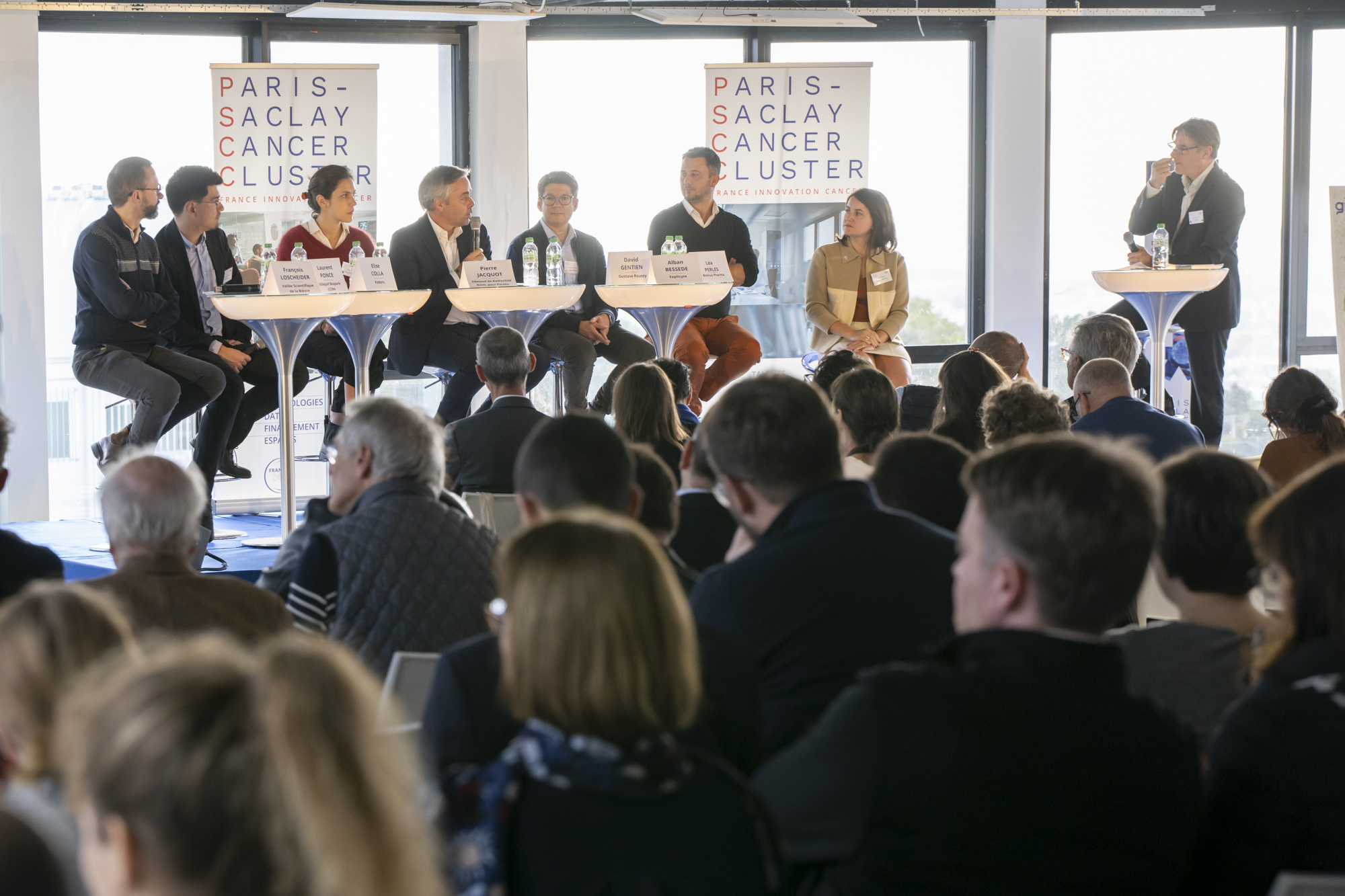
The campus adds a physical mechanism. Its current offer lists 45,000 square metres of laboratories and offices, with expansion towards 100,000 by 2032. At The Hive, tenants include Sanofi, Orakl Oncology and One Biosciences. Kadans Science Partner operates the Innovation Center. The point of shared infrastructure is practical: a young company can seek suitable space and services without assembling every piece of a research environment itself.
A startup needs a next step
For a founder, PSCC’s front door is its selective support programme, BOOST. The Support and Orientation Office helps teams examine development plans, find expertise, prepare for financing and connect with scientific partners. Its published remit includes the wonderfully economical instruction, “Challenge the roadmap”. A plan can be ambitious and still need someone to question the order of the experiments.
“Challenge the roadmap”PSCC’s brief to its Support and Orientation Office
The selection scorecard is unusually revealing. Scientific quality gets 40% of the weighting; the team gets 30%. Patient need and development opportunities account for 20%, and contribution to the cluster for 10%. Applicants submit evidence, intellectual-property information, a competitive analysis and a development roadmap. This is a programme for projects ready to be examined, with independent reviewers assessing the documentation.
Science / Team / Patient need & development / Cluster contribution
The users range from biotech and diagnostic developers to medical-device teams and pharmaceutical researchers. International applicants are welcome when they contribute to the French economy, subject to eligibility rules. PSCC Connect, a separate membership association, widens the circle to service companies, investors and institutions. Its public page lists more than 170 members. Membership creates opportunities to meet; project selection determines a different kind of support.
The expensive part comes before the cheque
There are two money stories here, and confusing them would miss the point. In February 2023, France committed €100 million over ten years to PSCC through France 2030. Payments were conditional, including intermediate objectives and partner commitments. This is public backing for an innovation organisation. The business model combines that support with partner contributions, while specialist operators provide property and research capabilities.
Separately, PSCC reported in February 2026 that nearly 80 supported projects had raised more than €200 million since 2023. That figure belongs to the projects. It indicates financing activity across the portfolio; it does not establish how much fundraising PSCC caused, or how many patients benefited. Those are different questions, requiring different evidence.
Public commitment to PSCC
Over ten years, conditional
Raised by supported projects
Since 2023, reported February 2026
The 2026 BOOST Grant addresses a familiar financing bind: investors want stronger evidence, while producing it costs money. In June, PSCC announced ten recipients receiving between €120,000 and €250,000 each. One Biosciences, for example, needs clinical evidence for its single-cell tumour-profiling approach. MSInsight needs to demonstrate diagnostic-software robustness across sequencing environments and strengthen its regulatory dossier. The money attaches to a development obstacle, giving the grant a concrete job.
Data that can travel without moving
Another obstacle is less visible than a laboratory building. Hospital records contain information in different systems, formats and freely written reports. PSCC DATA is working towards a federated network: data stay within institutions while research across sites becomes possible. Gustave Roussy, Institut Curie, AP-HP and Hôpital Foch are involved. Standardisation and quality are central tasks. Having a large collection is only useful when researchers can ask a consistent question of it.
Technology access follows the same collaborative logic. Partner-operated platforms cover capabilities including cell therapies, tissue analysis, ex vivo models and early clinical research. PSCC can support and connect these resources without owning every instrument. Patients also participate through a collective that brings representatives and associations into discussions with innovators. Their role introduces another useful test: whether the proposed solution addresses the experience of the people expected to use it.
Borrow the handoff
The transferable idea is to name the next obstacle precisely. Find the specialist, sample, validation study or facility needed to clear it. Then make someone responsible for the connection. A founder can copy that discipline without building a campus. Replicating the whole organisation would require hospital partners, sustained capital, workable data governance and enough promising projects to justify the shared resources.
PSCC’s distinction lies in coordinating these pieces around oncology. A stand-alone incubator or a direct hospital partnership may solve part of the same problem. This cluster attempts a longer chain of handoffs. Its financing figures and growing project list show activity. The consequential test comes later: whether those handoffs help teams produce treatments and diagnostics that can earn a place in care.