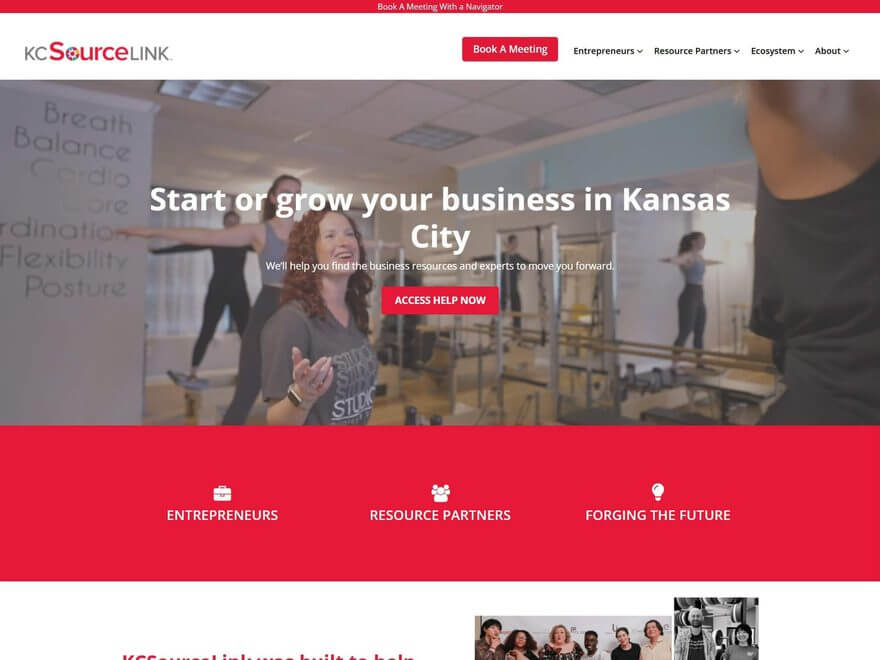
In 2003, Kansas City had a peculiar abundance: 147 resources for people starting and growing businesses. That sounds like good news. Unless you were the person trying to work out which door to open. A lender, a training program and a business adviser might all be nearby, yet effectively invisible to one another. The missing thing was a dependable introduction.
- SourceLink helps communities organize the business support they already have.
- Its customers run networks; entrepreneurs use the local front doors.
- The method combines searchable tools, human referrals and evidence of what happened next.
Maria Meyers began KCSourceLink with the University of Missouri-Kansas City, the Kauffman Foundation and the Small Business Administration. The original model became the basis for SourceLink, which takes the tools and operating knowledge to other communities. Its subject is entrepreneurship. Its specialty is the awkward space between organizations.
The trouble with another building
Kansas City had experimented with bringing business-support organizations together at 4747 Troost Avenue. But the region crossed a state line. A helpful building could still be a long way from the person who needed it. The eventual answer was a virtual network serving the wider metro.
The launch began with a $487,000 Kauffman Foundation investment, documented in the International Economic Development Council’s journal. That was the founding investment in KCSourceLink, the original model. It should not be mistaken for today’s software price.
Early partner organizations had a reasonable worry: make everyone’s work visible and funders might decide some of them were redundant. Mapping complicated that assumption. SourceLink’s account describes less duplication than expected, alongside holes in the available support. The inventory became a way to discuss what was missing.
“In Kansas City, if you reach out, people will answer.”
Maria Meyers · Founder · May 2026
There was also a simpler problem. Providers did not know one another well enough to make reliable referrals. A list could identify an organization. Repeated contact helped establish whether sending somebody there made sense. KCSourceLink has convened quarterly meetings among support organizations since its founding.

Search, hand off, remember
The product suite follows that sequence. Resource Navigator organizes services by business stage, industry, location and need. Someone looking for financing can narrow the field rather than decipher the institutional landscape. Partners can update their profiles, and administrators can study search activity to see where demand outruns supply.
SiteConnex supplies the public website around that discovery process. Communities can bring their own identity and content. The distinction matters: the local organization remains the recognizable entry point. SourceLink provides the machinery behind it. Resource Navigator can also sit inside an existing website.
A conceptual workflow, not a customer outcome.
The CRM records interactions, advising, referrals, surveys and outcomes. Pro serves individual organizations; Enterprise adds coordination across organizations, with separate peer systems, permissions and shared metric definitions. It is built for the situation in which several institutions help one business and somebody eventually asks what their combined effort achieved.
The customer behind the customer
The entrepreneur and the institutional customer have different jobs. An owner wants the next useful person. An economic development agency, university or nonprofit network needs current information, cooperating partners and reporting that can survive a board meeting. SourceLink’s business combines licensed technology with consulting tailored to those organizations.
Local sponsors help make affiliate services possible. That arrangement also explains why a public resource finder can coexist with software sold to institutions. The economic buyer is maintaining a community service, while the founder arrives with a particular business problem.
This is a recognizable market. EcoMap Technologies also sells resource discovery, relationship management and ecosystem reporting. A community can instead assemble a general CRM, a custom directory and spreadsheets. SourceLink’s case rests on the combination of purpose-built software, consulting and experience operating the original network. Buying a directory alone purchases only part of that combination.
Iowa supplied the maintenance crew
Iowa makes the operating model concrete. Its statewide network joined the University of Northern Iowa’s outreach and content work with the Iowa Economic Development Authority’s sponsorship and statewide relationships. The platform included SiteConnex, Resource Navigator and SourceLink Pro, plus a separate licensing navigator.
IASourceLink’s case study reports usage from every county and more than 20,000 entrepreneurs served through the network.
The useful detail is the work surrounding the tools: partner meetings, recurring outreach and keeping the content current. At quarterly roundtables, staff could show organizations the referrals sent their way. Cooperation acquired a visible return.
The same case study acknowledges that there was no statewide baseline before launch. Its reach figures describe use of the network; they do not establish how many additional businesses or jobs the platform caused. That distinction makes the results more useful to a careful reader.
Copy the habit before the software
SourceLink’s Resource Rail borrows the appearance of a transit map, with different routes for different kinds of businesses. The joke is practical. A neighborhood shop and an innovation-led venture may need different stops. Counting them as interchangeable “startups” produces some very strange directions.
A community can borrow the underlying habit immediately: inventory existing help, describe who each provider serves, assign somebody to maintain the information and follow the referral. Meet often enough to learn whether the handoffs work. Use the unanswered questions to guide the next investment.
There are conditions. Providers must participate, information must stay current, and organizations sharing client records must agree on permissions and definitions. SourceLink’s terms explicitly say referrals do not guarantee eligibility, funding or outcomes. A map can reveal an absent lender. It cannot lend the money.
That is the appeal of this particular company: it gives the introduction an owner, a process and a memory. For the business owner, the result can be wonderfully ordinary. Somebody knows where to send you next.