An investor introduction is supposed to end with a pitch. This one wandered into Pokémon. In 2022, when Henry Sebastián Remache was raising money for Mercately, Juan Manuel Amorós suggested he speak with Lautaro Schiaffino, an entrepreneur who had exited a business in the same industry. Remache sent a message. Then another. Four months passed before an answer arrived.
What followed was an unusually leisurely route to a funding decision: conversations about anime, tea shops and the overlap between entrepreneurship and parenthood. After several meetings, Schiaffino asked for Mercately’s numbers. Eventually he invested, became a mentor and joined the board. Amorós had made the introduction; the relationship developed on its own timetable. Apparently, even in venture capital, a cartoon creature can get through a door that a slide deck cannot.
That small episode offers a useful way into Amorós’s work. The founder and CEO of Emprelatam spends his time helping other founders find people, judgment and opportunities they might otherwise miss. The introduction is only the beginning. The interesting part is what becomes possible afterward.
Before the introductions, there was code
Amorós came to this work through technology. As a child, he developed a close relationship with computers and began teaching himself to program. He later studied at the Instituto Tecnológico de Buenos Aires, graduating as an informatics engineer. His LinkedIn profile dates his time at the institution to 2006–2011.
In 2011, he founded Redmint, a business developing digital products for startups. His career also took him through technology leadership at loyalty company Ashiwea, operations at recurring-payments fintech PagoTIC, and product and technology consulting at commerce platform Aper. Those roles put different parts of a company on his desk: the product, the machinery that runs it and the work of getting the operation to function.
He also founded Startups University, an academy for startups, and Gigvy, which worked on automating the hiring of remote technology teams. Look across those projects and a recurring concern appears: helping a company acquire a capability it needs. Sometimes that capability is software. Sometimes it is a team. Eventually, it would become access to other people’s experience.
A founder studies his own mistakes
In July 2019, Amorós turned a question about acceleration into the project that became Emprelatam. He spent weeks studying, revisiting his own errors and developing a method for supporting entrepreneurs in the region. It is a refreshingly unglamorous origin: a founder sitting with the evidence of what had gone wrong.
The organization grew around programs for different stages of business development. By its sixth anniversary in July 2025, its offerings included Exploración, Aceleración, Grow and Expansión. The companies could be bootstrapped or backed by venture capital, and they could work in different industries. The common ground was the need to make progress.
There is something revealing in that origin question. Accelerating a founder sounds straightforward until someone has to decide what the founder actually needs. Another lesson? A customer introduction? A harder conversation about priorities? A program can be neatly arranged on a website while the person joining it arrives with a much less orderly problem. Amorós’s project began by taking that mismatch seriously.
The company stays yours
Emprelatam’s defining commercial choice is equity-free acceleration. It does not take a share of the businesses it supports. Its published program terms also say it does not charge a fundraising success fee. Equity-free describes ownership; founders still need to review the price and terms of the program they choose.
That choice sits alongside a wider set of commitments. The organization says a founder need not live in a particular city, have attended a particular university or belong to a preferred social circle. Its remote format makes participation possible across borders. The early-stage Exploración program starts with nine weeks of remote work, a mentor assigned around the company’s challenges and follow-up with the team.
For Amorós, access and selection coexist. Making the door geographically wider does not mean accepting every applicant. The promise is specific help for a suitable company. That places responsibility on both sides of the conversation: founders need to know what they are trying to do, and the accelerator needs to judge whether it can usefully help them do it.
stays yours.
Equity-free participation · Remote programs · Support matched to business challenges
A low tolerance for borrowed wisdom
Amorós has a pointed way of discussing the startup support industry. In a 2025 LinkedIn post, he took aim at venture firms without funds, accelerators that amounted to courses and mentors without enough startup experience. His complaint was practical: a founder’s time is too expensive for advice that merely sounds familiar.
He argued that selection should work in several directions. A startup has to fit the process, the team, its mentors and the network. Mentors, in turn, should face scrutiny themselves. Reading a popular startup book and listening to a podcast were insufficient qualifications for the work he described. The reading list might be respectable; the founder still has a business to run.
The post gives his public voice some texture. He uses jokes, emphatic language and impatience with empty promises to explain operational choices. Behind the tone is a demanding proposition: if a program claims to help companies execute, the people providing the advice should have experience worth bringing into the room.
“Emprender no es una ciencia exacta.”
Juan Manuel Amorós · “Entrepreneurship is not an exact science.”
The engineer leaves room for uncertainty
His advice to founders has a similarly practical center. In a September 2020 essay, he outlined five recurring mistakes: solving no meaningful problem, building the wrong solution, failing to reach customers, running out of money and allowing misalignment within the founding team.
One example concerned two founders in online fashion. One wanted to build a substantial technology company; the other wanted to make money quickly. Their disagreement kept reappearing in strategic decisions until the partnership broke down. The lesson was about compatibility of ambition and method. A shared company name does surprisingly little to settle an argument about what the company is for.
Elsewhere, Amorós has described entrepreneurship as closer to an art than an exact science, shaped by uncertainty, timing and luck. Coming from an engineer, that admission is useful. A method can help a founder avoid mistakes without promising to remove uncertainty. The distinction leaves room for judgment, which is precisely the part of entrepreneurship that a checklist cannot do on anyone’s behalf.
A room full of people who were once on mute
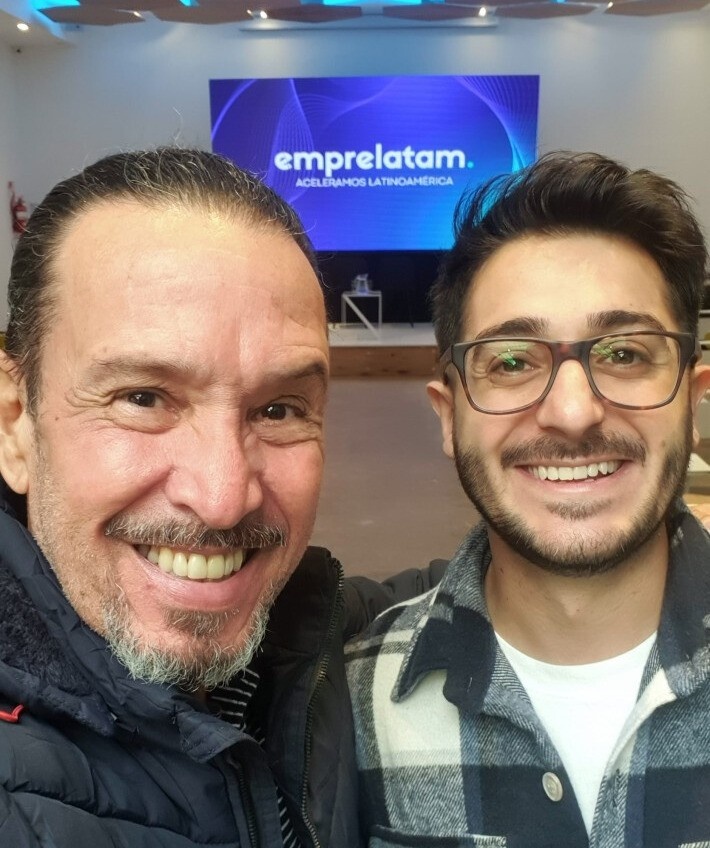
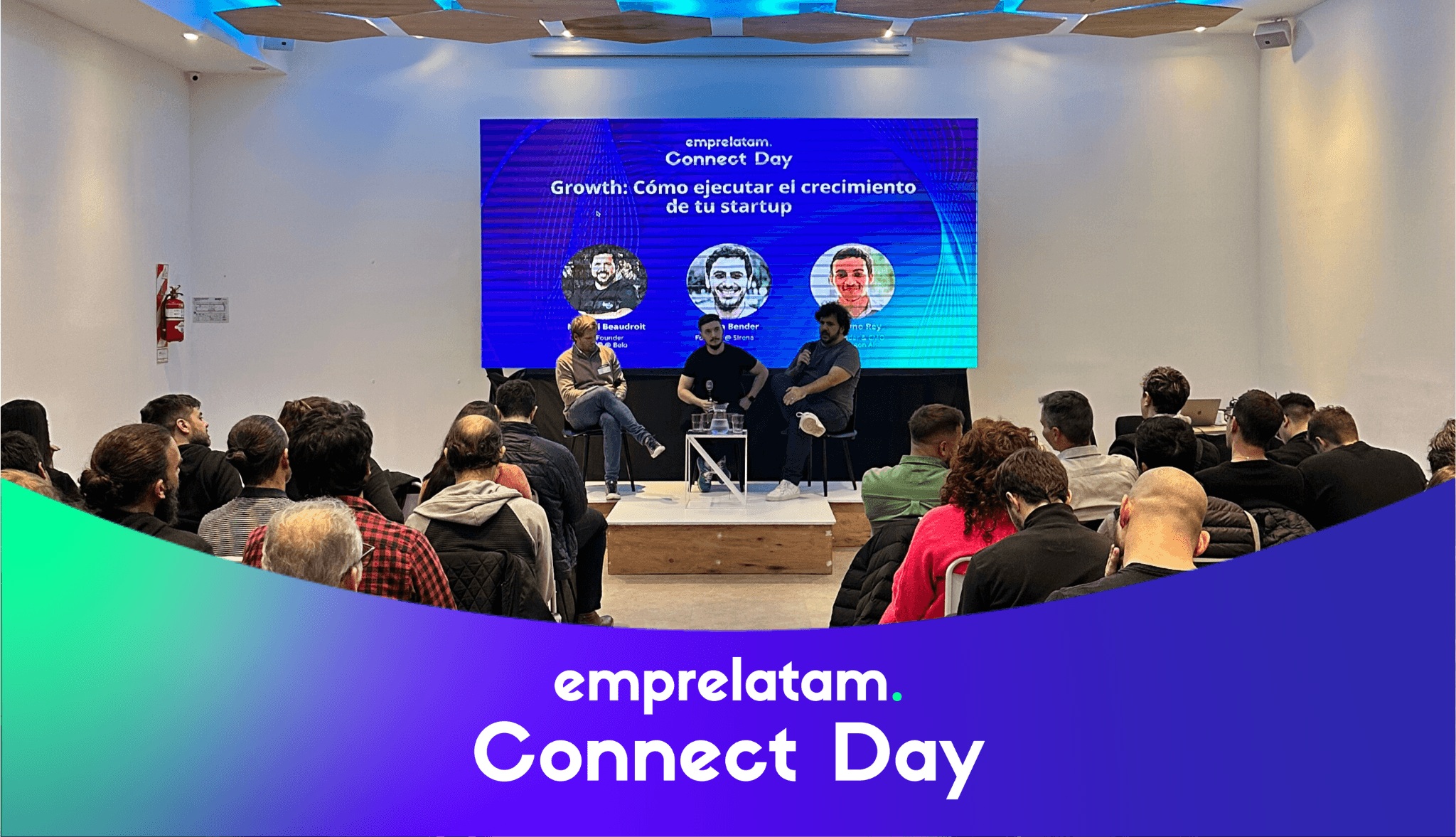
At an Emprelatam Connect Day described in June 2024, attendee José Gregorio Aldana noticed Amorós doing several jobs at once: leading, fixing things, welcoming people and appearing on a panel. The event brought a community accustomed to online meetings into a shared room.
Its program moved between entrepreneurship, growth and the choices facing bootstrapped and venture-backed businesses. There were short startup pitches, a coffee break and conversations with founders including people from Belo, Coderhouse and TurismoCity. The photograph of Aldana beside Amorós catches a smaller part of that day: the ordinary pleasure of meeting someone beyond a video call.
Amorós’s message at the gathering was that the region has talent and needs better conditions for it to succeed. The combination of that argument with the day’s practical chores is appealing. Someone has to talk about the future. Someone also has to make sure the gathering works. Here, the same person was doing both.
Argentina was a beginning, not a boundary
His involvement in founder communities predates Emprelatam. In July 2014, Amorós became a founding member of ASEA, the Asociación de Emprendedores de Argentina. Its stated purpose was to make entrepreneurship easier for people across industries, ages and circumstances. The regional organization he later built extended that concern beyond one country.
The cross-border work has taken practical forms. In April 2024, he was listed to introduce Emprelatam at an EU-LAC Digital Accelerator session connecting its community with opportunities involving European and Caribbean corporations. In another public update, he described startups spending three months preparing for expansion before a business week in Mexico City.
These are different versions of the same task: getting a company into a conversation it could use. International expansion is an imposing phrase. On a founder’s calendar, it becomes preparation, meetings and follow-up. Amorós’s role sits in that translation between the ambition on the page and the people who might help make it happen.
The next introduction
By May 2026, the manifesto signed by Amorós put Emprelatam’s reported reach at more than 1,100 companies and a network of more than 3,500 people. It reported more than $100 million raised and more than $210 million in annual portfolio sales. Those are company-reported, collective figures, rather than Amorós’s personal investment returns.
The language accompanying them emphasizes building from Latin America, selecting for work rather than pedigree and keeping relationships active after a program ends. In March 2025, he had also outlined an ambition to reach more than 10,000 entrepreneurs and business owners. That was a stated goal, with the work still ahead of it.
The Mercately introduction gives that larger ambition a human scale. Amorós knew someone a founder should meet. The founder persisted. The two people found something to talk about, then reasons to work together. An accelerator can organize the encounter; it cannot schedule trust. Sometimes the next useful step is simply making the introduction and giving the conversation room.
Continue the conversation
- Emprelatam
- Juan Manuel on LinkedIn
- Juan Manuel on X
- The five founder mistakes
- The Mercately introduction
- Connect Day account
- Entre Cervezas & Fundadores interview
- 2026 manifesto
- Career and 2025 ambitions
- Six years of Emprelatam
- Mentors and experience
- EU-LAC event
- Mexico expansion update
- Acceleration and uncertainty
- Exploración program video · YouTube