In 1994, a customer asked Interface what it was doing for the environment. Ray Anderson, who had founded the carpet company twenty-one years earlier, did not have a useful answer. Think about that predicament. Here was a manufacturer whose expertise lay in making the surface beneath everyone’s feet. A question from a customer suddenly made the ground feel less secure.
- Replace the damaged tile instead of replacing the room.
- Design variation into the pattern, so replacement pieces belong.
- Put carbon reduction into the materials, then measure the result.
Anderson picked up Paul Hawken’s The Ecology of Commerce. He later described the encounter as a “spear in the chest.” The book changed how he understood an industrial business dependent on extracting resources. The first thing to give way was a comfortable assumption: making a product people wanted was sufficient evidence that you were doing your job.
The useful part of this story is what followed the conversion. Interface pursued waste reduction, changed materials and reconsidered product design. Anderson later explained that early waste savings could either go into the bank or help finance the next stage. The company chose to reinvest some of them. Environmental ambition acquired an operating budget.
The forest had no matching problem
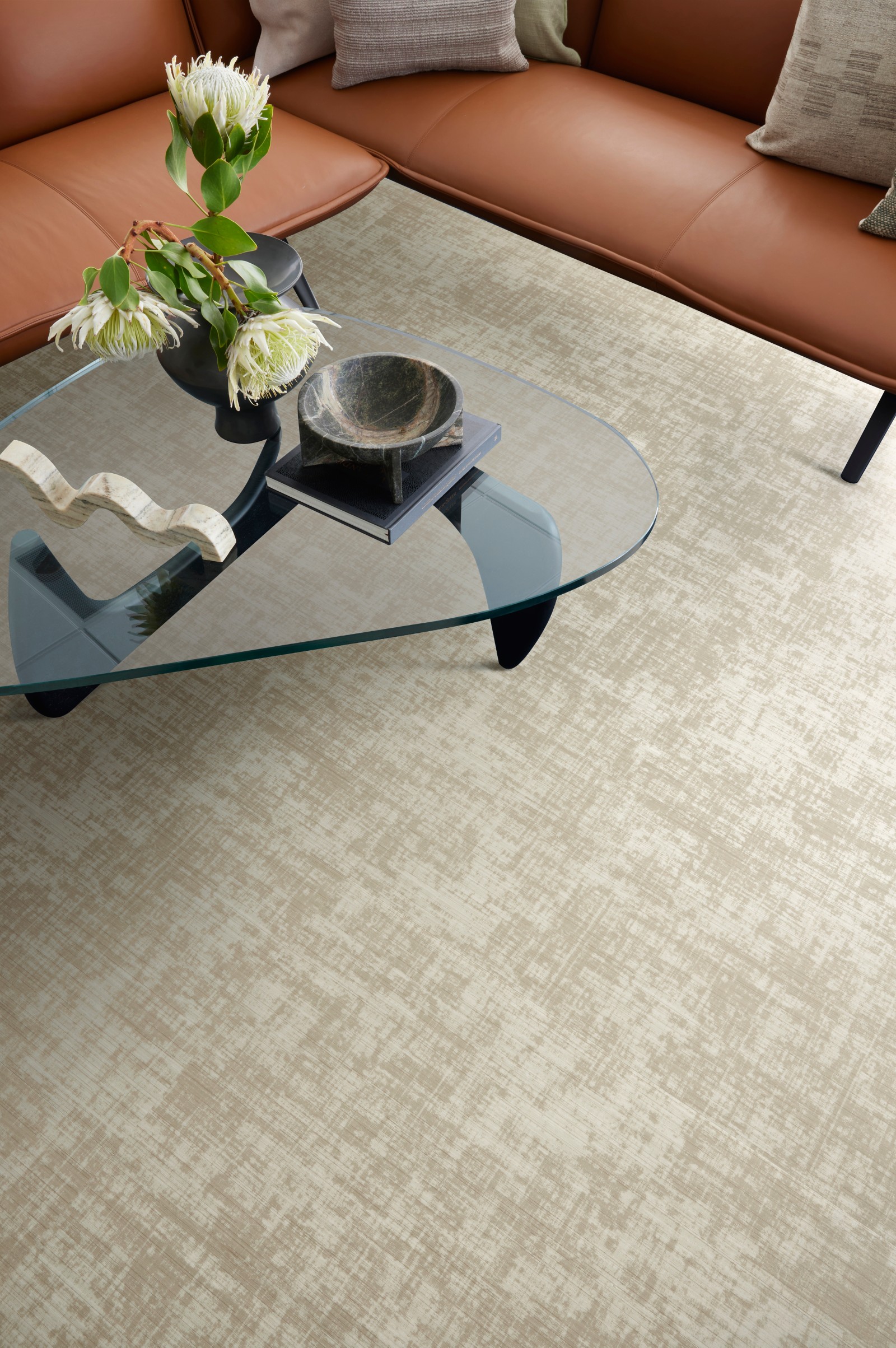
A conventional carpet pattern rewards precision. Repeat the motif. Align the pieces. Make the joins disappear. But a forest floor manages to look coherent without arranging every leaf in the same direction. Interface’s Entropy carpet, launched in 2000, borrowed that observation. Its variations in pattern and colour were intended to coexist rather than match exactly.
This sounds like an aesthetic preference. It also changes the maintenance problem. When a square wears out or suffers a stain, a replacement does not have to preserve an immaculate visual sequence. The mismatch that might expose a repair becomes part of the design. Entropy helped establish Interface’s i2 family of non-directional carpet tiles.
A floor can look coherent without every piece being identical.THE DESIGN IDEA BEHIND ENTROPY
An older Biomimicry Institute case study put average installation waste at 1.5% for i2 non-directional carpet, compared with 14% for broadloom. Those are historical comparison figures, not a promise for every room. Their significance is the mechanism: fewer alignment constraints and modular pieces can leave less material headed for the bin.
Average installation waste in a historical Biomimicry Institute case study. Project geometry and installation method affect actual waste.
The business beneath the pattern
Interface sells flooring to people who must live with the consequences of specifying it: architects, designers, building owners and facility managers. Their projects include offices, schools, hospitals, hotels and shops. The company earns revenue from product sales, directly and through contractors and distribution channels. FLOR, its area-rug brand, also reaches household buyers.
The portfolio extends beyond carpet. Interface offers luxury vinyl tile, while nora supplies rubber flooring for demanding environments. Its 2018 agreement to acquire nora was announced at approximately $420 million. That was a consequential purchase: hospitals and laboratories require performance characteristics that an attractive carpet sample cannot supply. A broader portfolio lets Interface compete for more of a building’s floor.
Its competitors include Milliken and Mohawk, alongside other carpet and resilient-flooring manufacturers. Polished concrete is an alternative, too. Interface’s proposition combines design choices, replaceable modules, technical support and environmental documentation. Whether that combination earns the order depends on the specification and budget. A sustainability pedigree cannot rescue the wrong material for the room.
TacTiles illustrates the attention to seemingly minor decisions. These adhesive connectors join compatible carpet tiles to one another, creating a floating floor rather than bonding everything to the subfloor. Selective replacement becomes simpler. Yet Interface’s own guidance calls for full adhesion in some circumstances, including heavy rolling loads or particular substrate conditions. The installation detail matters as much as the idea.
Move the money into the material
The carbon strategy has undergone its own redesign. In April 2024, Interface announced that it would discontinue its carbon-neutral programs and redirect former offset spending, beginning in 2025, toward direct carbon reduction and storage. Its enterprise-wide destination is carbon negativity without offsets by 2040. That remains a target.
In April 2025, the company announced captured carbon as a raw material in U.S. and European carpet-tile manufacturing. It said customers would receive the lower-footprint tiles at no extra cost. This is a specific price claim about that manufacturing change. It does not establish that every Interface floor costs the same as every competing floor, or that transforming the business was free.
spending↘Material innovation
+ carbon storage
The measurement boundary deserves equal attention. A carpet tile can be carbon negative from raw-material extraction through the factory gate without being carbon negative over its complete life. Transport, installation, use and disposal still count. Interface’s reported 2025 emissions reductions - 28% for Scopes 1 and 2 combined and 37% for Scope 3, against 2019 - describe progress, not a finished enterprise-wide transformation.
Specify the return journey
Consider the other end of the purchase. Interface’s ReEntry program, established in 1995, assesses used tiles for reuse, recycling or recovery. Its own description includes energy recovery when reuse and recycling are unavailable. A take-back arrangement therefore requires questions about local acceptance, collection and destination. The word “circular” cannot answer those questions for you.
The same practical instinct appeared in Net-Works, the collaboration with Aquafil and the Zoological Society of London. Discarded fishing nets entered a collection network and supplied Aquafil’s nylon-regeneration system. Interface could then buy regenerated yarn. The transferable lesson is specific: secure the collector, the processor and the customer. Waste does not become a dependable industrial input simply because somebody has identified a use for it.
Buyers can copy that discipline today: compare environmental declarations on consistent boundaries, check installation requirements, budget for replacement and arrange the exit before ordering. Interface reported $1.387 billion in 2025 sales. Its experiment operates at commercial scale, where the attractive idea must survive procurement, maintenance and the next renovation. Start with the square that needs replacing. Ask what would make the rest of the floor worth keeping.