Laurel Hurd’s first business classroom had a hardware salesman at the front of it. Growing up in Cleveland, she helped her father set up booths at trade shows and watched him sell. Later came Miami University in Ohio, then sales work at Dirt Devil. Long before she had a chief executive’s title, she had an education in the encounter between a product and the person being asked to buy it.
That is a useful place to begin with Hurd, now president and CEO of Interface. The company makes the surfaces beneath meetings, classrooms and everyday work. Its products have to satisfy people who notice the pattern, people who specify the materials and people who pay the bill. The floor has several constituencies. Few of them are willing to be tripped up.
A very large collection of small things
Before flooring, Hurd’s responsibilities included objects with rather different jobs. At Newell Brands, she led the Learning and Development segment, a business encompassing Sharpie, Elmer’s, Graco and Baby Jogger. In 2021, that segment generated more than $3 billion in revenue and approximately $600 million in operating profit. Its supply chain included eight manufacturing plants in seven countries.
A pen and a stroller make an unlikely pair until you consider the work behind them: product development, distribution, manufacturing and a reason for someone to choose your brand. Hurd’s career moved through sales, marketing, research and development, and general management. The commercial experience was accompanied by responsibility for what the businesses earned and how they operated.
Her board work offers another view of that range. She joined THOR Industries’ board in 2021, before becoming Interface CEO. The recreational-vehicle manufacturer lists her on its Audit and Compensation and Development committees and identifies her as a financial expert. The work stretches from selling products to overseeing how an enterprise accounts for its decisions.
The founder she never met
Hurd arrived at Interface on April 18, 2022, succeeding Daniel Hendrix. Here was a company with an unusually strong idea of what it wanted to become. Ray Anderson founded it in 1973. His later environmental commitments had made sustainability part of its identity, and its ambitions continued long after his death.
Hurd never met Anderson. That detail gives her assignment a particular character: responsibility for a founder’s mission without the benefit of a personal relationship with him. By the company’s fiftieth anniversary in 2023, she described feeling accountable for carrying his work forward. She also described an organization where environmental targets were already part of discussions about plants, suppliers and product development.
“What we’re trying to do is truly be restorative,” she said in 2023.
There is considerable work concealed inside that word. A manufacturer buys materials, consumes energy and moves physical goods. Changing its environmental impact means changing those activities. A successor can preserve a founder’s language quite easily. Preserving its force requires decisions that reach beyond the anniversary celebration and into the next purchasing order.
“At the center of everything is the customer.”
Laurel Hurd · Georgia Tech, March 2024
The customer still gets a vote
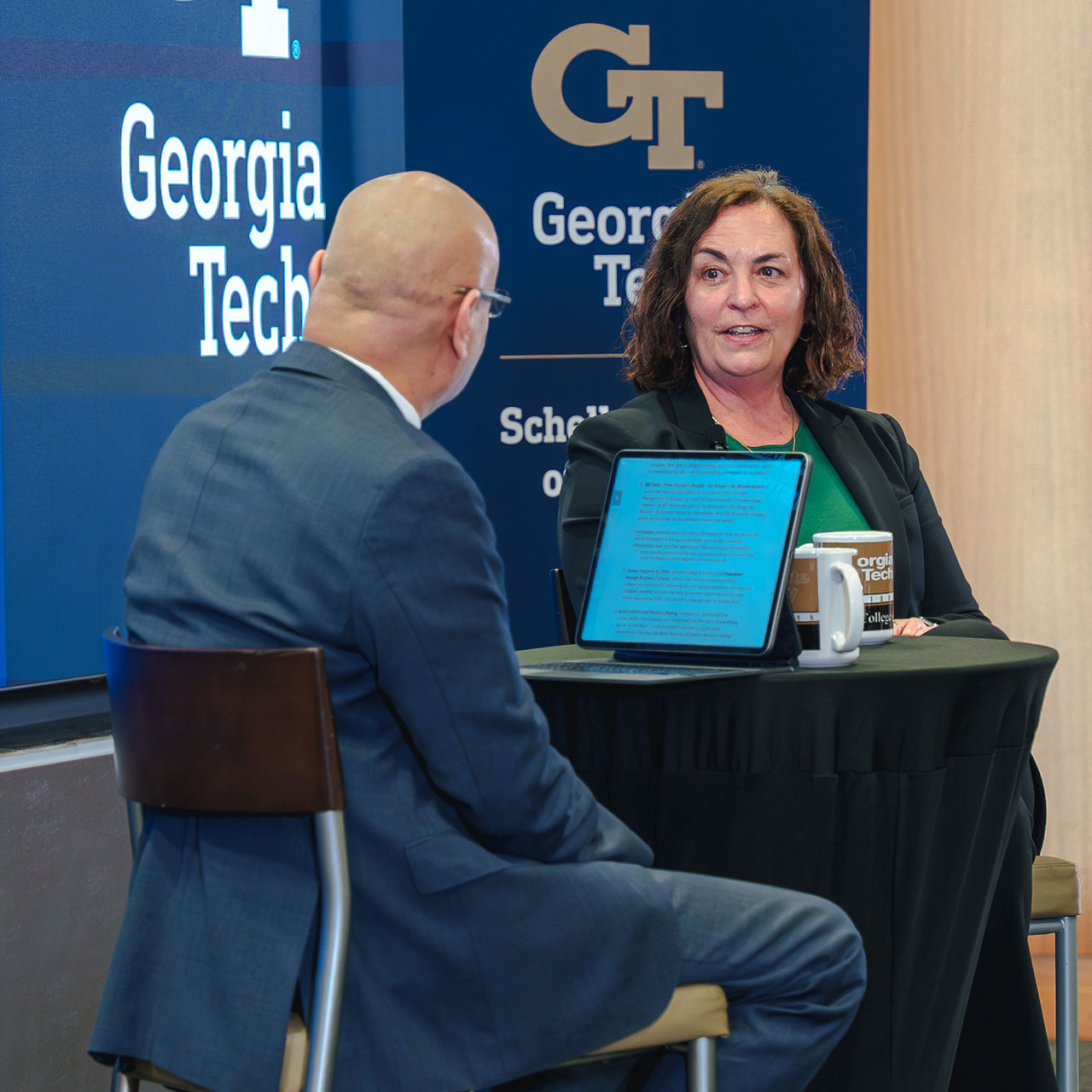
In March 2024, Hurd sat down with Anuj Mehrotra, dean of Georgia Tech’s Scheller College of Business, for a public conversation about sustainable business. The setting had a connection to the company’s history: Anderson was a Georgia Tech alumnus, and the event involved the center bearing his name.
Hurd discussed the circular economy, carbon footprints and the demands of making a business both sustainable and profitable. Her explanation kept returning to the customer. The people buying Interface’s products, she said, were looking for sustainable solutions.
That observation helps explain why her consumer-brand background belongs in this story. However demanding the environmental target, a product still enters a buying decision. Design and performance remain part of the bargain. A customer may be persuaded by the purpose and still need a floor that suits the room.
There is a practical restraint in this approach. The customer supplies a test that corporate language cannot administer to itself. Someone has to approve the specification, accept the price and use the product. Hurd’s argument places environmental work inside that commercial conversation, where it must continue to earn attention.
Giving “One Interface” a job to do
Interface introduced its One Interface strategy in 2023. In Hurd’s account, the company was moving toward a more coordinated global operating model. Expertise across the business could be used more collaboratively, with global capabilities supporting the people selling in local markets.
The name sounds simple enough to fit on a meeting-room wall. Its usefulness depends on the less decorative questions beneath it. How can teams bring a broader product range to a customer? Where can manufacturing knowledge travel between operations? Which work becomes easier when functions act together?
Looking ahead to 2026, Hurd pointed to the combination of nora and Interface selling teams in the Americas as one change helping the business serve customers. She also described products at more approachable price points, giving buyers additional flexibility. It is a reminder that growth can depend on making a company easier to buy from.
The significance for her leadership is the connection between organizational design and the ordinary sales conversation. Coordination has a commercial purpose. A customer with several flooring needs should be able to encounter the company’s range without having to reconstruct its internal organization first. The strategy gives Hurd’s experience in brands and customer relationships a company-wide assignment.
When the carbon budget moved
On Earth Day in April 2024, Interface announced a consequential change in its climate approach. Beginning in 2025, it would redirect former carbon-offset investments toward projects that reduced emissions directly or stored carbon within its business and supply chain. Its stated destination remained a carbon negative enterprise by 2040, without offsets.
The distinction matters. Buying offsets and changing a manufacturing process involve different actions. The new approach put more emphasis on the materials, operations and supplier relationships behind Interface’s own products. It also made the distance between an ambition and its achievement easier to see.
Hurd inherited the 2040 goal. During her tenure, the company changed how it intended to pursue it. That is a more revealing leadership detail than a pledge considered on its own. Money previously assigned to one activity would be directed toward another, and the resulting innovation would have to prove useful.
and the supply chain
material innovation
2040 Carbon negative enterprise
Company target · without offsets · not yet achieved
A future deadline can be reassuringly distant. A spending decision arrives sooner. This one gives readers a concrete point at which to examine Hurd’s stewardship: what the company chooses to fund, and whether those choices change the footprint of what it makes.
What went into the carpet
In April 2025, Interface announced that its carpet tile manufacturing in the United States and Europe was incorporating captured carbon as a raw material. The company said customers would receive lower-footprint products without an extra charge or a compromise in design and performance. The work depended on collaboration with suppliers.
Here the commercial and environmental questions meet in a material specification. A product can look familiar while something consequential changes inside it. For Hurd, this is an example of the operational work that can give a public commitment substance: the purchasing and manufacturing decisions become part of the thing sold.
The company’s 2025 Impact Report also described a carbon negative nora rubber flooring prototype. Its carbon claim was measured from cradle to gate. That boundary covers the product through manufacturing; it does not turn a prototype into proof that the entire company has reached its goal.
The boundary deserves as much attention as the achievement. Carbon negative product options and a carbon negative enterprise are different measures of progress. Interface’s 2040 ambition covers a much larger undertaking. Hurd’s task includes keeping those distinctions intelligible while the work moves across product categories.
Recognition has followed her into this chapter: she appeared on Forbes’ 2024 50 Over 50: Innovation list. The more interesting evidence remains in the products and processes. An award supplies a moment. A changed raw material has to keep working after everyone has gone home.
The figures have their own fine print
Interface reported approximately $1.387 billion in net sales for fiscal 2025, up 5.4 percent, alongside record profitability. Hurd credited execution of One Interface, including stronger global capabilities, commercial productivity and simpler operations. These results provide a commercial measure alongside the environmental commitments.
The next year brought further growth. Second-quarter 2026 sales reached $395.7 million, up 5.4 percent year over year, or 3.8 percent when measured on a currency-neutral basis. Adjusted gross margin improved by 524 basis points. Of that increase, 393 basis points came from tariff refunds and 131 from operational improvements. The refund was worth $15.6 million.
Those details prevent a tidy success story from becoming too tidy. The business improved, and an external benefit helped the reported margin. Both facts belong in the picture. Leading a manufacturer means living with material costs, currencies and trade rules as well as the decisions management can directly control.
Hurd’s career has prepared her for businesses made of many such moving parts. The through-line runs from selling useful objects to coordinating the systems that put them in customers’ hands. At Interface, those systems also carry a carbon target.
The challenge now is to keep the connections working: the customer and the designer, the supplier and the factory, this year’s results and a commitment stretching to 2040. The floor beneath a room can appear wonderfully uneventful. Hurd’s job involves everything required to make it that way, and everything that has to change underneath.