Houston had one immediately persuasive quality: it was warm. Before Hanneke Faber crossed the Atlantic on a diving scholarship, she looked up the Texas city in an atlas. A girl coming from the Netherlands could appreciate a place whose weather required so little explanation. The university, the career, the family connections that followed would give the journey more lasting significance. But sunshine was a perfectly respectable place to start.
She arrived at the University of Houston in 1987. A year earlier, at the World Championships in Madrid, she had met diver Jane Figueiredo, who drew Houston coach Dave Parrington’s attention to her. Talent traveled through people before it traveled through recruitment portals. Faber earned her journalism degree in 1990 and her MBA in 1992. She also met her future husband, Aristotle Economon, in Settegast Hall. One scholarship produced a rather busy set of consequences.
Today, Faber runs Logitech, a business whose products sit where people meet their computers: mice, keyboards, cameras, headsets. Her career makes a useful case study in entering unfamiliar territory. She has moved between countries, between product categories, and between industries whose executives do not always imagine they have much to learn from one another. The recurring task is getting close enough to understand the person buying the thing.
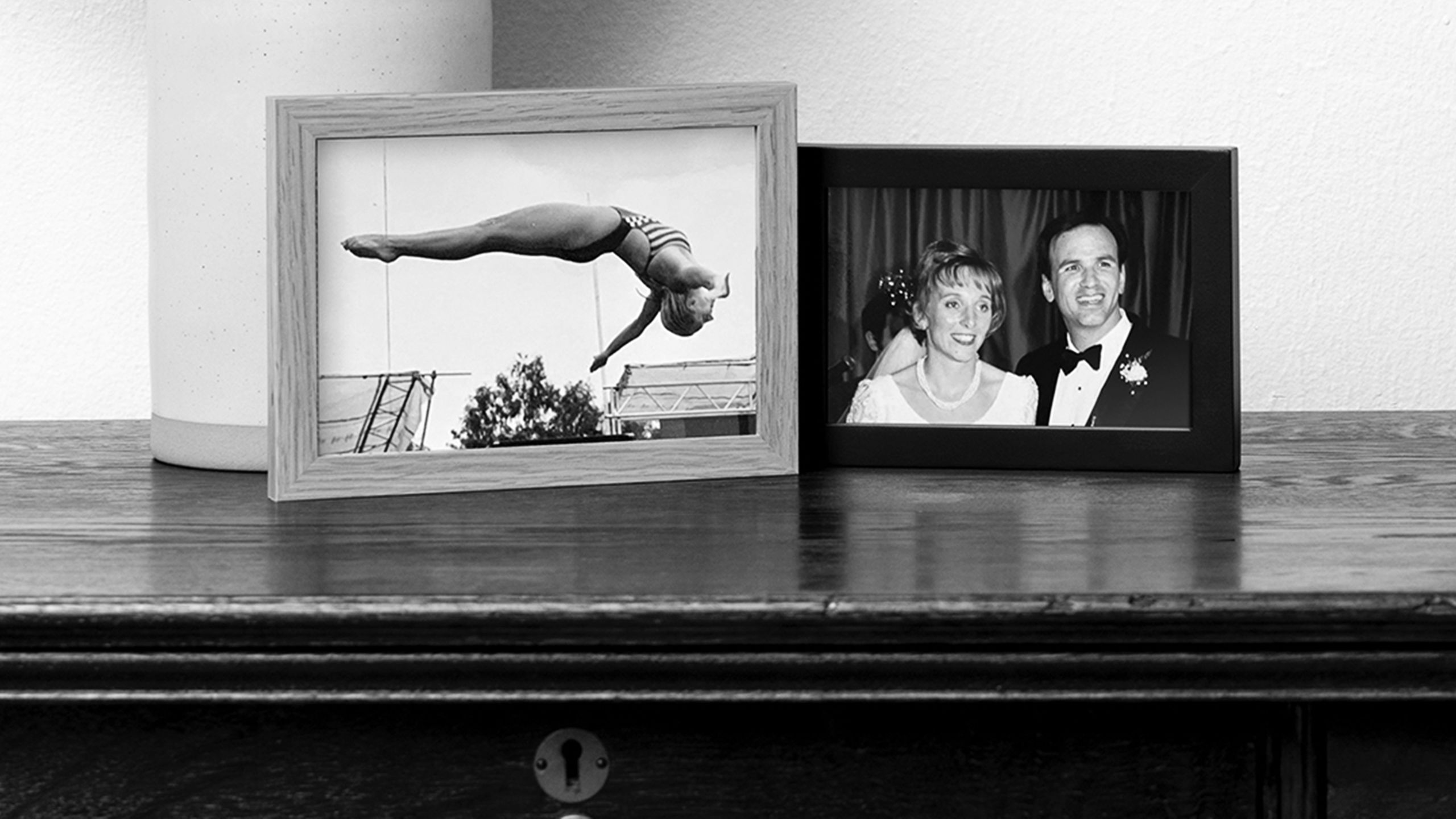
The board was ten metres high
Faber was a seven-time Dutch national diving champion and an Honorable Mention All-American. Those achievements can read like decorative items at the bottom of an executive biography. In her telling, they remain a working reference. A difficult presentation becomes more manageable when your previous standard for difficult involved flipping from a platform ten metres above water.
The comparison has a practical limit, which makes it more interesting. Diving takes preparation, repetition and a willingness to commit. Running a company also requires other people to do things you cannot do yourself. An accomplished athlete entering a new business cannot simply rehearse harder until she becomes its best engineer. Experience has to change shape.
That is an especially useful distinction in Faber’s case. Her route into technology was through the management of products people choose, use and replace. The corporate labels changed considerably. The habit of examining a purchase from the buyer’s side could travel with her.
- 1992Procter & Gamble
- 2013Ahold
- 2018Unilever
- 2023Logitech
Beauty shelves → grocery baskets → kitchen cupboards → the desktop
From the bathroom shelf to the desktop
She began at Procter & Gamble in 1992. Her international responsibilities eventually included Pantene, Head & Shoulders and Herbal Essences. She also launched Max Factor in China. These are products with different uses, prices and rituals, but all demand attention to what happens after a customer takes the packaging home.
At Ahold, which she joined in 2013, the question expanded from the product to the shopping trip. She served as chief commercial officer and later chief e-commerce and innovation officer. She moved to Unilever in January 2018 to lead Europe, then took charge of Foods & Refreshment in 2019 and Nutrition in 2022. By the time Logitech recruited her, she had worked across brands, retail channels and global operations.
The Nutrition business she left had roughly $14 billion in sales, a presence in more than 150 countries, and a supply chain of about 60 factories and contract manufacturers. Knorr and Hellmann’s were among its brands. The move to Logitech in December 2023 therefore brought a change in machinery and materials, alongside familiar questions about distribution, consumer preference and making a physical product at scale.
There was another education available at home. Before starting the job, she spent a weekend with her son learning video games, including Valorant and League of Legends. She calls it a 48-hour boot camp. A CEO can commission a market presentation; getting beaten at the customer’s own game offers a different sort of briefing.
The exercise is worth considering alongside the scale of her previous jobs. Managing a portfolio can put layers of reporting between a leader and a user. Playing a game removes a few of those layers. A confusing control is immediately confusing. A missed action has an immediate consequence. Such encounters give the next conversation with a product team a more specific place to begin.
The mouse with an unexpectedly long tail
In 2024, Faber discussed a concept for a durable mouse, improved over time with software. She compared keeping such an object to keeping a good watch. Asked whether she could imagine a subscription, she allowed the possibility. The resulting controversy attached itself to an everyday fear: that something already purchased might acquire a recurring bill.
Logitech subsequently said it had no plans for a subscription mouse and that the concept was neither an actual nor a planned product. That clarification matters. An exploratory conversation and a product announcement carry very different obligations.
The episode also exposed the difficulty inside a useful ambition. Keeping hardware longer can reduce replacement and waste. Funding software support over that longer life still requires a business model people accept. A lovely object and an unwelcome invoice can arrive in the same box. Faber’s consumer background should make that tension familiar, even when the customer expresses it rather more vigorously than a focus group would.
China gets its own drawing board
Her response to competition in China was more concrete. Logitech had been losing share there. Faber put resources into a team designing for Chinese customers, with local engineers, designers, marketers and salespeople. It was a decision about who should be close to the buyer, and who should be allowed to act on what they learned.
By September 2026, she described China as the company’s fastest-growing market over recent quarters. Products made for that market provided a testing ground for releases elsewhere. Her argument is that competing in China keeps the business fit: the market responds quickly, and local competitors give nobody much time to admire last year’s work.
She has also put more resources into business customers. A camera in a meeting room has a different purchasing process from a mouse bought online. Both still need to work for the person using them. Her emphasis on simple meeting-room experiences is easy to understand if you have ever watched six well-paid adults search for the right cable.
“I try to be the beekeeper.”
Hanneke Faber, on leading engineers in an unfamiliar industry
A beekeeper with a board packet
Faber describes a change in her own management using two occupations. The younger leader was a shepherd, directing movement. The older one tries to be a beekeeper, creating conditions in which specialists can do their work. The metaphor allows room for expertise she does not possess. Bees would make rather unpromising direct reports anyway.
Her AI experiments extend into the boardroom. By March 2026, Logitech was using a proprietary tool to review materials before board meetings and offer feedback. She was explicit that an AI agent had not formally become a director. The distinction preserves human accountability while allowing a new way to question a familiar document.
The broader argument is physical. AI needs ways to receive sound and images, and people need ways to control it. Logitech already makes objects that perform those jobs. Faber’s opportunity is to improve them around actual human tasks. Her risk is that changing interfaces will alter which objects people need. An existing place on the desk is a useful starting position; it carries no promise of permanent residence.
How long should a useful thing last?
Sustainability gives that question another dimension. In its fiscal 2025 impact highlights, Logitech reported that 78 percent of its products used recycled plastic and that repair options had expanded to more than 60 countries. These are company-wide results, built by teams and programs, rather than a personal invention to assign to the newest CEO.
Faber’s own first-six-month account at Logitech described moving through operations, product development, design and customer service as a learner. The practical questions run through all four: what material goes into a device, how it is assembled, what happens when it fails, and whether someone can keep using it. The attractive idea of longevity becomes more credible when the repair is possible.
of products made
with recycled plastic
countries with
expanded repair options
Company-reported measures. Product share does not mean 78% of every product is recycled plastic.
There is still a factory at the other end
The results during her tenure offer evidence of progress, with qualifications. Logitech reported $1.23 billion in sales for the quarter ended June 2026, up 7 percent in dollars and 5 percent in constant currency. It marked a tenth consecutive quarter of growth. Operating income benefited from $61 million in tariff refunds, so the headline profit improvement cannot all be read as an operating achievement.
The same July announcement warned that an incident at a semiconductor supplier could constrain sales in later quarters. By September, Faber was publicly discussing her search for chips. For a company positioning itself around AI, the boom also creates competition for components. The next interface still has to be manufactured, shipped and put into somebody’s hand.
There are smaller indications of how she pays attention. In a public account of an early arrival at the San Jose office, Faber described asking front-desk and security colleague Nicholas Johnson about his weekend. An art show came up. She paused, learned he had been exhibiting his own street art, and celebrated his work. A routine greeting became a reason to look again.
That is a modest episode beside a global supply chain, but a revealing one. Faber’s career keeps returning to the same possibility: the unfamiliar person or place may contain something worth understanding. Once, it was a warm city located in an atlas. Now it might be an engineer, a gamer, a local design team, or the person at the front desk. The next useful question begins with noticing who is there.