When Pete Anevski talked about Progyny’s Manhattan office, he began with the commute. There were restaurants nearby, several ways to get to work, and Bryant Park within reach for lunch or a walk. A chief executive had been invited to discuss a property. He gave an answer about the people who would have to use it.
The choice of a building turns into thousands of small experiences: an easy connection, a place to eat, a conversation that happens because two colleagues are nearby. Anevski’s answer gave those details their due. It also offers a useful way into a career spent learning the practical business of making organizations work.
He became Progyny’s chief executive on January 1, 2022. By then, he had already held its finance, operations and president titles. Before joining, he had spent seventeen years at WebMD. The appointment was a new responsibility, but scarcely an introduction to responsibility itself. His route to the top had taken him through enough departments to make the organizational chart look familiar.
An accountant learns the whole business
Anevski earned a bachelor’s degree in accounting from Montclair State University. His early career included work as a CPA at Wiss & Co. and corporate accounting at Toys R Us. These are concrete beginnings: accounts to reconcile, records to examine, a business to understand through the evidence it leaves behind.
Accounting provides a particular vantage point. A company may describe itself with a slogan, but its financial statements ask more awkward questions. What came in? What went out? What has been promised? What still needs to be paid? The discipline is useful precisely because enthusiasm cannot settle the answers.
In 1999, Anevski joined WebMD. He stayed through a succession of senior finance and operations roles, becoming executive vice president and chief financial officer in May 2013. By that appointment, he had already spent fourteen years inside the organization and its predecessor companies. He knew more than the route to the executive floor.
His earlier remit included internal accounting, securities reporting, financial planning, and acquisition analysis and integration. That last pairing matters: a transaction has a closing date; getting the combined business to function requires a longer calendar. The responsibilities placed him where financial decisions meet the work of other teams.
WebMD also credited him with contributing to its restructuring and changes in pricing and market positioning. Here was a finance executive working on how the business sold and organized itself. The boundary between counting the results and helping shape them had become increasingly difficult to draw.
This is the interesting part of the résumé. Each new responsibility added another view of the same enterprise. Fourteen years is a long time to wait for a headline, but a useful amount of time to learn what the headline will leave out.
A familiar colleague, a different company
Anevski left the WebMD CFO role in September 2016. In January 2017, Progyny announced his appointment as both chief financial officer and chief operating officer. It was a substantial brief, bringing the books and the operating machinery under the same executive.
There was a familiar colleague waiting. David Schlanger, Progyny’s newly appointed chief executive, had worked with Anevski at WebMD. The move brought their professional partnership into another company. In accepting the job, Anevski specifically welcomed the chance to resume that working relationship.
The attraction of a known colleague is easy to understand without inventing a private conversation. A résumé describes what someone has done. Working together shows how they do it: how they handle detail, how they respond to questions, how their judgments survive contact with a deadline.
Schlanger’s explanation of the appointment was practical. Progyny needed Anevski’s finance and operating experience for its next stage. That is a different kind of recruitment story from hiring a famous name to decorate the letterhead. The job description reached into the daily functioning of the business.
In June 2019, Anevski became president while retaining his other responsibilities. His CFO tenure ended in September 2020; he continued as president and COO through December 2021. Read together, these changes show a leadership role being reshaped over several years, with responsibilities moving as the organization developed.
The title catches up
The succession announcement came in November 2021. Schlanger would become executive chairman. Anevski would become CEO and join the board. Michael Sturmer would become president. The changes took effect on the first day of 2022.
It was a coordinated change across the leadership group, with continuity explicitly part of the plan. The announcement described an evolution in the way the executives were already working together. Anevski’s preparation had happened inside the business he was about to lead.
There is something refreshingly untheatrical about that sequence. Corporate succession can invite the language of rescue or reinvention. Here, the chronology makes a plainer case: an executive arrived with experience, learned another company, took on broader responsibilities and eventually assumed the chief executive’s job.
The move also changed the kind of accountability he carried. A CFO has a defined professional remit. A COO has an operating brief. A chief executive must bring the different parts of the company into decisions that hold together. Earlier experience remains useful, but the responsibility gets wider.
In June 2024, EY named Anevski an Entrepreneur Of The Year New York award winner. The regional distinction placed his name among business builders from a range of companies. It was recognition arriving well into an operating career, after years spent doing work that rarely lends itself to a dramatic origin story.
Culture has a street address
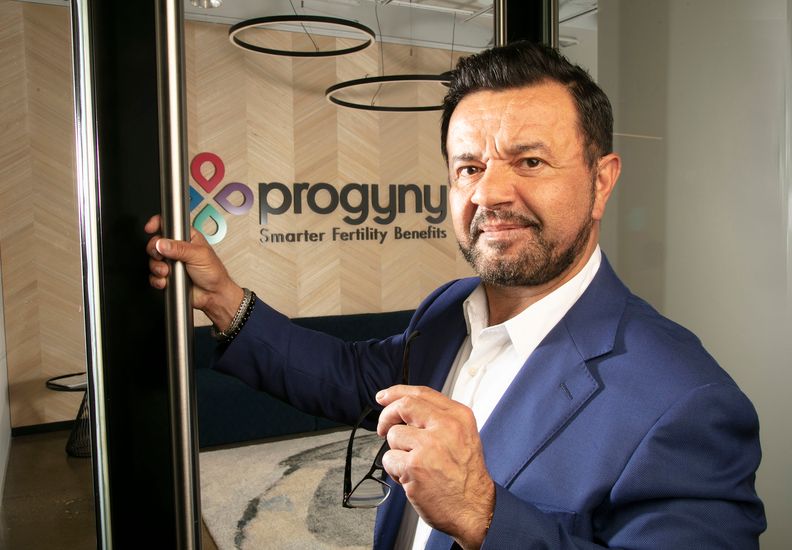
Return to the Manhattan office. Progyny committed to 70,573 square feet across three floors at 1359 Broadway in a lease announced in March 2022. In his subsequent office interview, Anevski discussed the location in terms of access and everyday usefulness.
“All those things are important to employees”
Pete Anevski, discussing the office neighborhood, 2023
He also described an open layout and a working environment intended to feel collaborative and informal. These were his stated aims for the space. They offer something more tangible than a promise about culture: an arrangement of rooms, a location, and a view of how colleagues should encounter one another.
A nearby park will never make a difficult business decision disappear. Nor can an open floor plan guarantee a useful conversation. But these choices do establish conditions in which people work. An executive who talks about them is revealing which details have made it onto his list.
The office conversation sits neatly beside the earlier career. Finance asks what resources are available. Operations asks how to use them. A workplace puts both questions into physical form. Someone has to sign the lease; someone else has to spend Tuesday there. Good judgment needs room for both perspectives.
The purpose has to travel
Anevski’s public account of leadership also gives purpose an operating role. In a post about a conversation with IVY’s Beri Meric, he connected a mission people understand with attracting colleagues, maintaining alignment and staying focused as an organization grows.
That is a demanding ambition. A small team can share an understanding through proximity. A larger one needs the purpose to survive new reporting lines, new colleagues and decisions made far from the chief executive. The challenge is to keep a clear reason for the work available to people doing very different jobs.
His LinkedIn presence includes interviews spotlighting Progyny employees, with questions about their careers and milestones. The format gives colleagues some of the attention usually reserved for the person at the top. It is a small editorial choice, but an observable one: other people’s working lives get space in the CEO’s public feed.
By August 2026, he was reporting another quarter’s results as chief executive. The company recorded $350.5 million in revenue and $28.1 million in net income for the three months ended June 30. Those are company results, produced by an organization. They also form part of the continuing test of the leadership team he heads.
For someone who has held both the finance and operations jobs, the distinctions inside those results deserve attention. Revenue, profit and cash tell related stories, but they answer different questions. A larger sales figure alone cannot explain how a business is being run. The useful reading requires looking at the measures together, with the same care an accounting career would demand.
At the end of June 2026, Progyny reported no debt and $236.9 million in cash, cash equivalents and marketable securities. Its quarterly operating cash flow was $50.4 million. Those figures describe the business at a particular date, rather than a permanent condition. Running a public company means returning to the account each quarter, with fresh numbers and fresh obligations to explain them.
That recurring examination gives Anevski’s story a different rhythm from the familiar tale of a single decisive breakthrough. His appointment matters, and so does the recognition that followed. But the company continues to have clients to retain, colleagues to coordinate and resources to allocate. A title can be announced once. The work attached to it keeps turning up.
The work keeps returning to ordinary verbs: hire, organize, explain, decide. Anevski’s career gives those verbs a long chronology. From accounting to finance, from operations to the chief executive’s office, the job has widened around him. And when asked about the office itself, he still found room in the answer for lunch.