Four sales meetings in two months. That was the itinerary Keith Pfeil described in a public post after becoming chief executive of Globus Medical. He had been in rooms with teams from Globus and Nevro, talking with the people responsible for winning business. The accompanying photographs showed suits, stages, colleagues and the particular blue glow that seems compulsory at a corporate gathering. The accountant had quite a travel schedule.
“I’m more energized now than ever,” he wrote. It is a small detail, but a useful place to begin. Pfeil’s career is usually compressed into three sets of initials: CFO, COO, CEO. The meetings put some people back into that progression. By then, his remit had grown from explaining the business through its financial results to taking responsibility for the whole organization.
A career with Paper Magic in the middle
The earlier chapters belonged to another industry. Pfeil joined CSS Industries in 2003 as a manager of financial analysis at its Paper Magic subsidiary. CSS was a publicly traded consumer-products company. Long before the Globus appointment, he was building a career inside an organization whose name had little in common with the technology company he would eventually lead.
His professional background also included the assurance practices of Arthur Andersen and KPMG, and transaction advisory work at Ernst & Young. Those are different assignments: examining financial information, then working around transactions. Their presence in his biography establishes the financial foundation of his career. There was considerable work with other people’s numbers before he became the executive expected to answer for his own company’s.
Within CSS, the titles accumulated gradually. He held positions in internal audit and financial analysis, became vice president of financial planning and analysis at Paper Magic in 2013, and later took on that function at the parent company. In 2017, his responsibilities expanded to senior vice president of financial planning and analysis and investor relations. On August 31, 2018, he became chief financial officer.
Put those dates beside one another and the pace becomes clearer. Fifteen years separated the first CSS role from the CFO appointment. A career biography can make that interval look like a tidy staircase. The calendar is less obliging. It contains years spent in jobs with titles too long for a business card and responsibilities too specific to make a splashy introduction.
Pfeil’s education followed the same professional territory: a bachelor’s degree in accounting from Elizabethtown College and an executive MBA from Saint Joseph’s University. The accounting degree came in 2000, the MBA in 2006. Those credentials sit naturally beside the work in audit, planning and finance. By the time he joined Globus, he had spent well over a decade taking on broader responsibilities at CSS.
A new company, a familiar starting point
Globus announced his appointment in June 2019, with an August 19 start date. He would become senior vice president and CFO. Dave Demski was then president and chief executive. Pfeil arrived with experience running finance at a listed company, although the business itself represented a change of industry. The new appointment put him in Audubon, Pennsylvania, in the Philadelphia area where his professional profile is based.
There is an appealingly unglamorous continuity here. The company changed; the financial job remained recognizable. Planning, reporting, evaluating performance and speaking to investors were all part of the territory he had already covered. Moving industries can make a career sound like a sudden reinvention. In Pfeil’s case, the bridge was a set of practical responsibilities that travel reasonably well between organizations.
He joined a company founded by David C. Paul in 2003. Paul remained its executive chairman, and would later be central to the announcement of Pfeil’s promotion to CEO. Pfeil therefore entered an established business with its founder still involved. His eventual rise would take place within that continuing leadership structure, alongside executives he had already worked with for years.
- 2003Financial analysis
CSS / Paper Magic - 2018CFO
CSS Industries - 2019CFO
Globus Medical - 2024COO + CFO
Globus Medical - 2025President + CEO
Globus Medical
The deal after the deal
The next consequential date was September 1, 2023, when Globus completed its merger with NuVasive. The combination expanded the organization’s commercial reach, portfolio and operating capabilities. Pfeil helped lead the acquisition and served on the executive steering committee overseeing the integration. That placed him in the work of making two businesses operate together, as well as in the transaction that brought them together.
An acquisition has a pleasingly definite closing date. Integration has a much less cooperative diary. Commercial teams, operating processes and corporate systems must function inside the same organization. A transaction can be described in a paragraph; the follow-through requires people to keep making decisions after the announcement has disappeared from the news cycle. Pfeil’s committee role put that continuing work inside his brief.
In February 2024, Globus added chief operating officer to his CFO title. The appointment took effect on February 1 and was announced four days later. He would oversee daily operations while retaining responsibility for finance. Dan Scavilla, then CEO, explicitly connected the expanded role with operational efficiency, profitable growth and the continuing NuVasive integration. The promotion arrived with a substantial list of things to do.
That combined title matters to the story. Finance and operations were now attached to the same executive. Business plans, day-to-day activities and financial performance sat within a single remit. His later biography lists information technology, quality, pricing and contracts, internal audit, tax, investor relations, strategy and business development among the functions he led. The job description had become an organizational map.
A long list of functions can sound abstract until one considers how often their decisions overlap. Pricing affects revenue. Contracts affect what a company has promised. Systems affect how information moves. Planning depends on information arriving in a useful form. For an executive holding both jobs, the practical challenge is keeping those relationships visible while the business continues to operate. Pfeil’s remit put him at those intersections.
Friday’s appointment, Monday’s announcement
On Friday, July 18, 2025, the board appointed Pfeil president and chief executive. Globus announced the transition on Monday, July 21. Scavilla had resigned to pursue another opportunity. The company’s subsequent announcement thanked him for his service and presented Pfeil as an internal successor who had already spent six years with the organization. The title changed faster than the relationships did.
Pfeil acknowledged those relationships immediately. He thanked Paul and the board, and singled out Scavilla for “his mentorship and partnership.” It was a public expression of continuity at a moment when continuity mattered. The incoming CEO had worked within the existing team, helped handle a major combination and already carried responsibility for daily operations. He was taking over a business in which he had already held two senior roles.
“a valued and trusted partner of mine”
Keith Pfeil on incoming CFO Kyle Kline · July 2025
The finance handover followed the same pattern. Kyle Kline, previously senior vice president of finance, became CFO. He had joined Globus as assistant controller in 2017 after nearly ten years at Deloitte. Pfeil described him as “a valued and trusted partner of mine.” Two people were moving into new positions after working closely together, carrying an existing professional relationship into a different division of responsibilities.
Pfeil also joined the board and serves on its nominating and corporate governance committee. That added another dimension to the appointment: responsibility for the company’s direction and oversight as well as its management. By July 2025, his progression had taken him from a specialist financial role to operations, then to the executive position and board table. Each stage widened the field of decisions attached to his name.
The numbers need their footnotes
Globus had completed another acquisition, Nevro, on April 3, 2025, while Pfeil was still COO and CFO. The timing is important when reading the results that followed. His CEO appointment came in the middle of a year during which the composition of the company had changed. Comparing one year with another requires keeping track of which businesses were included and for how long.
For 2025, Globus reported worldwide net sales of $2.9389 billion, up 16.7%. Excluding Nevro, its base business reported sales of $2.6453 billion, up 5.0%. Both figures describe the same year, from different angles. The distinction gives the growth story some necessary texture. The larger percentage includes the acquired business; the smaller percentage describes the base business on the company’s stated basis.
Globus Medical worldwide net sales · full year
Nor does the annual figure belong wholly to Pfeil’s tenure as chief executive. He took the job in July. The results span periods under two CEOs and work performed by teams across the organization. A profile can record what happened during a leadership transition without awarding one person the entire income statement. Pfeil’s own background makes the difference between those claims especially relevant.
In August 2026, Globus reported second-quarter sales of $789.6 million, up 5.9% from a year earlier. It maintained full-year revenue guidance of $3.18 billion to $3.22 billion. Those are different kinds of numbers: the quarter was completed business; the annual range was management’s expectation. Keeping the labels attached is part of understanding what an executive has delivered and what remains ahead.
The room beyond the spreadsheet
Return to the sales meetings. Pfeil’s public post described conversations with Globus and Nevro teams and thanked the people he had met on the road. The photographs mixed formal presentations with group pictures and smaller discussions. For a career told so often through appointments and filings, it is a more ordinary view of the work: gathering people, hearing from colleagues and explaining where the business is going.
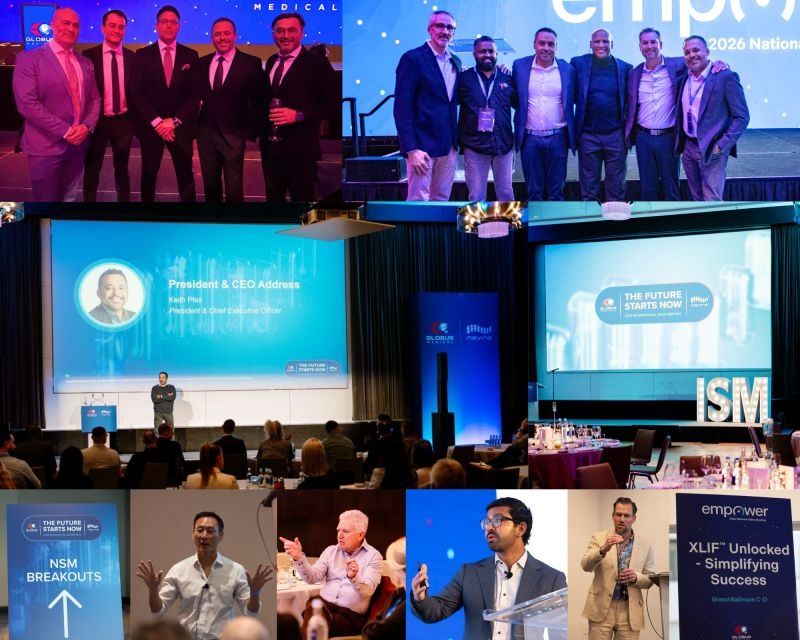
His stated priorities for 2026 included expanding the sales force, introducing new products and building growth with operating leverage. Those ambitions connect commercial activity with financial discipline. More selling capacity and more offerings bring their own demands on an organization. The task ahead requires the different functions he once supervised to move together, with the CEO now responsible for how the whole arrangement performs.
The span of Pfeil’s career is striking for its duration as much as its promotions. Paper Magic in 2003. CFO at CSS in 2018. CFO at Globus in 2019. COO in 2024. CEO in 2025. The final appointment was a single date. The preparation occupied decades. Now the numbers person has a whole company to account for, and, judging by that itinerary, rather more meetings to attend.
Follow the next chapter
Continue with Pfeil’s professional profile, company updates and the announcements behind the career milestones.