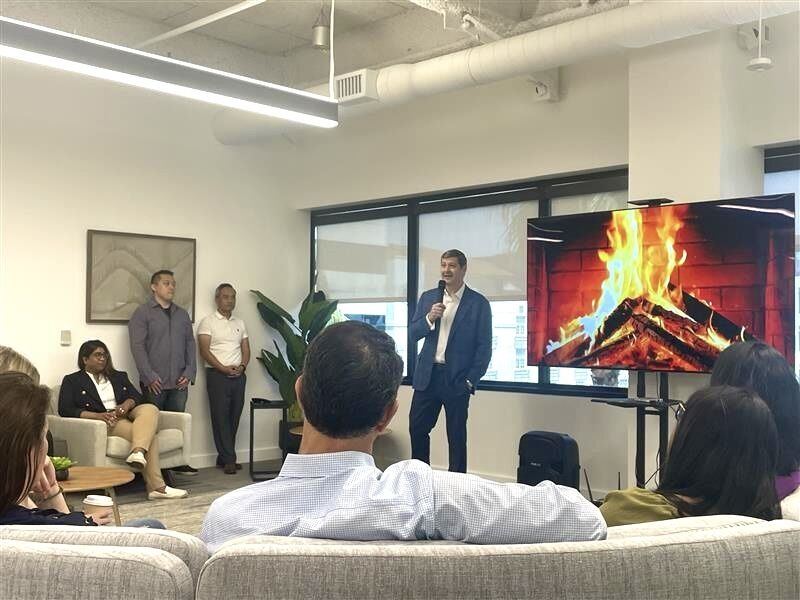
The fire was on a screen. Chuck Divita stood beside it with a microphone, facing colleagues gathered around office sofas. In photographs from his July 2024 visit to the West Coast, the new chief executive of Teladoc Health appeared at a fireside chat equipped with an unusually obedient fireplace. No logs to shift. No smoke. Silicon Valley had dealt with the housekeeping.
Divita enjoyed the joke. In his account of the visit, he said the team had taken the idea of a “fireside chat” to the next level. He had met colleagues from technology, product, marketing, communications and people teams. The photographs showed the less ceremonial business of arriving somewhere new: standing in front of the people who already work there, introducing yourself and listening.
He had become CEO on June 10, 2024. The scene offers a useful starting point for a career more easily described in figures than in flames. Before Teladoc, Divita had overseen a GuideWell commercial business with $23 billion in annual revenue. Before that, he had been a chief financial officer. Earlier still, he had worked in public accounting. His route to the microphone ran through the machinery of organizations.
The accountant leaves the accounting department
Charles Divita III, known professionally as Chuck, studied accounting and finance at Florida State University and became a Certified Public Accountant. He began his career at Arthur Andersen, then held operations and risk management roles at Prudential Financial. The movement between those functions matters. Accounting measures what happened. Operations is where decisions acquire consequences.
By 2000, he was at FPIC Insurance Group. Over the following years, his assignments included finance, strategy and the presidency of Employers Mutual, a subsidiary. He had already been a business chief executive before becoming the parent company's finance chief. The tidy version of a corporate career, with every promotion moving one square upward, needs a few extra arrows here.
Employers Mutual was sold in 2005. That December, FPIC announced that Divita, then senior vice president for operations and strategy, would become CFO on January 1, 2006. His predecessor, Kim Thorpe, would stay through March to help with the handover and year-end reporting. Even a promotion arrives with a closing calendar.
FPIC chief executive John Byers pointed to Divita's knowledge of the organization and his experience in both finance and accounting. The distinction was practical. This was an appointment from inside the business, of someone who had moved between its functions. He knew more than the figures presented at the end of the month; he had held jobs involved in producing them.
- 2000Joins FPIC Insurance Group
- 2006Becomes FPIC's chief financial officer
- 2011Joins Florida Blue as chief accounting officer
- 2014Steps into the CFO role
- 2018Takes charge of GuideWell commercial markets
- 2024Becomes Teladoc CEO and a director
Selected appointments. Each date marks a role change, rather than a measure of company performance.
A larger job than the title suggests
Divita joined Florida Blue in 2011 as chief accounting officer. His responsibilities included accounting, corporate development and procurement. That is a revealing combination: recording spending, considering where a company should expand and overseeing how it buys. The three functions meet whenever an attractive proposal encounters an actual budget.
In September 2013, Florida Blue announced his promotion to senior vice president and CFO, effective the following January. He would report to chairman and CEO Patrick Geraghty. He also joined the executive management team and operating committee immediately. The announcement put him in the decision-making group before the new title formally took effect.
His subsequent finance responsibilities at GuideWell extended across investments, corporate tax, actuarial work and financial reporting. These are different views of the same organization. One asks what the company owns. Another asks what it owes. Another asks what assumptions have been made about tomorrow. A finance leader has to keep the answers in conversation.
By 2018, Divita was moving into leadership of commercial markets. His remit eventually encompassed individual consumers, employer groups and large national accounts, together with sales, operations, analytics, product and marketing. The financial perspective remained useful, but the assignment now reached further into the decisions that determine whether a business wins and keeps customers.
That number describes the scale of his responsibility. It is not a measure of his personal wealth, nor a claim that he created every dollar. Its interest lies in the breadth behind it. A business of that size contains customers with different expectations, teams with different incentives and decisions that cannot all be escalated to one desk.
For Divita, the progression from accounting to finance to commercial leadership meant successive changes in what he was accountable for. A correct report is an achievement with a defined deadline. Running a commercial operation adds a more unruly requirement: the next set of results must be earned while the current ones are being explained.
Two seats, one arrival
On June 10, 2024, Teladoc appointed Divita chief executive and added him to its board. The appointments were concurrent. He would lead daily management and participate in the board's consideration of the company's direction. He joined an existing business, with existing colleagues, customer relationships and obligations.
David Snow, then board chairman, highlighted Divita's combination of large-company leadership and public-company experience. Both elements had precedents in his career. FPIC had given him a public-company finance role; GuideWell had given him a broad commercial assignment. Teladoc brought those strands together in the chief executive's office.
At his appointment, Divita emphasized working with his new colleagues, advancing priorities and positioning the company for sustainable success. The language was conventional. The assignment behind it was concrete. He was taking responsibility for a business whose next phase would be judged through decisions about spending, organization, products and execution.
By the end of 2024, he described steps to simplify the organization, concentrate on priorities and improve its cost structure. He had also spent time with customers and other stakeholders. Those activities belong together. A leader deciding where to concentrate resources needs to understand which parts of the business other people value enough to keep buying.

The verb for 2026
In January 2026, Divita described the year ahead in terms of execution. “It's really about execution now,” he said. After setting strategy and priorities, he was placing the emphasis on carrying them out. There is something bracing about the word. Execution is where an elegant presentation encounters a diary full of meetings.
He also described acquisitions as a way to advance strategy, alongside investment inside the company. That framing gives a transaction a job to do. Buying a business can add capabilities, people or a presence in a market. The announcement itself does not complete the work. The buyer still has to integrate what it has purchased.
His distinction between strategic priorities and their delivery is useful when reading his career. At FPIC, he held an operations and strategy title before becoming CFO. At Florida Blue, corporate development sat alongside accounting. His assignments repeatedly placed plans close to the people and systems responsible for making them workable.
None of that makes a future result inevitable. Experience supplies comparisons and questions; it does not remove uncertainty. What Divita had by 2026 was a long record of moving among the functions that must agree for a plan to proceed. The question facing him at Teladoc was how effectively that experience would translate into coordinated action.
“It's really about execution now.”
Chuck Divita, January 2026
The colleagues around the chief executive
Divita's own job briefly included another familiar responsibility. Teladoc's 2026 proxy listed him as interim principal financial officer as well as CEO. On August 31, Michael Grasher became CFO, ending that interim arrangement while Divita continued as chief executive. The former finance chief had been covering the finance function again.
Grasher brought experience at IFG Companies, Fortegra and AMERISAFE, as well as equity research. Divita's welcome emphasized financial stewardship, operating discipline and public-company experience. The selection added a permanent finance leader with a background in insurance and financial services, fields familiar from Divita's own earlier career.
A separate succession followed in September. Teladoc announced that chief legal officer Adam Vandervoort would leave effective November 1, with Jonathan Dorfman due to succeed him on November 2. Divita praised Dorfman's judgment and knowledge of the business, and credited Vandervoort with building the team from which his successor emerged.
The two appointments illustrate ordinary but consequential CEO work: deciding who should hold responsibility, handling a departure and preserving knowledge through a transition. Strategies are often discussed as though organizations carry them out automatically. In practice, someone must assign the work, understand the handover and know which decisions belong to whom.
Back to the room
Alongside executive work, Divita has served on the boards of Availity, Prime Therapeutics and Vim. His community commitments have included a board role with Teach for America. These positions widen the record beyond his own reporting line. Board service also puts an executive on the questioning side of the table, reviewing choices that somebody else must implement.
The West Coast photographs bring that abstract career back to human scale. There are chairs, sofas, a microphone and a group assembled in an office. Divita's accompanying message thanked colleagues for meeting him and named the range of teams he had visited. A new chief executive had gone to see some of the organization he was now responsible for leading.
His public career can be followed through a series of widening assignments: accounts, operations, finance, commercial markets, a company. Each change increased the number of people whose work he needed to understand. The screen beside him supplied the fire. The colleagues in front of him would have to supply the answers.