A medical device can have an excellent sales history and a mysterious working life. The account is won, the unit is deployed, and the CRM records the triumphant moment. Then a physician stops using it. An authorization expires. A referral waits in somebody's inbox. The sales chart looks fine because the trouble has slipped off the chart altogether.
This is the gap servis.ai has chosen to occupy. The California software company started as FreeAgent CRM, a tool for managing customer work. It now describes itself as a business operations platform. The change sounds like software vocabulary until one asks a plain question: after the customer says yes, who sees what happens next?
- Servis.ai connects CRM records to the work that follows: referrals, scheduling, visits, cases, staffing, and inventory.
- Healthcare and medical-device teams are its sharpest current focus, though the platform also serves other complex operations.
- Its 2024 rebrand followed a $12.6 million Series A in 2021 and added a stronger emphasis on AI and voice controls.
The part of the story after “closed won”
FreeAgent's original case was familiar: put sales, service, projects, and customer activity in one cloud system. In April 2021, it announced a $12.6 million Series A led by Pelion Venture Partners, with Altara Ventures and BlueRun Ventures joining. The company said subscription revenue had grown 2.5 times through the pandemic and that it had completed six quarters of sequential growth. Its ambition then was to give companies an alternative to the established CRM giants.
By November 2024, the company had renamed itself servis.ai. Its own explanation was an evolution from CRM toward a system of record with AI-powered operations. The old product did not vanish: the transition page says existing customer data and features remained. What changed was the question the product promised to answer. A CRM can remember a contact. Servis.ai wants to coordinate the consequences of that contact.
“I didn’t plan to build software for healthcare organizations. I fell into it.”Dave Stephens, CEO, reflecting on the company's healthcare work
That remark from CEO and co-founder Dave Stephens gives the pivot a human scale. He wrote that seeing the software used in behavioral health changed how he thought about execution: delayed intake and stalled referrals mean people can fall through gaps nobody meant to create. The company has not published a neat origin myth in which one incident explains everything. Its public material does show a move toward the operational work surrounding care.
A patient is a sequence, not a row
On the provider side, servis.ai lays out a chain: referral received, intake and eligibility checked, clinician assigned, care coordinated, and follow-up completed. On the wound-care side, it adds credentials, field visits, supplies, and billing handoffs. In medtech, the chain runs from account relationships to procedures, device use, and patient follow-up. These are different businesses, but their common problem is the same: each department holds a fragment of the answer.
The useful unit of software here is not a pretty dashboard. It is an accountable next step. A coordinator should be able to see that a referral has no owner. A manager should see a clinician's credential before assigning a visit. A device company should know whether a deployed product is being used, rather than treating shipment as proof of success. Servis.ai sells configurable apps and workflows to put those actions beside the records that explain them.
The voice in the room
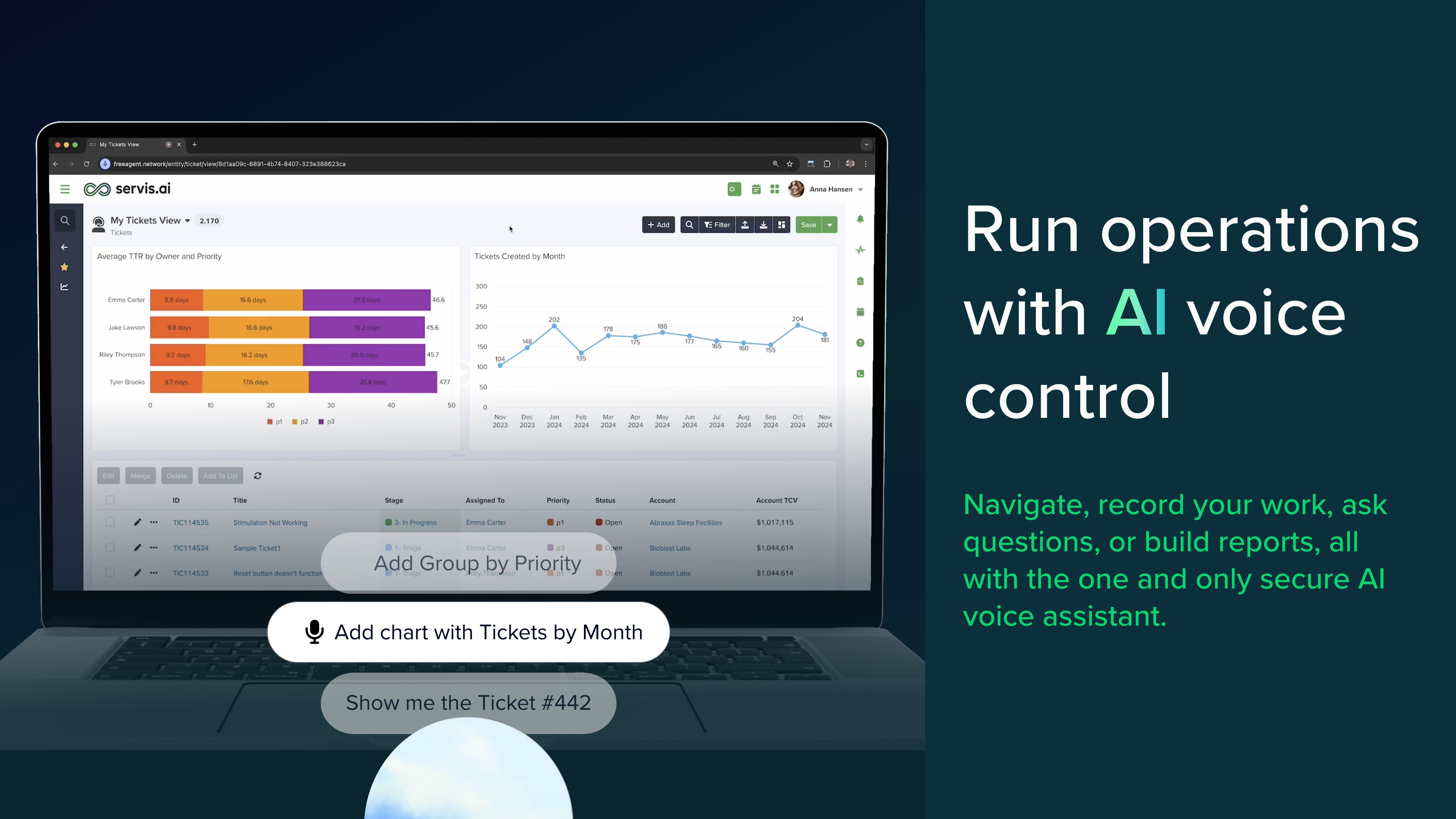
Servis.ai also offers an AI Analyst for plain-language questions and trend alerts, plus a voice interface demonstrated on support tickets in December 2024. In its product pages, the Analyst is meant to flag referral slowdowns, scheduling gaps, account utilization changes, and expiring authorizations. The voice feature is pitched for navigation, record changes, and report building on web and mobile. These are vendor-described capabilities, and their value depends on the underlying records being complete.
The distinction matters. Asking an AI why admissions slowed is only helpful if the referral queue, intake status, and schedule are connected. Otherwise the machine can speak beautifully about incomplete evidence. Servis.ai's more durable idea is the plumbing beneath the question: one operating record for work that used to be divided among spreadsheets, inboxes, an EHR, and a conventional CRM.
The subscription figure is a public Capterra listing for the Professional plan; larger tiers and implementation needs vary.
What the buyer actually buys
This is subscription software sold to organizations, with public pricing listed from $75 per user per month for Professional and $150 for Mid-Market; a broader Unlimited tier requires a quote. Capterra's listing places HIPAA-related features and a business associate agreement in the Mid-Market tier. The company's own site asks prospective customers to book a demo, which is sensible for a platform whose value depends on configuration and integration.
Its likely rivals are whichever systems an organization already uses to hold the pieces: Salesforce or Creatio for customer workflows, an EHR for clinical records, a scheduling tool, a field-service product, and the spreadsheet that nobody put in the architecture diagram. Servis.ai's pitch is to reduce the seams. It says it can connect to existing EHR systems, and its documentation describes both prebuilt integrations and custom connections. That means a prospective buyer should count the handoffs it can truly retire, not the number of modules printed on a sales page.
The company names healthcare providers, in-home health teams, behavioral health organizations, wound-care programs, and medical-device makers as target customers. Its site also markets applications for financial services, manufacturing, distribution, and media. This breadth is a strength only when the underlying workflow is specific enough. A wound-care program needs product traceability and clinician credentials; a medtech seller needs utilization after deployment. Those jobs should not be flattened into the same generic pipeline.
The ledger of things that almost happened
What failed first in the company's story was not a public product collapse. It was the limit of the CRM frame. A system built to remember customer interactions can leave the operational aftermath to other tools. The rebrand made that limitation explicit and gave the company a larger job. The public record does not establish how many customers have adopted the newer healthcare workflows, or whether the advertised efficiency figures generalize across deployments. It does establish what the company is building and the problems it wants buyers to recognize.
There is a practical lesson in that shift. Map one process from first request to final outcome. Name the person responsible at each handoff. Count how often the answer lives in another system. Then decide whether automation, a shared record, or simply a better assignment rule fixes the delay. Servis.ai offers one commercial answer to that exercise. The exercise itself is available to anyone with a whiteboard and the patience to follow a referral all the way home.
Go further
- Visit servis.ai and its clinical operations guide.
- Read the FreeAgent transition page and 2021 funding announcement.
- See the voice demo, product walkthrough videos, and company updates on LinkedIn.