The six weeks were not a medical decision. Diego Baugh had been told to see a specialist after a college hospitalization for stomach trouble. No one called. He went back to the hospital, was referred again, and waited another six weeks. A patient can be handed a plan for care and still have no appointment, no explanation, and no idea who owns the next step. Baugh later co-founded Tennr with Trey Holterman and Tyler Johnson to work on precisely that interval.
It is an odd place to find a software company’s central drama: somewhere between a doctor’s office and a fax machine. Yet the referral is a chain of small obligations. A receiving practice must read the order, identify the patient, find missing records, check coverage, meet the insurer’s rules, contact the patient, and get the service scheduled. When each obligation belongs to a different inbox, the chain becomes a waiting room with no chairs.
The short version
- Tennr sells software to U.S. healthcare providers that handle heavy referral and intake volume.
- Its platform reads clinical documents, checks payer requirements, routes work, and follows up with patients and providers.
- The company’s best evidence is operational: customer-reported backlog, processing-time, and first-contact changes.
- The useful buying test is a real batch of your own messy documents, plus a baseline for time, accuracy, and completed care.
A fax is easy to send. The bill comes due on arrival.
Tennr’s founders met at Stanford, where they worked on advanced AI research. The product they built is less interested in making the fax disappear than in doing the work the fax leaves behind. Incoming pages can be classified and split; names, service codes, and clinical details can be extracted; missing evidence can be flagged; coverage and medical-policy requirements can be checked before an order moves further. Staff get a next action instead of another PDF to inspect.
That distinction matters because a tidy digital document is not the same thing as a completed referral. A scanned order might be perfectly searchable and still lack the chart note an insurer requires. Tennr calls its specialized document model RaeLM, but the surrounding system is the real proposition: document reading joined to eligibility, benefits, qualification, authorization, outreach, and status tracking. The model is an instrument; the outcome is a patient who moves.

The buyers are referral-heavy organizations: infusion providers, home medical equipment suppliers, orthopedics groups, sleep services, homecare operators, and behavioral-health practices. They sell care, equipment, or treatment; paperwork is the toll they pay to deliver it. Tennr’s sales process is enterprise software by demonstration and contract. Public list pricing is absent, so a buyer should judge cost against its own volume, rework, staffing, and lost or delayed orders. The company said in 2025 that it worked with hundreds of healthcare organizations and processed roughly 10 million documents a month.
One referral, four gates
The first machine failed the handwriting test
Noctrix Health offers the sort of case study that software companies usually edit out. As referrals for its restless-legs therapy grew, thousands of unstructured faxes landed in a manual process. The company tried an OCR vendor. After months, it still could not reliably handle the handwritten, irregular documents that dominated the queue. Noctrix built its own tool to tag and route incoming faxes. That helped, until volume and the work beyond routing outran it too.
In July 2025, Noctrix evaluated seven outside partners. It did not ask Tennr to perform a polished sample exercise; it handed over actual documents from its CRM. Tennr could split packets containing several orders and route pages to the right records, then configure around the internal process Noctrix already understood. That practical test changed the buying decision. Six weeks after launch, Noctrix reported an 800-plus appeal backlog cleared, document processing reduced from 36 hours to three, and order creation up 122 percent. Those figures come from Noctrix’s account on Tennr’s site, and describe that deployment rather than a universal result.
“We tasked the other vendors with very similar asks, and Tennr definitely came above the rest.”Raja Tamilarasan · Noctrix Health
There is a lesson here worth stealing even if you never buy Tennr. Start with the papers that defeat your current system. Count how long they take, how often a patient is misidentified, and what happens after a document is read. A successful demo of clean typed forms tells you very little about a clinic’s worst Tuesday. Noctrix’s homegrown tool was useful too: it gave the vendor a map of the work, even though it did not scale far enough on its own.
The answer was not merely faster typing
At TwelveStone Health Partners, a specialty infusion provider, the bottleneck stretched across teams. First patient contact ran about ten days behind. A referral took roughly 16 days to reach prior-authorization submission; medical-policy review alone could take eight. Tennr and TwelveStone introduced the platform in stages, checking each stage before expanding. The later deployment included automatic calls and an authorization manager. TwelveStone reports same-day first contact, a roughly 70 percent cut in time from referral to authorization submission, and medical-policy review under a day.
The telling detail is what changed minds. TwelveStone initially doubted that it wanted AI calling patients. After using the tool for welcome calls, missing information, and insurance checks, its project manager joked that the team wanted more calls automated. The joke hides a serious condition: the call must gather correct information and hand off delicate decisions to people. A voice bot that produces a transcript but leaves staff to discover the missing allergy or coverage detail has moved the queue, not the patient.
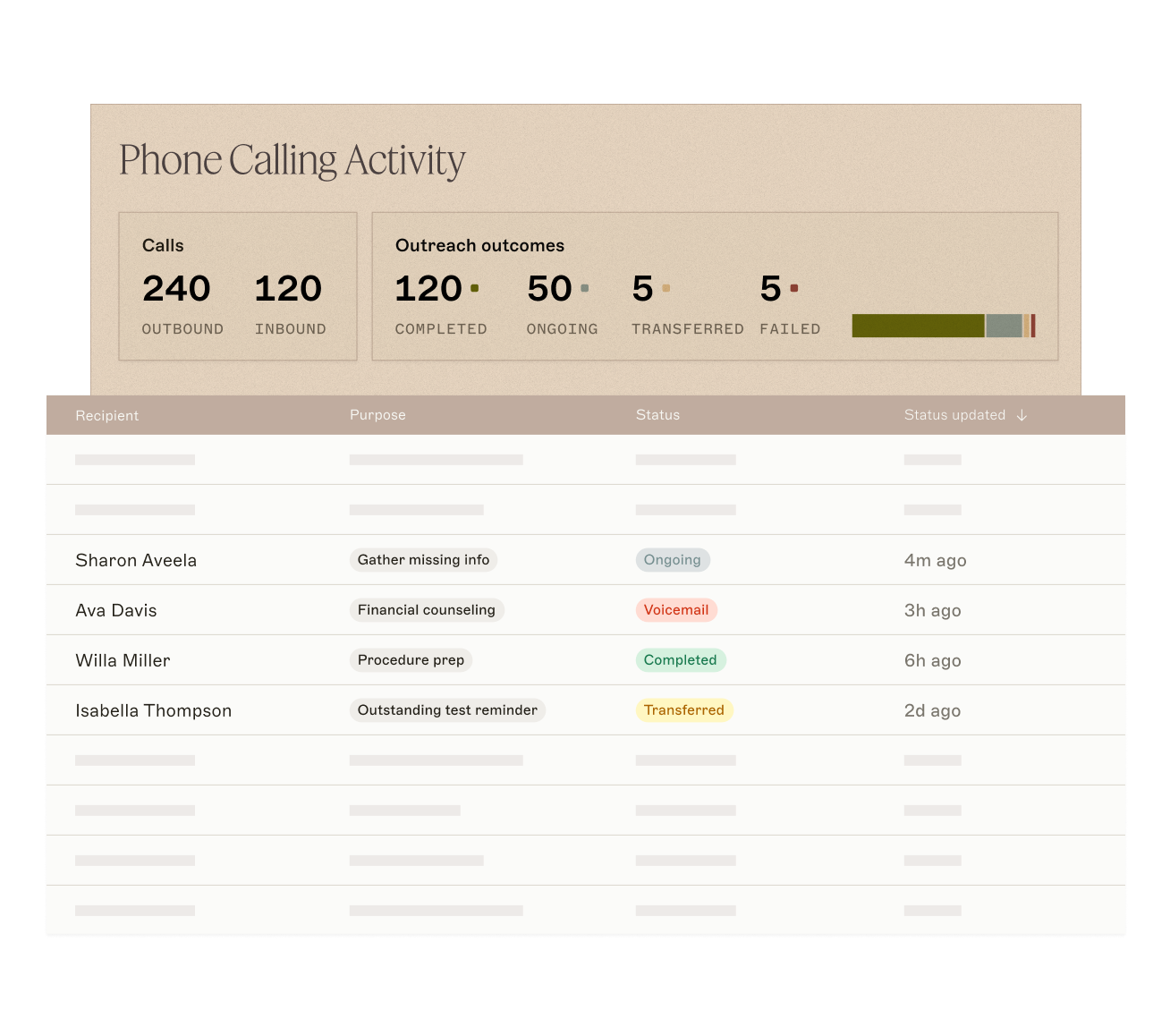
Tennr has expanded from reading inbound documents to quality-controlled Autopilot, insurance-benefits work, qualification reviews, communications, and a Network that gives referring and receiving teams more visibility into a patient’s status. WeInfuse integrated Tennr’s extraction into its infusion software in 2024; KabaFusion announced a home-infusion partnership in 2025. These moves put Tennr in a crowded market of EHR workflows, generic OCR vendors, and internal tools. Its difference is a narrow obsession with the entire pre-visit handoff, including the awkward payer-specific decisions that a generic document reader does not finish.
The common pilot
Try a handful of neat documents. Measure extraction speed. Declare the paperwork solved.
The useful pilot
Bring actual packets, missing notes, handwriting, duplicate patients, and insurer rules. Measure time to the next correct action.
A company measured in hours
Tennr raised $18 million in a 2024 Series A, $37 million in a Series B later that year, and $101 million in a 2025 Series C that valued it at a reported $605 million. Capital explains how the company can build a specialized model and a large implementation team; it does not prove that every practice should automate every step. In its own careers materials, Tennr emphasizes direct disagreement, clarity, and solving the customer’s problem. For this market, that is more than a recruiting slogan. Payer rules change, referral patterns differ, and the consequential mistakes tend to appear at the seams between teams.
The reported gains depend on conditions that buyers can inspect. High referral volume makes fixed implementation work easier to justify. Messy but recurring document types give a model something to learn and a workflow something to standardize. Staff must be willing to redesign queues, set review thresholds, and measure errors alongside speed. Low-volume practices, unusually unstable processes, or organizations without a clear owner for the handoff may see less benefit. A system that accelerates an incorrect order is simply an expensive way to make a denial arrive early.
The better question is almost comically plain: after the referral was sent, when did the patient hear from someone, and did the care actually happen? Baugh’s two six-week waits are memorable because they expose a peculiar accounting trick in healthcare. The sender can count a referral as done. The receiver can count it as received. The patient, meanwhile, is still waiting. Tennr’s wager is that the space between those three ledgers can be made visible, assigned, and shortened.