At school, Brian Evanko’s friends brought equations to the lunch table. They supplied the challenge; he supplied the answer, calculated in his head. It is a tidy origin story for a future finance executive. The more interesting question is what happens after being good at numbers stops being enough.
Evanko became president and chief executive officer of The Cigna Group on July 1, 2026. He had joined the company in 1998. Between those dates, he moved through actuarial work, international finance, business leadership and the group’s chief financial officer role. His résumé offers an unusual kind of continuity: the company stays familiar while the job keeps changing.
A long tenure is easy to mistake for a stationary life. His included Singapore and Hong Kong, different operating responsibilities and, eventually, responsibility for the entire organization. The business card changed more slowly than the view from the office. For someone trained to assess uncertainty, he has spent a fair amount of his career agreeing to encounter more of it.
A career with an itinerary
He studied actuarial science at Pennsylvania State University, graduating in 1998. The discipline gave him a professional starting point, and he accumulated the FSA, MAAA and CFA designations. Those letters represent a substantial technical foundation. They also make a formidable little procession after a name; Evanko had equipped himself to ask detailed questions about a business before he was asked to run one.
His first route into Cigna was its Actuarial Executive Development Program. The program’s premise was movement: assignments changed every 18 to 24 months. For a new employee, that arrangement makes expertise provisional. Just as one corner of an organization begins to feel comprehensible, another assignment arrives with different questions.
The geography widened too. His work took him from Connecticut to Philadelphia and overseas, including senior actuarial and financial assignments in Singapore and Hong Kong. He later returned to Connecticut. Remaining with the same employer had still required him to become the newcomer in another place.
The distinction matters when considering his eventual appointment. Years of service tell us how long someone has been present. Different assignments tell us something about what they have had to learn. Evanko’s preparation combined both. The company could draw on a familiar executive whose experience had been gathered from several vantage points.
He has remained publicly connected to Penn State as well. A Connecticut Valley alumni chapter newsletter listed him as its planned spring dinner speaker in 2020, identifying him as a member of the class of 1998. By then, the graduate who had arrived with a specialist degree was leading a business. The connection provides a small marker of distance traveled: the university affiliation stayed constant while the introduction before his name grew longer.
- 1998Actuarial development program
- 2021Group chief financial officer
- 2024Adds business CEO responsibilities
- 2025Group president & COO
- 2026Group president & CEO
Selected appointments, rather than a complete list of assignments.
The numbers acquire colleagues
His business leadership responsibilities expanded in 2013 and again in 2017. In January 2021, he became group chief financial officer. That title put him over financial operations, investment management and underwriting. It also placed his technical training within a larger set of decisions about where the company would put its money and attention.
Finance has a reputation for arriving with a red pencil. Evanko has described its people as “co-pilots for growth.” The phrase gives them a seat beside the person making the journey. Their job includes understanding what a business wants to do, weighing the exposure and helping it choose a workable route.
By January 2024, his remit included another substantial job: president and CEO of Cigna Healthcare, alongside the group CFO position. The arrangement put financial oversight and operating responsibility on the same desk. A decision’s cost and its practical consequences were now part of the same executive’s daily brief.
There is an appealing efficiency to that combination, though two titles do not make a working day twice as long. The arrangement also makes delegation essential. The executive who once earned trust by answering the question has to create conditions in which other people can answer it. Technical competence remains useful; carrying every decision personally becomes an increasingly awkward plan.
Evanko’s stated approach places more responsibility with the leaders around him. That is a recognizable transition in a career built on specialist knowledge. As the remit grows, being the person who can calculate quickly gives way to being the person who can organize judgment across a team.
The handover had a timetable
On March 13, 2025, Cigna announced that Evanko would become group president and chief operating officer, effective March 31. All business lines would come under his oversight. Ann Dennison would take the CFO role. The organizational chart made the change plain: his focus was moving from a combination of finance and business leadership to the operating whole.
The next announcement arrived on March 3, 2026. Evanko would succeed David M. Cordani as CEO on July 1. He would also join the board, with that appointment effective April 1. Cordani, after nearly 17 years as chief executive, would become executive chair. The transition was divided into dates and responsibilities, giving the handover a visible sequence.
Evanko publicly thanked Cordani for his mentorship and the directors for their trust. Those acknowledgments point to the relationships behind a succession. A board chooses an individual, but the individual arrives with a history of colleagues, assignments and accumulated expectations. In this case, much of that history had been built inside the organization he was now to lead.
Cordani described his future contribution as support: coaching, acting as a sounding board and helping solve particular problems. That arrangement puts a premium on judgment on both sides. The successor needs room to lead. The predecessor brings experience that can still be useful. The quality of the relationship matters beyond the announcement photograph.
“confident humility”
Brian Evanko’s term for learning while continuing to make decisions
Deciding without pretending
Before the CEO appointment was announced, Evanko had already offered a revealing description of leadership. In a January 2026 conversation with Celia Huber, he emphasized continuous learning and the ability to act while recognizing the limits of one’s knowledge. His compact name for the combination appears above.
It is a demanding pairing. Humility is comfortable when no decision is due. Confidence is easy when nobody is allowed to ask another question. Putting the two together requires an executive to remain open to information without turning every choice into an indefinite seminar. The meeting must eventually end; the learning need not.
In a separate conversation with Lance Glinn that month, Evanko connected leadership with calculated risks. His own examples included accepting roles whose outcome he could not know in advance. He also stressed the importance of explaining a direction clearly and being candid with colleagues about uncertainty.
That is a useful window into his career. An overseas move or a broader operating assignment can be sensible without being predictable. The calculation involves enough confidence to proceed and enough curiosity to adjust. His technical background gives the story an extra turn: training in risk can be a reason to take a considered chance.
His language also leaves room for colleagues. A team can work with an honest account of what its leader understands and what remains unsettled. Pretending every unknown has already been resolved makes cooperation harder. For an executive with decades inside one company, staying receptive is a practical way to keep familiarity from becoming a closed door.

The next person’s starting line
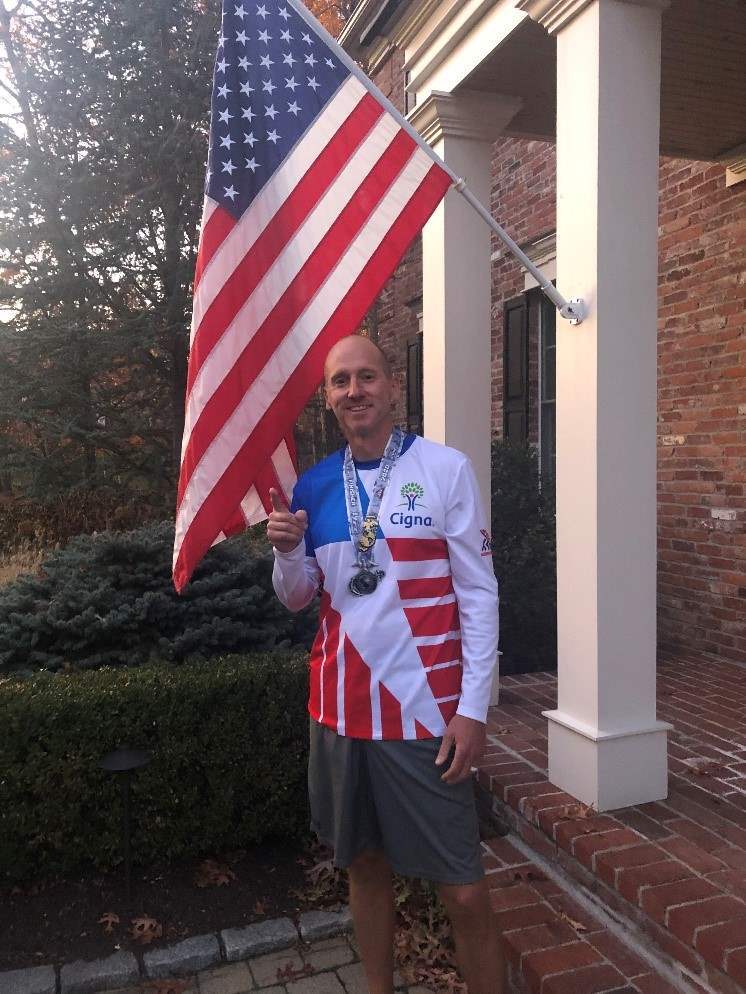
In the marathon photograph, Evanko stands on the left, wearing race number 273. Soto is in the center, carrying an American flag; Amell is on the right. Evanko and Amell served as Soto’s guides at the 2018 event. The scene supplies a welcome change of clothes from the usual executive portrait, and a concrete example of doing something alongside other people.
The photograph captures an activity with an unusually clear shared destination. Everyone is on the same course. Corporate life rarely supplies such convenient signage, which may help explain the appeal of a race-day picture amid the formal biographies. Here the colleagues have numbers pinned to their shirts, and the next task is visible on the road ahead.
His professional life contains another version of that relationship. The development program he entered as a graduate was one he eventually led. In a public post about a finance leadership summit in St. Louis, he described more than 300 professionals gathering for three days of learning and exchange. He singled out the event as a highlight of his year.
That interest has an institutional form beyond Cigna. Evanko joined the TriNet board in July 2024, bringing his financial and operating experience to a company serving small and medium-sized businesses. In Connecticut, he also serves as a vice chair of the Science Center’s board of trustees.
In June 2026, the center named Brian and Erika Evanko honorary chairs of its annual gala, scheduled for October 3 under the title I Want My STEM-TV. Erika’s background includes work as a math teacher and actuary. Their support gives the mathematics thread in his story a local continuation: a place where younger visitors can explore what interests them.
Twenty-eight years after his arrival, Evanko’s newest assignment carries the largest brief of his career. His route to it suggests a particular kind of ambition: keep accepting work that enlarges the field of view. The lunch-table calculator could produce an answer on his own. The chief executive’s work depends on making room for the people who will find the next one.