At a large automotive manufacturer, the hiring process already looked reassuringly thorough: an online assessment, a hands-on simulation, an interview. Then Talogy compared those exercises with what employees actually did at work. Parts of the simulation were too easy or too difficult to reveal useful differences. The interview predicted performance, but lacked a uniform passing standard. A process can look scientific while leaving its most consequential decisions surprisingly loose.
- Talogy sells assessments, software and consulting for hiring and development.
- Its useful discipline: compare selection evidence with performance after hiring.
- Customer results depend on the surrounding process, including interviews and follow-through.
01Who tests the test?
Talogy revised the simulation’s scoring and recommended consistent interview pass decisions. The case also contained a practical constraint. Employees with extremely high assessment scores had fewer recorded injuries, but rejecting everyone below that threshold would have been impractical. The client was exploring training around the relevant competencies instead. A correlation can inform a decision without becoming a sensible hiring rule.
This is the interesting territory Talogy occupies. Employers want to predict something difficult: how a stranger will behave in a particular job. Applicants have résumés, practiced answers and uneven opportunities to demonstrate their abilities. Talogy supplies structured ways to examine the gap, then helps employers decide what to do with the evidence.
- 01 Define the job
- 02 Gather evidence
- 03 Check outcomes
- 04 Revise the process
The useful loop continues after the offer letter.
02Four hospitals. One front door.
Consider four hospitals in the same health system, all within 15 miles of one another. Their service roles included dietary staff, environmental services and patient transporters. Turnover had reached as high as 63%. Earlier attempts to fix it had achieved little. Talogy’s predecessor Select International helped build a common competency model around qualities including dependability, compassion and collaboration.
The intervention went well beyond sending candidates a test. Recruiting was centralized. Screening became consistent. Managers received structured behavioral interview guides and training. Across the first four months, the system hired 121 people, compared with 119 in the equivalent period a year earlier. Talogy reports that short-term turnover halved, with $450,000 in savings during that period and $1.3 million over a year.
Assessments + centralized screening + structured interviews. The results belong to the combined intervention.
The most memorable feedback came from nurses: “transport gets it.” One patient returned from a transport in better spirits after bonding with the transporter. That small observation gives the numbers a job description. The employer was trying to find people whose behavior would improve somebody else’s day.
03An old question gets new software
Talogy traces its earliest business to psychologist Floyd E. Ruch in 1946 and work helping returning veterans enter employment. The current name arrived in 2022, bringing acquired businesses including Caliper, Cubiks and Select International under one brand. Those dates describe different things: a long assessment lineage and a much younger corporate identity.
Today, TalogyTech delivers configurable assessments and reports through an online platform that can connect with an employer’s applicant tracking system. The modular approach lets an organization combine relevant measures into one candidate experience. The point is to ask questions that matter for the role without making applicants complete an obstacle course assembled from unrelated tests.
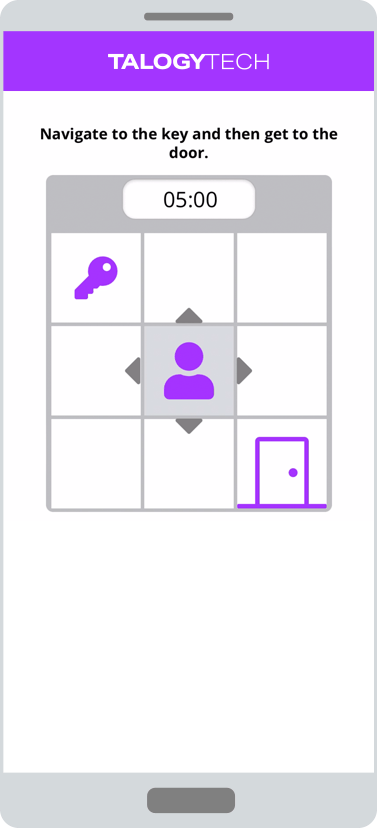
A door.
A thinking task.
Mindgage puts cognitive assessment into an interactive format.
Actual product screenshotThe portfolio covers several kinds of evidence. Caliper examines personality for selection and development. Mindgage measures cognitive ability through interactive tasks. Spotlight addresses early-career hiring, where a short employment history provides limited clues. InView Leadership combines assessment, 360 feedback and development. Industrial solutions focus on workforces where reliability and safety matter alongside technical capability.
“Talogy has worked really well. It’s all really user-friendly and very simple.”
Emily Vantrease · Volkswagen
TalogyTech customer testimonial
04The human still gets a chair
Talogy says it has more than 150 in-house psychologists and psychometricians. Their specialty is turning an apparently simple question, such as whether someone is dependable, into something an employer can examine consistently. The distinction matters when a process is repeated across sites and languages. A shared questionnaire alone cannot tell a manager which behaviors the job requires or how much weight each measure deserves.
At McDonald’s, Talogy’s executive process includes a briefing with the hiring manager, a 90-minute behavioral interview, an assessor-written report, candidate feedback and a debrief. Talogy reports more than 130 executive leadership assessments across regions. The framework creates consistency while leaving room for an experienced person to examine context.
That combination places Talogy in the enterprise assessment market alongside companies such as SHL and Hogan, with leadership consulting overlapping firms such as Korn Ferry. Its proposition is the breadth of the collection: assessment content, software and consultants working across frontline selection and senior development. Buyers can bring several talent decisions to the same supplier.

The commercial arrangement matters. Caliper subscriptions include a negotiated number of assessment administrations and unlimited access to the included Essentials reports. That distinction separates assessing another person from producing another report about an existing result. Consulting and development add further work around the tools. A useful purchasing conversation starts with candidate volume, required reports and implementation effort.
05Potential needs somewhere to go
Talogy’s May 2026 High Potential launch adds another wrinkle: not everybody wants to become a manager. Its model considers aspiration, agility, commitment and capacity, and recognizes specialist careers. An employer can waste talent by confusing strong performance with an appetite for promotion.
A 2026 partnership with Symulate explores immersive, AI-powered simulations. The ambition is to make richer behavioral exercises available at greater scale. It also extends a familiar Talogy question into a new format: can a digital encounter tell an employer something useful about how a person will work?
Its September 2026 research raises a related problem. Among 207 surveyed HR and talent professionals, 78% expressed concern about the long-term loss of critical leadership skills as AI changes work. If junior tasks disappear, employers must deliberately create other opportunities to learn.
There is a useful lesson to copy here. Define the work before choosing the test. Give interviewers a common standard. Compare predictions with later outcomes. Then revise. That approach depends on credible performance measures and managers willing to act; a polished report cannot supply either. Talogy’s most revealing cases show the effort between measuring a person and improving a workplace.