Company File · Boston, MA · Est. 2015
AceUp.
Coaching used to be a leap of faith. AceUp brought it a spreadsheet.
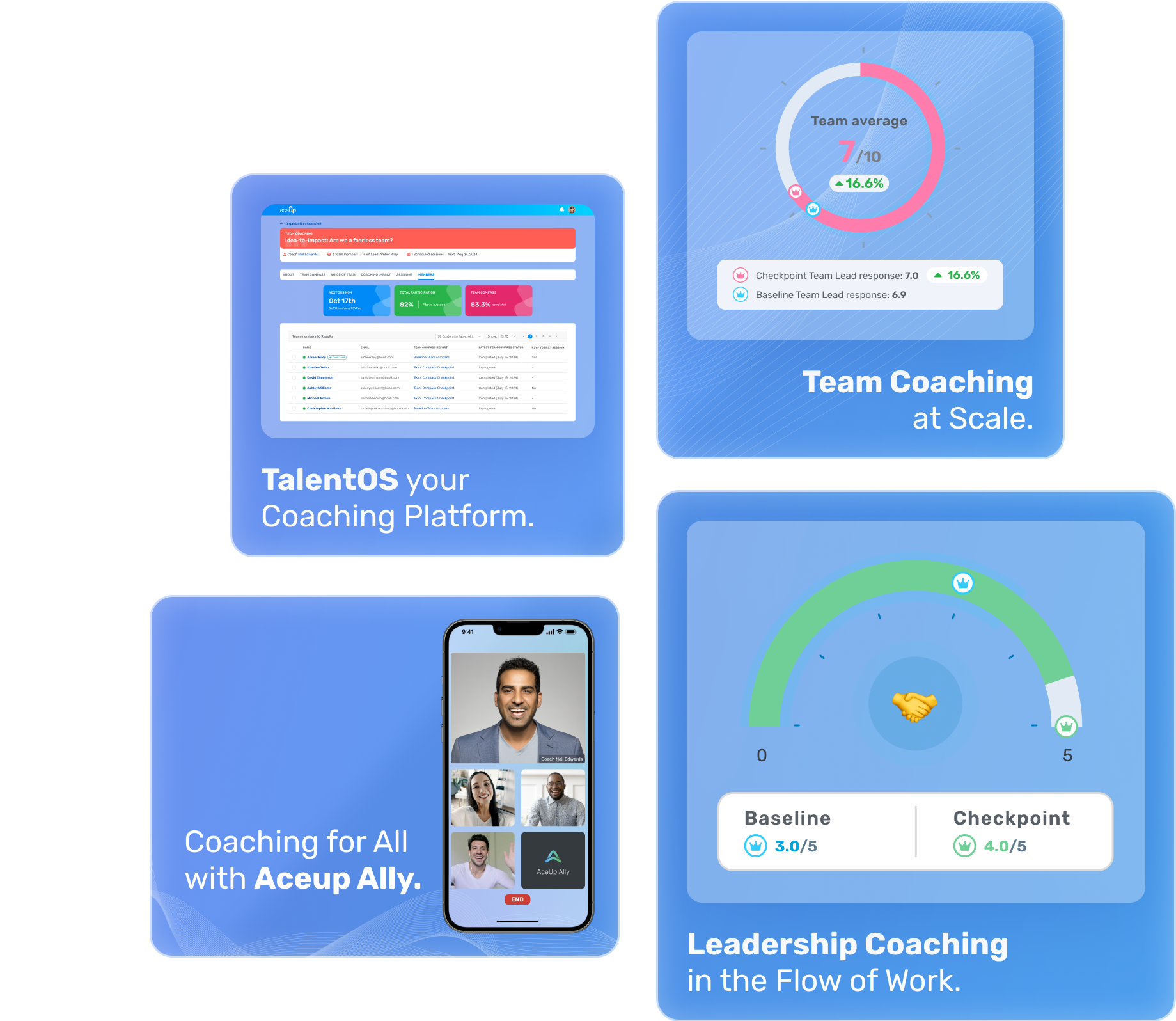
Coaching used to be a leap of faith. AceUp brought it a spreadsheet.
Somewhere inside a Fortune 100 company this morning, a newly promoted manager logged into a platform, answered a few questions, and got matched with a coach on another continent. By the afternoon, her progress was a data point on her director's dashboard.
That small, unremarkable moment is exactly what AceUp was built to make ordinary. The Boston company sells leadership coaching - an industry that has spent decades insisting its value is real but hard to measure - and then does the unfashionable thing: it measures it. Human coaches do the talking. An analytics layer the company calls Ally keeps the receipts.
AceUp now runs in more than 100 organizations, including IBM, L'Oreal and LVMH, supported by a network of over 3,500 certified coaches. It has landed on the Inc. 5000 list of fast-growing private companies four years running. None of that would impress anyone if the underlying idea were obvious. It wasn't.
For years, executive coaching lived in a strange place. Companies believed in it enough to spend four figures a month on it for their most senior people, and believed in it too little to offer it to anyone else. It was a perk, a reward, a quiet line item - and almost never a metric.
The trouble with a leap of faith is that finance departments don't budget for faith. When a CFO asked what coaching actually returned, the honest answer was a shrug and a testimonial. Good for the soul, hard for the spreadsheet.
Coaching that you can't measure is a coaching program that you can't defend.The skeptic's case AceUp set out to answer
So coaching stayed small. It reached the corner office and stopped. The talent one rung down - the managers who actually run things - got a webinar and a wish of luck. AceUp's founders looked at that gap and saw it was not a coaching problem. It was a data problem.
Will Foussier did not start out planning to fix coaching. He started out as a financial analyst. When he decided to change careers - eventually toward the Clinton Global Initiative - he hired a coach to help, then spent a frustrating stretch discovering how hard it was to find a good one, vet them, and afford them. The market was opaque, expensive and personal in all the wrong ways.
He and co-founder Rohit Begani made a contrarian bet: the way to scale something as human as coaching is to wrap it in data. Not to replace the coach - to give the coach, and the company paying for the coach, a way to see what was working. They incubated the company through Techstars and started building.
To thrive in the agentic world of work, you'll need to develop more human-centered leaders.AceUp's framing of the bet
It is a faintly ironic premise - using algorithms to make leadership more human - and that irony is the whole point. The machines handle the measuring so the people can do the part machines are bad at.
Co-Founder & CEO. Ex-financial analyst who became a coaching evangelist after struggling to find one himself.
Co-Founder & CTO. The engineering half of the bet that coaching could be a data product.
What AceUp sells is a pairing. On one side, live coaching: one-on-one sessions with ICF-certified coaches, and systemic team coaching that treats a team as a system rather than a pile of individuals. On the other side, software that watches the whole thing and turns it into signal.
AceUp's platform assesses an organization's strengths and gaps, recommends who should work on what, and renders the results as departmental heat maps - growth areas you can literally point at in a meeting. Between sessions, AI-powered microlearning keeps the habit alive.
The pricing tells the strategy. Coaching that once cost executives well over a thousand dollars a month can start, through AceUp, at roughly $20 per employee. The expensive expert tier still exists - upwards of $1,595 a month for senior coaching - but the floor dropped low enough that coaching stops being a perk for the few and starts being infrastructure for the many.
What gets measured gets a budget. AceUp's quietest innovation was making coaching countable.Why the heat map matters
Skeptics are right to ask whether any of this works. So here is the evidence AceUp puts on the table - customers, capital, and reach.
The Series A came in at $22.5 million in September 2024, led by PJC with Techstars Ventures, Gaingels, Water Bear Ventures and Launchpad Venture Group. That round pushed total funding past $25 million and, notably, AceUp says it reached the round already profitable - the kind of detail investors remember.
My coach helped me leverage important aspects of myself that I previously never had the time to invest in.Sandra Quince · CEO, Paradigm for Parity
The client list reads like an HR director's wish board: IBM, L'Oreal, LVMH, BNP, John Deere, WM, Teradyne, EssilorLuxottica, PVH. AceUp also keeps one foot in the science of coaching through a partnership with the Institute of Coaching, and has drawn on the thinking of figures like Dr. Carol Kauffman and Dr. Marshall Goldsmith.
Strip away the dashboards and AceUp's mission is simple to state and hard to pull off: make coaching accessible, scalable and measurable. Move it out of the corner office and into the org chart. Treat developing people as something you can plan and prove rather than hope for.
The company's own values circle the same idea from different sides - empowering people, embracing learning, cultivating a growth mindset, driving positive change. Pleasant enough as poster copy. The interesting part is that AceUp tied them to a measurement system, which is the only thing that keeps values from being decoration.
The bet was never that software coaches better than people. It's that software lets more people get coached at all.The mission, minus the poster
AceUp's pitch for the next few years is pointed: as AI agents take over more of the doing, the scarce skill becomes leading. Judgment, alignment, the ability to move a team of people - and, increasingly, a team of people and software - through change. Those are exactly the muscles coaching trains, and exactly the ones companies have under-invested in.
If that thesis holds, AceUp is selling the thing every organization will suddenly wish it had bought earlier. If it doesn't, the company still has a profitable business measuring something competitors mostly guess at. Not a bad place to be wrong from.
Return to that newly promoted manager from this morning. A decade ago she'd have gotten a webinar and a wish of luck. Today she gets a coach, a plan, and a number that says whether any of it is working. AceUp didn't invent coaching. It just refused to keep treating it like magic.