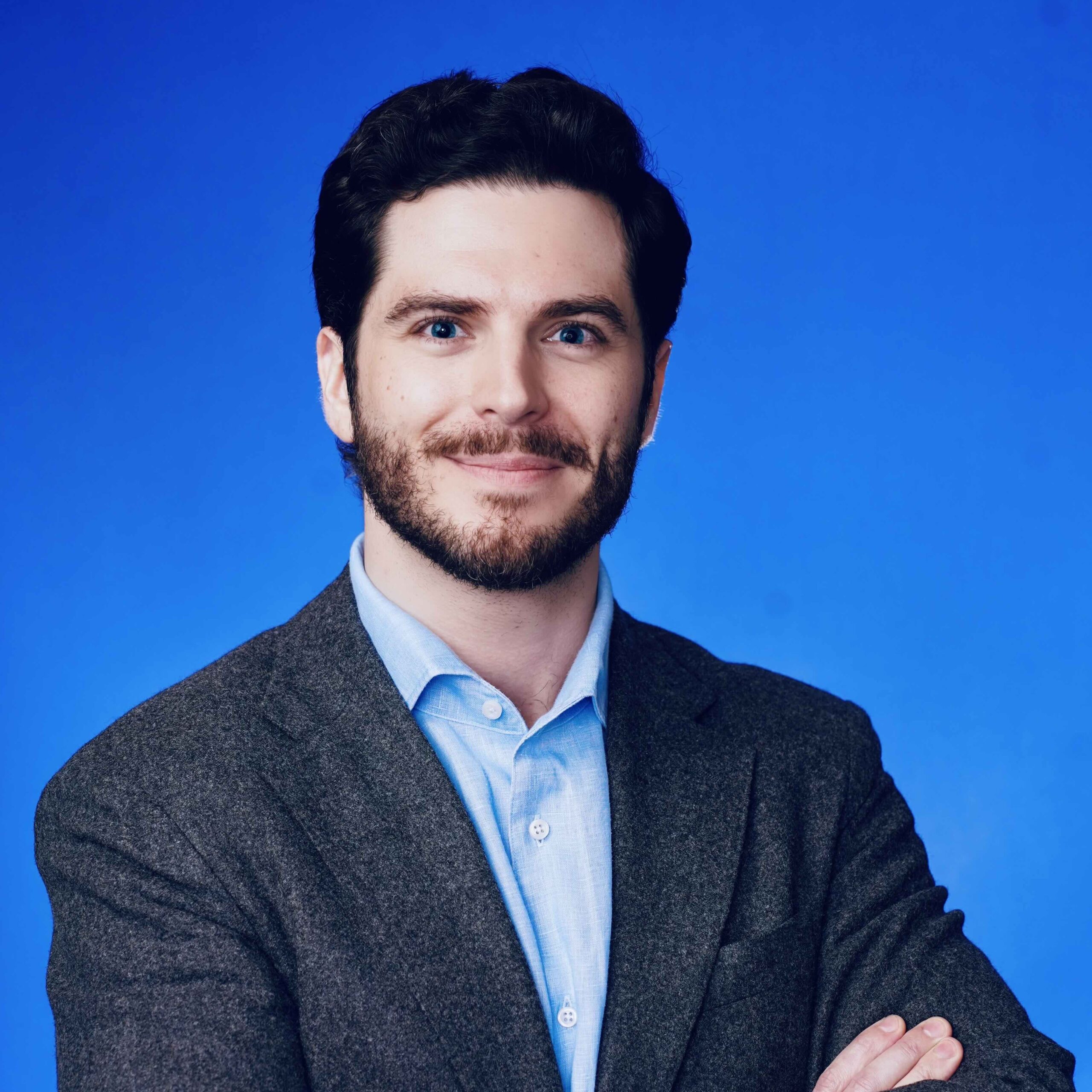
He turned the thing that fixed him into a business.
In 2015 Will Foussier was a numbers person who'd just walked into a room where numbers didn't help. He had left a financial-analyst seat at Raymond James in France and joined the Clinton Global Initiative's 20/30 program in New York, where the job was fundraising for social impact - persuasion, negotiation, reading a room. None of which a spreadsheet teaches. So he hired an executive coach. Within weeks the thing that had been stuck came loose. "By working with the right expert, I quickly developed new skills that transformed my performance and ability to collaborate," he says. The fix was so clean it annoyed him: why was something this useful locked away behind a price tag most people never see?
That irritation became AceUp. The premise has not moved an inch since: everybody deserves a coach.
Today AceUp is an AI-powered coaching and team-transformation platform run out of Boston, built originally inside the Harvard Innovation Labs. It is the rare HR-tech company doing two unfashionable things at once - growing fast and turning a profit. Foussier raised a $22.5 million Series A in September 2024, bringing the total to roughly $25 million, and tells reporters the nine-year-old company is in the black. The coaching that once cost a fortune now starts at about $20 per employee per month. The expensive version, C-suite engagements led by top experts, still runs north of $1,595 a head. The point was never to make it cheap. The point was to make the math work at scale.
Everybody deserves a coach.
Coaching, read like a balance sheet.
Most of the $14 billion coaching market runs on instinct - a good coach, a willing executive, a handshake, and a hope. Foussier's whole bet is that you can do better than hope. AceUp turns a workforce into data: algorithmic recommendations for individuals and teams, organizational heat maps that show where a company is strong and where it's quietly bleeding. "I believe you must invest in your teams and bring data-centricity to coaching to effectively pinpoint improvement areas," he says. It is the analyst's old habit applied to the softest of skills.
He frames the differentiator bluntly: where rivals like BetterUp and HumanQ sell coaching, AceUp sells coaching plus the evidence it worked. The platform was developed with the Harvard-backed Institute of Coaching, where Foussier also sits as a strategic advisor and is a founding member of its Research Consortium for Human-Centered Leadership. The science is not a marketing garnish. It's the load-bearing wall.
Three quiet shifts, one big gap.
Foussier doesn't talk about coaching as a feel-good extra. He talks about it as the answer to three forces that have been reshaping work whether companies noticed or not. The first is demographic: a generation now in the workforce ranks career development above salary, and walks when it isn't there. The second is technological: a technical skill has a useful life of roughly five years before it's stale, while the behavioral skills - how you lead, listen, decide, recover - compound instead of decay. The third is behavioral itself: people increasingly expect development that is built for them, not poured over them in a once-a-year seminar.
Put those three together and you get the gap AceUp lives in. Organizations know they should develop their people individually, at every level, all the time. Almost none can actually do it at scale - personalized coaching has historically been a luxury good, hand-matched and hand-priced. Foussier's contention is that automation alone won't close the gap, because a chatbot can't build trust. What closes it is a hybrid: software that handles the matching, the measurement, and the heat maps, paired with real humans doing the part only humans can. Efficiency where it helps, presence where it counts.
Five things he hires for.
For a company built on developing leaders, the question of what makes one is not academic. Foussier keeps returning to a short list of what he calls power skills - the durable, behavioral kind that outlast any tool. He looks for effective communication, the plain ability to make yourself understood. He looks for adaptability, because by his own count AceUp has had to reinvent itself at least four times, and a person who can't bend with it won't last. He looks for value alignment, growth potential, and leadership - the willingness to carry other people, not just outrun them.
It is a revealing list, because it's the same one he'd have failed a decade ago. The analyst who joined the Clinton Global Initiative could model anything and persuade no one. That's the whole origin of the company: he was the candidate who had four of the five and was missing the one that mattered most in the room. Coaching gave it to him. Now he screens for it - and sells the cure for its absence.
Hospitality school to heat maps.
Foussier did not take the obvious on-ramp to enterprise software. He studied at the Ecole Hoteliere de Lausanne - hospitality, the business of looking after people - before a professor there lit a fuse for finance. From Lausanne he went to a master's in management at Harvard, and somewhere between the two he traded the hotel lobby for the boardroom. The thread that survived the journey: both are service businesses, both live or die on how people feel when they leave the room.
Show up before you're ready.
Ask Foussier how he gets through the hard parts and he reaches for an idea most founders are too proud to admit: presence over polish. He talks about "showing up" even when unprepared, because momentum is built by being in the room, not by waiting to be perfect for it. When COVID hit, he flipped AceUp's business model overnight - by his own count the company has reinvented itself at least four times. During a painful restructuring he chose open forums and listening over decrees, betting that trust would outlast the discomfort.
His favorite words aren't his own. They belong to Maya Angelou: "Do the best you can until you know better. Then when you know better, do better." It is a builder's creed disguised as a kindness - permission to be wrong, paired with an obligation to improve. The rest of his philosophy fits on a sticky note: the leap from a "me" to a "we" mentality is the entire job of leadership.
Who's on the couch.
AceUp's coaching runs inside roughly a hundred companies, and the logos are not small. The platform sits between a global network of more than 3,500 contract coaches and the leaders who need them - matched, measured, and tracked.
Do well by doing good.
There's a phrase Foussier comes back to so often it functions as a thesis statement: we can do well by doing good. It's easy to wave off as founder boilerplate until you trace where it comes from. The Clinton Global Initiative was social-impact work; the professor at Lausanne who lit the finance fuse did it in a school built around service; the coach who unstuck him wasn't selling a product so much as a way of being better at carrying other people. AceUp is the place where those three threads tie off. The business model and the mission are not in tension - the more leaders it makes measurably better, the more it sells.
The number he reaches for when asked how far this goes is deliberately absurd: a billion people. He frames AceUp's work as helping people "unleash their full human potential," and a billion is the scale at which a coaching company stops being a vendor and starts being infrastructure. Whether he gets there is a different question. But it explains the data obsession, the Harvard science, the refusal to let coaching stay a perk for the corner office. If everybody really does deserve a coach, then the only honest way to mean it is to build something big enough to reach them - and rigorous enough to prove it worked.
Small things, worth knowing.
He's a Harvard, EHL and Techstars alumnus - and a Forbes 30 Under 30 honoree.
The aspiration he says out loud: unleash the full potential of a billion people.
AceUp was built with the Institute of Coaching, tied to Harvard Medical School and McLean Hospital.
He started in hospitality - the discipline of making people feel looked after never left.