Rob Michael spent 31 years preparing for a job that, for the first 20 of them, belonged to a company that did not yet exist on its own. He joined Abbott in 1993. AbbVie separated from Abbott in 2013. In July 2024, he became AbbVie’s second chief executive. Corporate careers can be untidy. This one has unusually legible arithmetic.
The numbers suggest patience, though they cannot tell us what he felt along the way. What they do show is a succession of assignments that brought him closer to the workings of the whole enterprise. Before he became the person responsible for the company’s direction, he helped build its ability to plan.
There is something pleasingly unfashionable about that route. No garage features in it. No founding myth requires a napkin. Michael’s story starts with accounting, develops through finance and operations, and arrives at the CEO office through a handover prepared over years. The interest lies in how much can happen inside an apparently continuous career.
The education between the job titles
Michael earned an accounting degree at Indiana University’s Kelley School of Business and an MBA at UCLA Anderson. At Abbott, he entered the financial development program. A development program is an appropriate opening for this particular story: his later career kept widening the scope of what he had to understand.
His early assignments included division controller responsibilities in the supply chain and other parts of Abbott. These are jobs with a close view of how an organization spends, produces and accounts for its decisions. A strategy may look elegant from a distance. A controller has to live with its details.
It would be easy to read the eventual promotion backward and make every early assignment seem inevitable. Careers offer no such guarantee. The useful observation is narrower. Michael accumulated experience across businesses before assuming responsibility for a separate public company. His preparation included the internal connections that a new recruit would have needed time to learn.
That distinction matters when thinking about an executive who rises within an institution. Familiarity can mean knowing the vocabulary. It can also mean understanding where a decision travels after it leaves a meeting. Michael’s progression through financial and operating responsibilities gave him repeated opportunities to see that journey from different desks.
A new company needs a plan
The separation in 2013 changed the setting. AbbVie was now an independent company, and Michael established and led its first financial planning organization. His title was vice president of financial planning and analysis. It sounds like a supporting credit. In the life of a newly separate business, it is a consequential assignment.
A company needs ways to compare ambitions, allocate resources and understand the consequences of its commitments. Financial planning supplies part of that machinery. The work sits behind the announcements, translating a collection of intentions into something people can organize around. The machinery rarely gets invited to the launch party.
Michael subsequently held roles involving commercial controllership, treasury and corporate controllership. In 2018, he became chief financial officer. The sequence is useful because it shows movement within finance rather than a single long posting. Planning, cash and reporting place different questions on the desk.
Read this way, his career is an education in the relationships between functions. A commercial decision becomes a financial commitment. An investment becomes an operating task. A company’s future depends partly on whether the people responsible for those different pieces understand one another. Michael’s assignments repeatedly put him at those intersections.
When the brief grew wider
In 2021, Michael became vice chairman for finance and commercial operations. He became vice chairman and president in 2022, then president and chief operating officer in July 2023. By then, the brief encompassed global commercial operations, finance, human resources, global operations, business development and corporate strategy.
The expanding list changes the meaning of the earlier finance career. It had become a route into responsibility for people, operations and growth across the enterprise. The future CEO was already working on decisions that extended well beyond the accounts. The promotion to chief executive would formalize a broader responsibility he had been approaching for years.
There is a difference between collecting senior titles and acquiring a wider field of view. The responsibilities attached to these jobs are what make the sequence informative. They connect Michael’s earlier expertise with the operating questions he would inherit. His career becomes easier to understand when the duties receive as much attention as the rank.
The conversation before the corner office
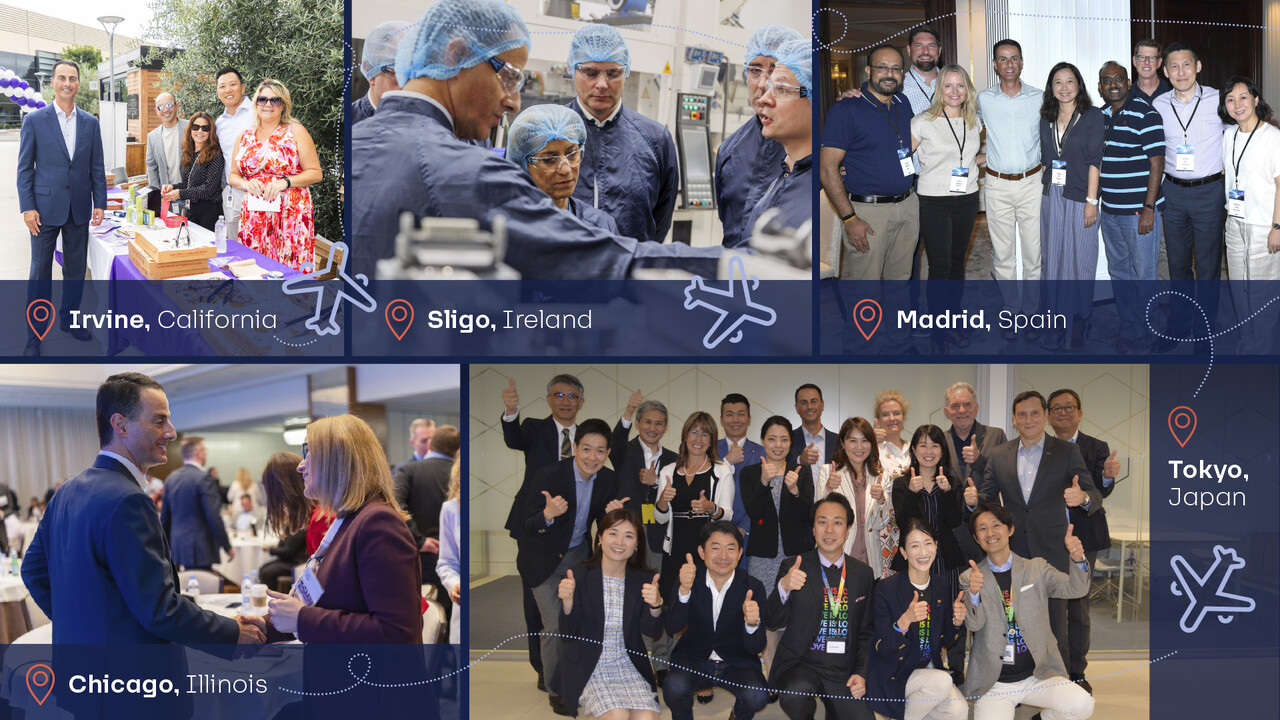
Before his CEO appointment was announced, Michael published a December 2023 essay about lessons from employees. It described conversations with large groups and smaller gatherings over coffee. Visits included manufacturing sites in Ireland and meetings in California and Japan. The accompanying collage supplies a welcome change of scale: colleagues, group photographs, ordinary encounters.
Two of his observations were compact enough to survive almost any meeting: “Innovative ideas are everywhere.” And: “Diverse opinions lead to better solutions.” Both put value on contributions from people with different experiences. In the context of a finance-led career, the emphasis broadens the picture.
These were his own public reflections, rather than a test of how every employee experienced the workplace. Their significance is that he chose to frame himself as someone learning from colleagues. He described movement around the company as an opportunity to listen. The hierarchy did not have to determine the direction in which useful information travelled.
A leader’s calendar can fill with people explaining the company on someone else’s behalf. Site visits and smaller conversations at least create occasions to hear from the people doing the work. Michael’s essay gives those occasions a place in his account of preparation. The coffee, in this telling, had a business purpose.
“Innovative ideas are everywhere.”
Rob Michael, December 2023
Two Julys, one handover
On February 20, 2024, AbbVie announced that its board had unanimously selected Michael to succeed Richard Gonzalez as CEO. The appointment would take effect on July 1. Gonzalez, who had led AbbVie since its formation, would become executive chairman. Michael would also join the board.
The interval between announcement and arrival gave the succession a visible timetable. The choice itself placed responsibility with an executive who had helped run the business and develop its direction. AbbVie was moving from its first chief executive to its second, a change with institutional weight even when the successor was familiar.
Michael called Gonzalez a personal mentor. That relationship adds a human detail to the formal choreography. The person whose job he was taking had also helped him develop. They would continue working together while Gonzalez served as executive chairman, linking the new appointment to the company’s existing leadership.
On July 1, 2025, Michael assumed the chairmanship as well. Roxanne Austin served as lead independent director. The two July dates mark separate steps: first the transfer of executive leadership, then the board chair. A succession that fits into one line on a biography had occupied a full year on the calendar.
The structure also gave Michael’s preparation a new consequence. As CEO, he was accountable for the direction of the business. As chairman, he took on responsibility for leading the board too. The executive who had spent years working inside the organization now occupied both of its most visible leadership positions.
The future gets an address
By April 2026, one view of the work ahead could be found in Durham, North Carolina. AbbVie announced a $1.4 billion manufacturing campus on 185 acres, with plans for 734 permanent jobs. Construction was scheduled to begin in 2026, with the first phase expected to be completed by the end of 2028.
These were announced commitments and plans, with the hiring and construction still to be carried out. Their specificity is useful. An investment acquires a location. A growth ambition acquires a physical footprint. Engineers, operators and laboratory technicians become part of the proposed future workforce. The statement of intent comes with things that can later be measured.
185acres planned
734permanent jobs planned
Michael described the announcement as an expansion into a new region of the United States and a long-term partnership with Durham and North Carolina. For someone whose early work involved financial planning and supply chains, it offers a particularly concrete continuation. The numbers on a plan are attached to people and places.
That connection runs through the career. A trainee becomes a controller. A planning executive helps a newly separate company organize its future. A CFO takes on operating responsibilities. The eventual CEO inherits an institution whose internal workings he has spent decades learning, while making commitments that extend beyond his own apprenticeship.
The 31 years explain how Michael arrived. They cannot do the work that follows. The next judgment will come from decisions made under his leadership, from the colleagues carrying them out, and from whether announced plans become functioning operations. After a career spent learning the company, he now has to keep it learning too.