In September 2023, Michael Bender offered a useful description of his work with other executives: “I’ve seen the movie before.” He was talking about helping people prepare for the unexpected. Less than two years later, the chairman of Kohl’s would find himself taking the lead role in a corporate plot with rather more twists than anyone had ordered.
On May 1, 2025, Bender became interim chief executive after the departure of Ashley Buchanan. He had joined the board in 2019 and become chair in May 2024. The assignment moved him from overseeing management to running the business. By November 23, the interim designation was gone. The board had unanimously chosen him as permanent CEO.
That sequence gives Bender’s story its tension. An experienced director can ask management difficult questions and then go home. A chief executive inherits the answers, the timetable and the next morning’s problems. For Bender, a career spent moving between operations and oversight had arrived at a job where both mattered at once.
Kohl’s needed customers to return and buy. There is a pleasing lack of glamour in that sentence. It also describes a difficult management problem: how to make thousands of ordinary decisions feel right to someone who has come in looking for a reasonably priced pair of trousers.
The education before the corner office
Bender’s route into retail began with economics at Stanford, where he graduated in 1984. He later earned a master’s degree in management from Northwestern’s Kellogg School. His early professional years were spent at PepsiCo, in sales, finance and operations. Those are three different ways of seeing the same transaction: persuading someone to buy, making the numbers work and getting the product where it belongs.
He stayed at PepsiCo from 1984 to 1999. Fifteen years is a substantial apprenticeship in how a consumer business functions. His responsibilities included strategic planning, market development and category management. Before the department store, before the board committee, there was the patient work of understanding what people buy and how a company delivers it.
From 1999 to 2002, he was vice president of store operations at Victoria’s Secret. It was a move into a business where the physical setting and the people working in it are part of the product. A spreadsheet can record a sale; it cannot greet the customer. His later career would repeatedly bring him back to that distinction.
The range of his assignments matters more than a parade of employer names. Finance teaches the consequences of a decision. Store operations exposes the decision to actual people. A leader who has worked in both has fewer excuses for treating either as someone else’s department.
Twenty-two states, then an endless aisle
Bender joined Walmart in 2009 as a vice president and regional general manager. He advanced through the Mountain division and, in 2011, became executive vice president and president of Walmart West. That business covered 22 states. By 2014, he had moved into the role of chief operating officer of Global eCommerce, which he held until 2017.
The geographic progression is striking: a region, a division, a sprawling western business, then an operation whose storefront could fit on a phone. It put him on both sides of a retail argument that was often presented as a contest between buildings and browsers. His responsibilities included integrating digital commerce into existing and new formats.
At a July 2015 manufacturing summit in Bentonville, he described Walmart.com’s assortment of more than seven million items. “But what I love even more than the selection, is the sortability and personalization,” he said. That preference is revealing. A huge assortment is only helpful if a shopper can find something worth buying.
His remarks also addressed product information, search visibility and videos showing where goods were made. The details were practical. A badge had to help an item appear in searches. A product listing had to explain itself. Even an endless aisle required signs. The internet had expanded the shop; it had retained the obligation to be useful.
- 2009Southwest region
- 2011Walmart West
22 states - 2014Global eCommerce
Physical operations and digital commerce, in one career.
A smaller chain, a more direct conversation
In September 2017, Bender became president of Eyemart Express. He became president and CEO in January 2018 and remained in that role until April 2022. After Walmart’s scale, he was leading a specialty retailer where the relationship between an associate and a customer was particularly immediate.
During his tenure, the company described an open-door policy that allowed employees in stores, distribution and the home office to bring ideas or feedback to leadership, including the CEO. It invested in employee education and career development. These were concrete expressions of a familiar management ambition: make the person nearest the customer feel heard by the person furthest up the chart.
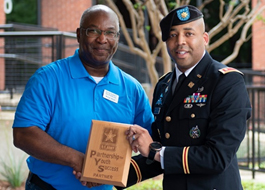
A 2021 hiring partnership with the Army’s Partnership for Youth Success program offered another example. Eyemart Express linked the arrangement to opportunities for qualified soldiers across 231 stores. Bender attended a ceremony in Dallas with Major Whitted of the Dallas Recruiting Battalion. His comments emphasized military experience in leadership, discipline and technical skills.
The company also brought in an investment from Leonard Green & Partners, while FFL Partners and the Barnes family retained a majority stake. Bender was operating amid owners, employees and customers with different interests and different time horizons. When he left in 2022, he thanked the people he had worked with and described his pride in their shared accomplishments.
The director who still wanted a mentor
Board work became another substantial strand of Bender’s career. He served on the board of the company now called Ryman Hospitality Properties from 2004 to 2019, joined Kohl’s in July 2019 and joined Acuity’s board in September 2022. These roles extended his view beyond a single retailer’s daily trading.
His advice to a new director was unusually attentive to the social mechanics of a boardroom. Understand its culture. Find an experienced colleague who can explain its language and its silences. Consider what you want to learn as well as what you can contribute. Seniority, in this account, did not exempt anyone from being a beginner.
That fits the mentoring work he described with directors and senior executives. His public manner also included offering encouragement to colleagues on LinkedIn. It is a modest detail, but a useful one in a profession whose public vocabulary can make every meeting sound like the conquest of a small country.
His connection to Stanford has continued, too. He was a co-chair of the class of 1984 reunion campaign and appears on the Stanford Associates Board of Governors for 2026-27. In his explanation of giving back, he emphasized helping the next generation receive the opportunities a university education had given him. The interest in preparing other people runs through several parts of his public life.
Experience can be passed on. Curiosity still has to be renewed.An observation on Bender’s approach to mentoring
The customer gets the deciding vote
At Kohl’s, Bender’s responsibilities encompass more than 1,100 stores and the online business. The company’s current biography describes a workforce of 100,000 associates. Those numbers put a different weight on the idea of listening. A CEO cannot personally hear every customer or coach every employee; the organization has to carry that attention.
When he accepted the permanent appointment, he set out an ambition to restore Kohl’s position by putting customers first. His earlier interim statement had emphasized a base of more than 60 million customers. That is a large audience for an established brand, and an equally large collection of expectations about what a visit should deliver.
By August 2026, he was discussing familiar store details alongside newer digital tools: proprietary brands, clearer displays, better distribution of inventory and the convenience of store pickup. Pickup represented more than 20 percent of digital demand, he said on the second-quarter call. The store network and the online business were meeting in the same shopping trip.
There is continuity here with the Walmart executive who cared about making an assortment navigable. A customer should be able to find the right product, understand the offer and complete the purchase. The technology can change considerably while the human impatience at the other end remains wonderfully consistent.
A smaller minus sign still matters
The early numbers offer a measured way to assess the assignment. In the first quarter of fiscal 2026, comparable sales fell 1.1 percent and net sales fell 1.7 percent. Kohl’s reported a $14 million net loss. Bender described improving execution and cleaner inventories, but the sales line still had a minus sign attached.
In the second quarter, ended August 1, comparable sales declined 0.9 percent. Net sales were $3.3 billion, also down 0.9 percent. Inventory fell 3 percent from a year earlier. The company raised its full-year outlook and announced that it was restarting share repurchases. These developments showed progress without settling the larger question of sustained growth.
The details require care. Second-quarter gross margin benefited from roughly $100 million in tariff refunds. Reported net income was $151 million, compared with $153 million a year earlier. A profile of the CEO should leave room for those complications. Better trends and a completed turnaround are different stages of a story.
Bender’s career has prepared him to recognize how much work sits between the two. He has managed territories, screens, specialty stores and boardrooms. The next test is repeated at a far smaller scale: one customer finds what they came for, feels the price makes sense and decides to return. After four decades in business, the final judgment still belongs to the person holding the shopping bag.
Year-over-year change. A 0.2 percentage-point improvement between quarters; both periods remained below the previous year.