Steve Lawrence has a useful way of explaining a merchandising problem: his son changed sports. First came Little League, with a bat, a ball and a glove from Academy. Then came soccer, and the baseball equipment went into the closet. The store could outfit a beginner without making the parent regret having encouraged an interest. But if that interest became serious, Academy had a problem. The child could improve faster than the assortment.
That small domestic calculation sits inside Lawrence’s larger assignment as chief executive of Academy Sports + Outdoors. He wants a customer’s next purchase to stay within reach of the first. The family buying introductory gear should still have reasons to return when someone makes a travel team, develops a running habit or discovers that fishing involves rather more equipment than a rod.
There is something pleasingly ungrand about this starting point for corporate strategy. A child’s abandoned sport is familiar territory for a parent. A customer’s abandoned store is expensive territory for a merchant. Lawrence has occupied both positions.
The customer before the corner office
He was already an Academy shopper when he joined the business in February 2019. He described himself then as a longtime Texan with a personal attachment to the brand. His new job, executive vice president and chief merchandising officer, put buying, planning and allocation, pricing and sourcing under his direction. Those are the decisions that determine what a customer actually encounters beneath an expansive corporate promise.
Lawrence arrived with a finance degree from the University of Notre Dame and a career spent inside established retailers. Ten years at Foley’s/May Co. preceded nearly twelve in merchandising leadership at J.C. Penney. From May 2012 through September 2016, he was chief merchandising officer at Stage Stores. He then became president and CEO of francesca’s, serving on its board from October 2016 until January 2019.
The route matters because it places the emphasis on merchandise. These were businesses where choosing a product, pricing it and getting it into the appropriate store were central responsibilities. By the time Lawrence reached Academy, he had worked across department stores, regional retail and a specialty chain. Sporting goods became the next setting for that accumulated experience.
Stage Stores
francesca’s
Academy
Academy
His promotion to CEO took effect on June 1, 2023. He succeeded Ken Hicks, who moved to executive chairman, and became the seventh chief executive in Academy’s then 85-year history. The company credited Lawrence’s merchandising tenure with improvements in planning and allocation, growth across its four merchandise divisions and record merchandise sales and gross profit in 2021.
He inherited a business whose public-market chapter had already begun. Academy went public in October 2020, while Lawrence was its chief merchant. The chief executive appointment widened his responsibilities; the customer and the shelves were already familiar.
A chair belongs in this story
At an investor discussion in April 2024, Lawrence reached for a modest example of value: a portable chair selling for $5.99. Academy sold more than two million of them, he said, and had held the price for about a decade despite rising costs. Here was a retail strategy you could carry to the sidelines.
It is an unusually practical object around which to discuss a multibillion-dollar business. A chair has no ambition to become a lifestyle. It merely needs to unfold, hold its occupant and make the price seem sensible. For families moving between school, games and weekends outdoors, that sort of usefulness has a constituency.
In the same discussion, Lawrence described Academy’s core customers as active young families. The household budget was part of his explanation. Keeping an inexpensive private-brand item affordable gave the retailer a way to remain useful when shoppers were watching their spending.
“As a longtime Texan and Academy customer, I have a deep passion for the brand.”
Steve Lawrence, on joining Academy in 2019
The harder assignment was adding choice above that entry point. Lawrence argued that customers were willing to buy more advanced equipment from Academy. The store needed to earn the next purchase as carefully as it had earned the first. A parent should be able to buy an affordable starter kit without the retailer assuming that affordability defined every future decision.
The second pair of shoes
That thinking became visible in the Jordan launch. On April 23, 2025, Academy introduced Jordan Brand in 145 stores and online, alongside an expanded Nike assortment. The presentation brought apparel, footwear and accessories together by gender in a branded shop. The business was changing how merchandise appeared as well as which labels appeared on it.
By March 2026, Academy had announced plans to add the Jordan shop concept to another 55 locations. The arithmetic brought the planned reach to 200 stores. A successful product relationship could therefore become a repeatable way of presenting a brand, rather than an isolated new item on a shelf.
In September 2026, Lawrence explained that selling higher-priced Nike running shoes had helped demonstrate Academy’s ability to carry more expensive footwear. Hoka was another step: the company announced an early-October introduction online and in fifteen stores across Arkansas, Georgia, Louisiana and Texas.
145 original shops + 55 additional shops announced. A distribution count, not a sales comparison.
The fifteen-store introduction also shows why Lawrence talks about the shop floor and the website together. Store associates equipped with handheld devices can help a shopper order merchandise unavailable at that location. In his description, a limited physical launch could still reach customers through the wider chain. The shelf has a boundary; the associate’s ordering device can cross it.
There is an ordinary human problem underneath that technology. A customer who has made the trip wants a particular size or product. Being able to arrange the order during that conversation gives the employee another useful answer. It also gives the shopper a reason to finish the purchase with Academy.
The numbers refuse a neat ending
Lawrence’s tenure has also required explaining results that do not fit a celebratory expansion story. In March 2024, he discussed why new stores in unfamiliar markets were taking longer to develop than stores where Academy was already known. He described a five-year ramp, with stronger growth expected early in that period. Opening a door and establishing a shopping habit were separate jobs.
The distinction is useful when looking at the company he now leads. At the end of fiscal 2025, Academy had 322 stores across 21 states and approximately $6.1 billion in annual sales. Its April 2026 analyst presentation set out long-range ambitions exceeding 450 stores and $8 billion in sales. Those figures were goals, with the work of achieving them still ahead.
The September 9, 2026 results offered a more immediate test. Second-quarter net sales rose 3.0% to about $1.65 billion, while comparable sales fell 0.4%. E-commerce sales increased 12.8%. The period ended August 1 with 327 stores. Growth in the whole business and a slight decline on a comparable basis could coexist.
Quarter ended August 1, 2026. Different measures answer different questions.
Lawrence acknowledged pressure on consumer spending, especially among lower-income households. He emphasized the occasions and categories that mattered to shoppers, alongside new brands, loyalty and store initiatives. The reporting leaves room for a fairer assessment of his assignment: extend the business while giving existing customers enough reason to keep coming back.
A microphone, a room of students
Another public appearance offers a view of what Lawrence chooses to teach. At Texas A&M’s Flippen Leadership Institute in April 2026, he addressed students in the Lead with Purpose Executive Speaker Series. The discussion emphasized setting priorities and explaining the reasons behind decisions.
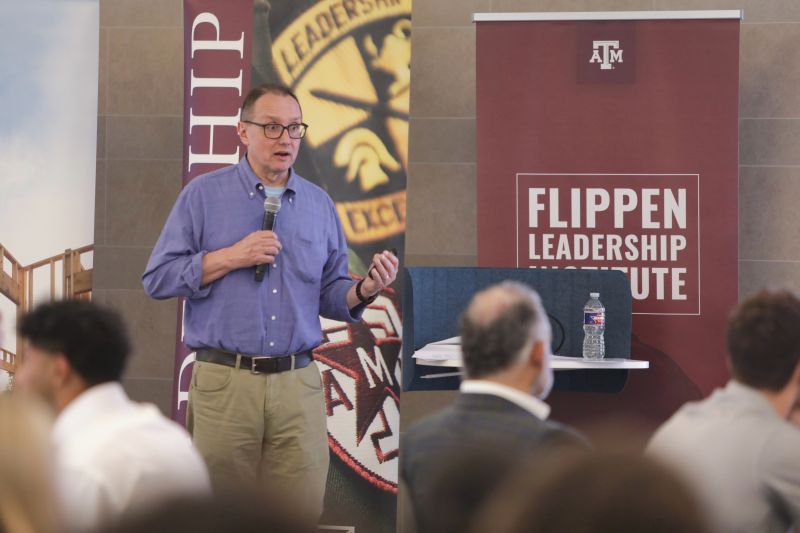
The institute’s account of the conversation described leadership through consistent example: demonstrate the values expected of others, prepare for opportunities and find work and colleagues you enjoy. These were lessons about everyday conduct. Their modest scale suits someone whose professional decisions eventually have to make sense to the person working a department.
Explaining why also carries a practical obligation. An employee can repeat a direction; understanding the reasoning makes that employee better equipped for the next decision. In a retailer with hundreds of stores, the distance between an executive’s intention and a shopper’s experience is filled by other people.
The next store was home
In August 2026, the expansion became personal. Academy opened in McAlester, Oklahoma, Lawrence’s hometown. He shared the opening publicly: “Excited to open up a store in my hometown!” The company paired its celebration of the McAlester and Celina, Texas, openings with $10,000 in donations benefiting sixty children from local organizations.
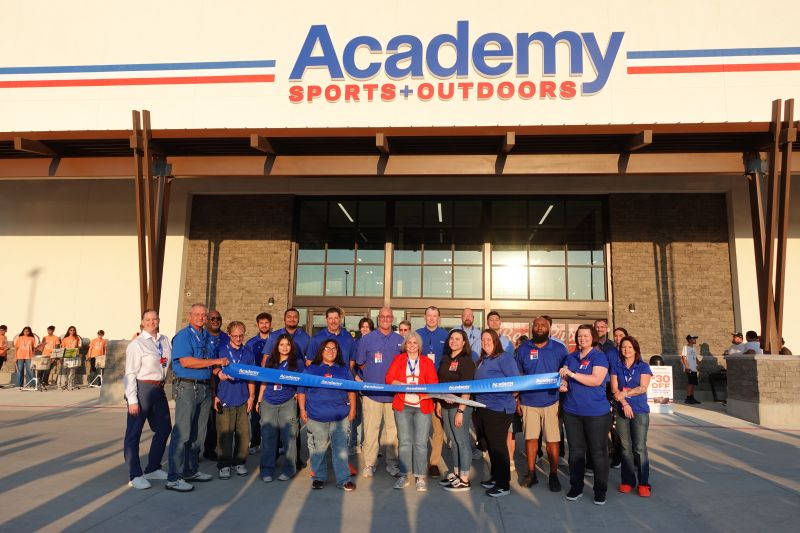
For a career that runs through several retail names, the hometown opening supplies a different measure of distance traveled. McAlester appears in his public story as a place of return. Houston is his base; Katy is where Academy has its headquarters. The store network now includes a place he calls home.
His work will continue to be judged in sales, margins and the performance of new locations. Yet the question that gives this career its shape remains small enough to ask in an aisle: when the customer comes back for the next thing, will the store be ready? A beginner’s glove, a better shoe, a chair for the parent. Lawrence’s next chapter has plenty of room for all three.
Follow the decisions
Public conversations, career details and the next chapter at Academy.