Todd Vasos had been retired for roughly six months when Dollar General put him back in charge on October 12, 2023. He knew the company, the board and the people running it. He also knew something a returning executive can find inconvenient: a substantial part of the business he had been asked to repair had been built during his own watch.
His first run as chief executive, from June 2015 to November 2022, had produced an unmistakable physical result. Dollar General added approximately 7,000 stores. Annual sales rose more than 80 percent. Nearly 60,000 net new jobs followed. These were accomplishments you could count, drive past and walk into. The yellow signs multiplied across the country.
Now the assignment involved the less photogenic side of retail: getting merchandise onto shelves, giving employees time to do their work and making the checkout function properly. Expansion lends itself to a ribbon and a pair of ceremonial scissors. A reliably stocked aisle generally has to settle for a customer putting something in a basket.
The second act would test a different kind of ambition. Could an executive so closely associated with opening stores make an enormous chain feel manageable again? By October 2026, with another succession approaching, that question had become the thread connecting Vasos’s early training, his growth years and his return.
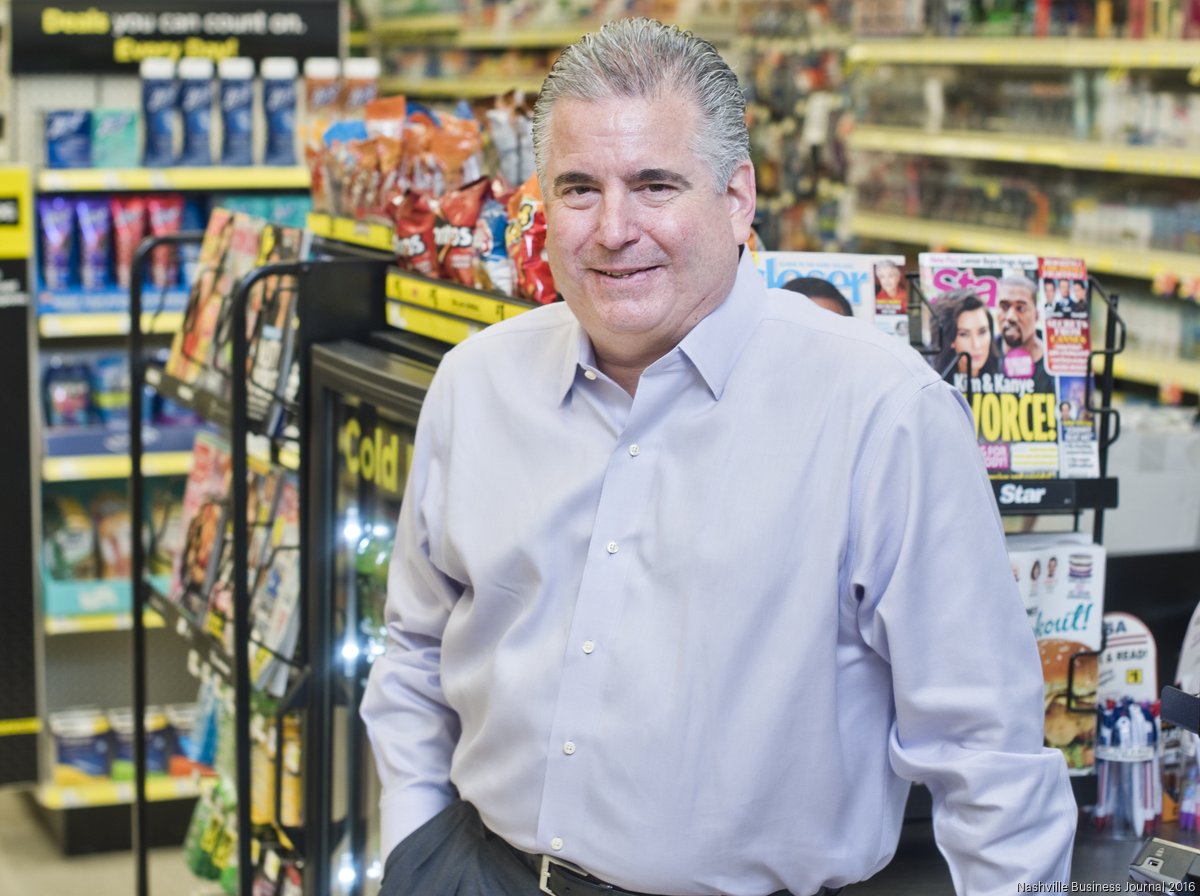
A career his mother helped set in motion
Vasos grew up in Wilmington, North Carolina, and studied marketing at Western Carolina University. After graduation, his mother encouraged him to apply for Eckerd’s management training program. About 300 people applied; six were selected. He was one of them. For a future chief executive, the beginning was pleasingly practical: listen to your mother, fill out the application.
At Eckerd, he progressed through assistant manager, store manager, district manager and regional manager. Later, he left that relatively stable setting for Phar-Mor as it emerged from bankruptcy. The move brought responsibility for operations and then an opportunity to learn merchandising at its corporate office in Youngstown, Ohio. He described the gamble as a way to learn more.
“I had a passion for it right from the start,” he said of retail. The sequence helps explain his later career: he learned to run stores before moving deeper into decisions about what those stores should sell.
By 2001, he was senior vice president and chief merchandising officer at Longs Drug Stores. He became executive vice president and chief operating officer in February 2008. That December he joined Dollar General as executive vice president, division president and chief merchandising officer. His experience covered both the buying office and the shop floor, a useful combination when the two began making unreasonable demands of each other.
- 2008Joins Dollar General as chief merchant
- 2015Becomes CEO and joins the board
- 2023Returns to the CEO role in October
- 2027January handoff to JJ Fleeman, scheduled
The yellow signs multiplied
Dollar General promoted Vasos to chief operating officer in November 2013 and chief executive in June 2015. The latter appointment also gave him a board seat. His route to the top had followed the workings of the business: merchandise, operations, then responsibility for the whole enterprise.
The familiar storefront can obscure how much machinery sits behind it. In 2019, under Vasos, Dollar General launched DG Fresh to distribute frozen and refrigerated goods itself. That changed the work happening away from the sales floor. A freezer is a small piece of shop furniture with a rather demanding logistical life.
The business also developed its own trucking operation and expanded its distribution capacity. These investments made the growth story about more than finding another location for a sign. They increased the company’s responsibility for moving products through the network, with more of the journey under its own control.
There was experimentation at the customer-facing end, too. In 2020, Dollar General introduced pOpshelf, a separate concept aimed at suburban shoppers, offering home décor, seasonal merchandise, craft supplies and other discretionary purchases. At launch, roughly 95 percent of its products were priced at $5 or less. The first locations were in Hendersonville and Clarksville, Tennessee.
That was a different invitation from a quick stop for household essentials. A customer could browse for something she had not planned to buy. Vasos’s company was trying to extend its knowledge of inexpensive merchandise into another kind of shopping trip. The distinction mattered: a useful bargain and an irresistible little indulgence occupy different places on a household list.
During Vasos’s first CEO tenure, June 2015 to November 2022. A bigger footprint brings a longer to-do list.
The return came with a reckoning
Vasos stepped down as CEO in November 2022, stayed as a senior adviser and retired in April 2023. He remained a director. Jeff Owen succeeded him, then left when the board brought Vasos back that October. The board’s stated purpose was to restore stability and confidence. Familiarity was part of the appeal.
There was also an awkward continuity. When the return was announced, Citi analyst Paul Lejuez argued that many of the challenges had originated while Vasos was CEO. The observation complicated any neat rescue story. A returning leader can bring institutional knowledge and institutional responsibility in the same briefcase.
Vasos called his response Back to Basics. The phrase sounds modest enough to fit on a training-room poster, but the work reached into staffing, inventory and supervision. The problem was how to make thousands of locations execute the same ordinary tasks consistently. Ordinary becomes difficult when it has to happen everywhere.
By March 2024, he described new inventory management shifts and specialized training in every store. The company had added more than 140 districts and district managers, reducing the number of stores assigned to each manager by about 15 percent. That meant a closer span of supervision and more opportunity to engage with store teams.
Listening was part of the program. Vasos and his leadership team held sessions with employees in stores, distribution centers and the support center. More than 400 field leaders gathered in Nashville that February; the company also spent time with more than 1,000 additional leaders around the country. A large company was making a deliberate effort to shorten the distance between its layers.
Ordinary becomes difficult when it has to happen everywhere.
The scale of the assignment
A cashier returns to the equation
The checkout offered a visible example of the change. Dollar General had installed self-checkout widely. Under the turnaround, thousands of those registers became employee-assisted lanes. By May 2024, the company had converted about 12,000 stores away from self-checkout as part of its response to inventory losses, known in retail as shrink.
For customers, the distinction was immediate: an employee would handle the transaction. For the business, it was an admission that the checkout required more attention. A machine could scan a barcode; the company still had to make the whole arrangement work, including the staffing and controls around it.
The same concern ran through the inventory changes. Too much merchandise can create work without creating a sale. Items must be received, stored, moved and eventually put where a shopper can find them. A product stranded in the wrong place is doing a remarkably convincing impression of money that has disappeared.
By the end of fiscal 2024, average inventory per store had fallen 6.9 percent from the prior year. But the period also showed how expensive the repair could be. Operating profit fell 29.9 percent to $1.7 billion, including charges associated with a review of the store portfolio. Improving the operation and improving reported earnings did not arrive on the same timetable.
In March 2025, Dollar General announced plans to close 96 namesake stores and 45 pOpshelf locations, with six more pOpshelf stores slated for conversion to Dollar General. The closures represented less than one percent of its overall store base. Even so, the decision gave the growth story a necessary qualification: some doors were better closed.
A better quarter, with the customer still in view
By the second quarter of fiscal 2026, the results offered firmer evidence of progress. Net sales reached $11.3 billion, up 5.2 percent. Same-store sales rose 3.5 percent, combining a 2.0 percent increase in customer traffic with a 1.5 percent increase in average transaction value. The distinction matters because additional stores can lift revenue while an existing location remains sluggish.
Operating profit rose 29.2 percent, and diluted earnings per share increased 33.3 percent to $2.48. Vasos pointed to a fifth consecutive quarter of customer traffic growth. These figures gave his operational argument something more substantial than a new slogan. They described people coming through existing doors and a business earning more from the activity.
The customer remained under pressure. At a September 2026 investor conference, Vasos described how fuel prices around $4 a gallon changed the behavior of Dollar General’s core shopper: staying closer to home, shopping more frequently and buying less on each visit. He also described pressure extending into middle- and higher-income households.
The observation makes his attention to proximity easier to understand. Convenience has a monetary value when the trip itself costs money. His job involves translating that household arithmetic into decisions about locations, stock and service. A chain’s national scale becomes useful to an individual shopper only when the nearby store can meet a fairly immediate need.
Reported figures, rounded.
The next exit has a date
This time, the handoff is scheduled. On March 24, 2026, Dollar General announced that Jerry “JJ” Fleeman Jr. would succeed Vasos on January 1, 2027. Vasos is to serve as senior adviser through April 2, 2027, and is expected to remain on the board after the transition. As of October 2026, he is still the CEO.
Vasos participated in the search for his successor. Fleeman brings more than 35 years of experience at Ahold Delhaize companies, including leadership of its U.S. business. The choice places another career retailer in charge of a company whose recent experience has underscored the demands of retail operations.
At the September conference, Vasos reached for a compact description of his ambition: “you leave it better than you found it.” The sentiment belongs to a long tradition of borrowed rooms and inherited responsibilities. Applied to his second tenure, it also creates a demanding test. The company he found in 2023 carried plenty of his own fingerprints.
His career began with learning how a store works, then widened into learning how thousands could work together. It brought him the authority to expand, the uncomfortable opportunity to return and the responsibility to help someone else take over. The next executive will inherit both the reach of that network and the routines needed to keep it useful. For Vasos, the last measure of a growing business may be how well it works after he leaves.
Keep reading
More of the career, the company and the conversations.
- Todd Vasos on LinkedIn
- Dollar General
- Career biography
- The 2018 alumni interview
- The 2023 return
- The checkout changes
- The pOpshelf launch
- Fiscal 2024 results
- Q2 fiscal 2026 results
- September 2026 conversation
- The scheduled CEO handoff
- KeyCorp biography
- Dollar General on YouTube
- Dollar General on X
- Dollar General on Instagram
- Dollar General on Facebook
- The return, reported by AP
- The May 2024 checkout update