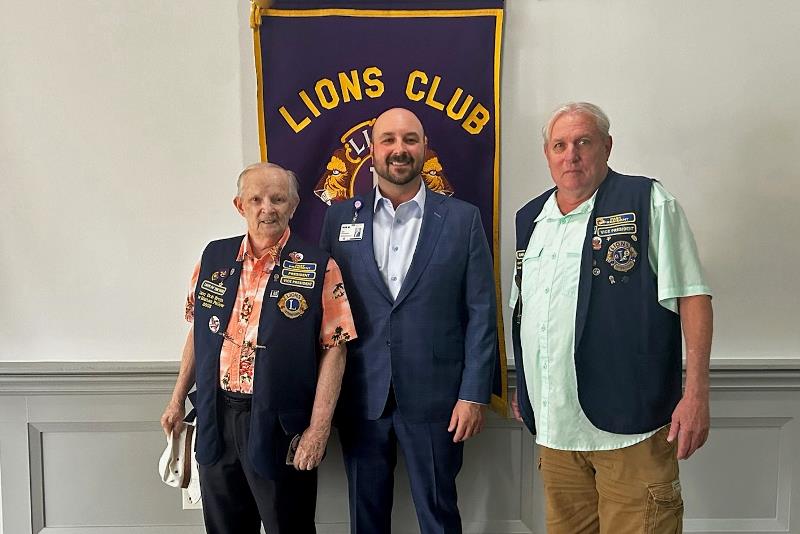
In August 2024, Robert Marmerstein stood between two Tomball Lions Club directors for a photograph. Bob Ervin was on one side, Bubba Hardee on the other. Behind them hung the club’s banner. Marmerstein wore a suit; his hosts wore their Lions vests. It was a small civic occasion, the sort that seldom makes an executive biography. It makes a useful opening here. By then, the executive who had arrived in Tomball four years earlier was appearing in the town’s everyday institutional life.
His route there had included Florida, Virginia and several stops around Houston. The job titles rose along the way. So did the number of local organizations attached to his working life. Read together, those two itineraries suggest a question more interesting than the usual account of successive promotions: when does taking a job in a place become taking a part in it?
The hospitality entry on the résumé
Start with the undergraduate degree. Marmerstein studied hospitality management at the University of Central Florida. His early experience includes Loews Hard Rock Hotel at Universal Orlando Resort. A hotel is an appealingly concrete entry in a management biography. Someone has to make the welcome work. Someone has to coordinate the people who keep the place running. A polished lobby can conceal a considerable amount of organized effort.
He later earned a master’s degree in administration at Virginia Commonwealth University. His career took him into HCA, with an administrative residency at Reston and subsequent roles at LewisGale. The hospitality qualification remained part of the record, an early interest carried into a different kind of organization.
It would be too tidy to make one degree explain an entire career. Still, it offers a useful lens. Hospitality asks managers to think about how an institution feels to the person entering it. Operations asks how the institution actually works. The two questions have reason to stay in conversation. Even an excellent organizational chart has never welcomed anyone through a door.
Virginia, then a Texas address
At LewisGale in Virginia, Marmerstein’s responsibilities included an associate chief operating officer role. His work touched rebranding, construction and renovation projects. Those assignments combine the visible and the administrative: an organization’s public identity, the physical setting in which it operates, and the coordination needed to change either.
There was charitable work alongside the operating work. He managed LewisGale’s annual employee giving campaign, helping raise more than $200,000 for United Way of Roanoke Valley. The distinction matters. This was an employee campaign, with contributions and effort extending beyond the manager whose biography records it. Giving campaigns make collective participation visible in a way that a job title cannot.
In June 2015, he became chief operating officer at Mainland Medical Center in Texas City. The move put a new state on his career map. It also began the Houston-area sequence that would eventually lead to Tomball.
A relocation can look deceptively simple when compressed into a line of professional history. The line supplies an employer and a year. Around it sit the less convenient questions of learning a place, understanding its institutions and finding where one can contribute. Marmerstein’s subsequent civic roles make that surrounding story worth following.
- 2015Mainland
Chief operating officer - 2017Kingwood
Chief operating officer - 2020Tomball
Chief executive officer - 2025Tomball chamber
Chair of the board
A promotion, followed by a place
Kingwood came next, in 2017. There, Marmerstein oversaw a $35 million tower expansion. Capital projects give an operating executive a particularly tangible responsibility. Plans eventually become structures; decisions acquire walls. Their scale also makes clear why management experience is built through successive assignments rather than conferred whole with a new title.
In 2019, the Lake Houston Area Chamber of Commerce selected him for its Top 4 Under 40 recognition. Texas House Resolution 756 congratulated him and noted an American College of Healthcare Executives Regent’s Award. The resolution also mentioned his wife, Laila, a small personal detail tucked into the formal language of public recognition.
He became CEO of HCA Houston Healthcare Tomball in July 2020. It was the next step up an established operating career. Within a year, his name appeared in a different municipal context: on June 21, 2021, Tomball’s mayor presented a Winter Storm Uri Heroes Day proclamation honoring Marmerstein and his team.
The final words deserve their place. A profile necessarily follows one person. The proclamation widened the frame to colleagues. It is possible to recognize an executive’s responsibility while preserving that wider view. Indeed, the words “and Team” make the honor more revealing. The city was acknowledging an organization’s people as well as its leader.
“Our board members understand Tomball because they are part of Tomball.”
Robert Marmerstein, September 2026
Twenty-five reasons to look ahead
In 2023, another group entered the picture. Twenty-five students formed the inaugural class of a local P-TECH initiative. Before its August start, they met Marmerstein, Lone Star College-Tomball president Lee Ann Nutt and Tomball Star Academy principal Kelly Marchiando. More than 100 students had applied.
The partnership brought together HCA Tomball, Tomball ISD, Lone Star College-Tomball and the Tomball Economic Development Corporation. It connected school and college coursework with workplace experience. The development corporation received a statewide Workforce Excellence Award for the collaboration.
Marmerstein’s presence belongs within that shared effort. So do the college, school district and economic development leaders. The point of the gathering was the students and the possibilities ahead of them. For a manager whose own route included formal study and successive operating assignments, it is an apt scene to place beside the promotion timeline.
Workforce planning often arrives in the language of forecasts. A meeting with an incoming class supplies faces. It also makes the timetable easier to understand: the people who may one day fill an organization’s roles are currently working out what they want to learn. The partnership put education and employment into the same local conversation.
The chairman’s other table
In 2025, Marmerstein chaired the Greater Tomball Area Chamber of Commerce. Here the constituency expanded beyond the organization he ran. A chamber chair sits among businesses with different products, pressures and prospects. The common concern is the place in which they are trying to succeed.
His message for the year addressed member businesses directly: “For 2025, we want to partner with you, understand your business”. The phrasing is useful because understanding comes before the implied promise of assistance. A chamber cannot be helpful to a business it has reduced to an entry in the directory.
His chamber role followed other civic commitments. He had served on education foundation boards in Texas City and Tomball, and on the Greater East Montgomery County Chamber of Commerce board. Across those entries, education and local enterprise recur beside executive management. They make the community chapter longer than a single ceremonial appointment.
There is a practical difference between representing one employer and participating in an organization of employers. The latter requires room for other people’s concerns. A growing town can welcome investment and still ask what that growth means for the businesses already there. The chamber role put Marmerstein at a table where those questions could meet.
These are modest units of evidence, but useful ones. A student introduction shows who is invited into a professional future. A giving campaign shows colleagues acting together. A chamber message shows an executive addressing businesses outside his own. None supplies a complete portrait by itself. Together they shift attention toward the ordinary settings in which responsibility becomes visible. The photograph belongs in that company too: a moment with names attached, a date, and a local organization doing the familiar work of bringing people into a room. There is enough there to tell a career story without making its subject larger than the places and people around him.
Who gets to say “we”
By September 2026, he was describing the value of board members who brought experience from education, business and community leadership. His observation about people understanding Tomball because they belonged to it gives the career a useful point of arrival. Local knowledge has a place alongside professional expertise.
That same year, the organization he led returned to Modern Healthcare’s Best Places to Work list for a third consecutive year. It was an institutional recognition, reflecting a workplace rather than a personal prize. Its repeated appearance provides another checkpoint in the Tomball years, alongside the civic appointments and partnerships.
An award cannot describe every working day. A board appointment cannot measure every contribution. These milestones do, however, show the settings in which a career has developed: operating teams, charitable campaigns, education partnerships and a chamber’s membership. They give the abstract word leadership somewhere specific to stand.
Return to the Lions Club photograph. Three people face the camera beneath a familiar banner. For Marmerstein, it was one appearance among the larger responsibilities of running an organization. For this story, it is a reminder to look beyond the top line of the résumé. A career happens in places. Belonging is built in the encounters that follow arrival.