Aaron Wong once brought a management problem home for dinner. He invited colleagues over on Friday evenings; his wife cooked. Away from the office, conversation became easier, and he learned more about the difficulties facing his teams. A Singapore payments executive listening over a meal is a less familiar picture of fintech than a conference stage. It also offers a useful introduction to Wong: someone whose work has repeatedly depended on finding a better setting for people to learn.
His father was a schoolteacher. Wong has taught, mentored an MBA student and described himself as a servant leader. These are small personal details beside his PayPal responsibilities, but they help explain why education keeps appearing in a career otherwise crowded with finance, boards and international business.
The accountant who arrived with a question
Before PayPal, Wong built his career in industrial and financial services businesses. He worked at Johnson Controls, then spent 12 years across General Electric’s corporate operations and GE Capital. His responsibilities eventually included the chief financial officer role for ASEAN. That route brought him to digital payments through the finance department, carrying experience of established businesses and their obligations.
He was candid about the gap in his knowledge. “I knew finance, but I didn’t have a background in fintech,” he recalled in 2021. He joined PayPal in 2019. The admission is useful because it makes the career move intelligible: an experienced executive could bring a substantial professional education to the job and still have another education waiting for him.
“I knew finance, but I didn’t have a background in fintech.”
Aaron Wong, 2021
His formal qualifications had already taken him across institutions and countries. He studied banking and finance at the University of South Australia, qualified as a Certified Practising Accountant, and earned his IMD MBA in 2006. Accounting, banking and management each offered a different view of an organization. Together, they gave him several ways to examine a business before payments technology entered the picture.
The geography widened too. His international career has taken him to more than 10 cities. Moving between workplaces and jurisdictions is a practical education of its own: familiar job titles can sit inside very different arrangements. Wong’s later work with international legal entities makes that experience relevant. His career contains plenty of movement, although the enduring subject has been how an organization works.
The work behind a payment
Wong’s PayPal remit gives a rather specific meaning to leadership. As vice president for Global Entity Management and Oversight, and CEO and chairman of PayPal Pte Ltd, he works on the governance and regulatory agenda of the company’s international legal entity structure. He also partners with business teams on growth and accountability. These duties belong to the machinery that allows a payments business to operate across jurisdictions.
It is a job description with little natural sparkle. Legal entities seldom win applause. Yet they matter to the deceptively simple act of paying someone in another country. A customer encounters a product; the business must also contend with the organizations, responsibilities and regulatory relationships behind it. Wong’s professional territory includes that relationship between the customer-facing ambition and the institutions required to support it.
Singapore gives the role an international setting. PayPal has its international headquarters there, and Wong’s responsibilities extend beyond the city in which he sits. At the Insights Forum, his remit is described in terms of international governance and APAC growth initiatives. The combination is revealing: understanding an obligation and helping a business develop can occupy the same working day.
That helps explain why his public appearances increasingly concern the connections between systems. The 2025 Singapore FinTech Festival placed him on a payments infrastructure panel alongside Visa’s Chavi Jafa and Ant International’s Joyce Bo, with the Monetary Authority of Singapore’s Jo Yeo moderating. The subject was how networks and partnerships could support the next stage of money movement. It was a fitting discussion for someone whose job crosses corporate and regulatory boundaries.
A classroom inside the business
In August 2021, PayPal announced a partnership with Singapore’s Infocomm Media Development Authority, supported by Digital Industry Singapore. The company said it was growing its Singapore workforce by nearly 25%. New employees would receive support through IMDA’s TechSkills Accelerator programme. The announcement connected local training and hiring to work serving PayPal’s international customers.
The proposed work was concrete: help smaller businesses digitalize, improve wallet and commerce products, and strengthen risk, compliance, trust and security. Training was attached to actual problems a payments company needed to solve. At the time, PayPal said teams in Singapore had contributed to almost 140 patents, including work in communications security, data science and artificial intelligence. Those were team contributions, and the figures describe that particular moment in 2021.
“Our diverse workforce is our biggest competitive advantage,” Wong said in the announcement. The language makes talent central to the business case. A company’s ability to introduce services depends partly on who can build them, who can assess the risks and who can keep learning as the work changes. His contribution to the announcement placed Singapore’s people within that wider international effort.
He returned to the subject at an IMD event in Singapore in 2022, discussing PayPal’s collaborations with Nanyang Technological University and IMDA. The partnerships addressed cryptography research and technology skills. “With PayPal NTU, we train lots of students and take some of them on ourselves,” he said. It is an unusually direct account of how a learning partnership can become a route into employment.
There is a useful modesty in that mechanism. A partnership needs students, teachers, researchers, employers and actual work. Each contributes something the others require. In Wong’s account, learning and hiring sit close together. The students gain experience; the company gains access to people developing relevant skills. His interest in education therefore has a practical expression inside his executive responsibilities.
Learning outside the reporting line
Wong also chairs the board of Common Purpose Asia Pacific, the leadership development organization. The appointment extends his involvement in learning beyond PayPal. Here, the emphasis is on developing people who must work across different settings and perspectives. It adds another institutional home to an interest visible in his volunteering and alumni activities.
His public professional profile records leadership of the GE Volunteers Malaysia chapter from 2012 to 2016. It credits the chapter with 50,000 volunteering hours across 189 projects. Those are collective figures, representing the work of volunteers over several years. They give some scale to a period of service that accompanied his finance career.
He later became an APAC Community Impact regional sponsor at PayPal. His professional profile dates that role to April 2021. The continuity matters: community activity appears at more than one employer, across different stages of his career. It is a recurring commitment alongside the corporate appointments, with education among the interests he has chosen to pursue.
His alumni work offers another example. As president of IMD’s alumni group in Malaysia, Wong took part in the first IMD Asia Alumni Day in Singapore. He singled out interactive exercises that allowed executives to work through business challenges together. Even for people with senior titles, he valued the opportunity to try something, compare approaches and learn from other participants. Graduation had evidently left some unfinished business.
The learning has also continued in formal professional settings. His public profile records Fellow Certified Practising Accountant status issued by CPA Australia in December 2024, followed by Senior Accredited Director certification from the Singapore Institute of Directors in September 2025. The latter sits particularly close to his governance work. Years after his MBA, professional development still appears as a dated entry in his career.
At Singapore Management University’s September 2023 MITB alumni event, Wong joined a discussion about generative AI and professional development. His contribution included a practical recommendation to set aside time for keeping up with industry developments. The subject was new technology; the habit he advocated was familiar. Staying informed required deliberate time, even for people already established in their careers. It brought his learning theme into another university, with another group of professionals preparing for change.
More connections, fewer islands
At the 2024 Singapore Fintech Festival, Wong was among the PayPal leaders hosting a Luxembourg for Finance delegation at the company’s Innovation Lab. The wider week included conversations about digital trade, regulatory cooperation and the participation of smaller businesses in international commerce. A group photograph captures the ordinary human arrangement behind those subjects: people from different organizations assembled in the same room.
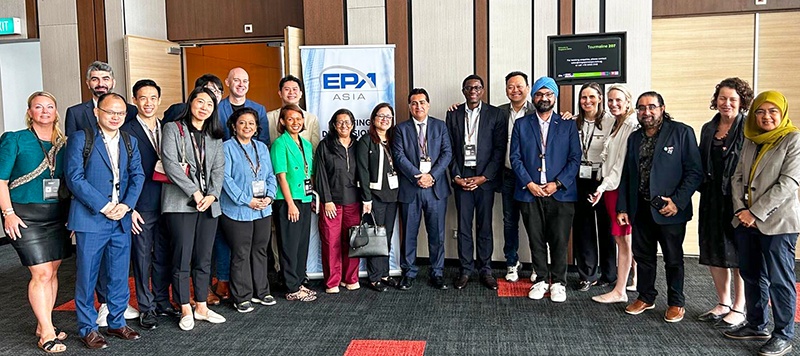
In his own reflections on the 2025 festival, Wong identified three themes: interoperability, agentic commerce and partnerships. Interoperability concerned technologies and platforms working together across borders. Agentic commerce concerned autonomous agents changing how purchases and transactions happen. Partnerships concerned the need for companies to work together on problems that exceed any single organization’s reach.
These were his stated discussion themes, rather than promises of particular products or results. They nevertheless show where his attention had moved. The finance executive learning the vocabulary of fintech was now discussing connected systems and autonomous commerce. The emphasis on cooperation remained familiar, even as the subject matter acquired a new set of technical terms.
His public agenda continued into 2026. Money20/20 Asia listed him for an April discussion about regulated liabilities, stablecoins and cross-border efficiency. The Global SME Finance Forum’s 2026 speaker roster also names him as PayPal Singapore’s vice president and chief executive. The subjects connect his governance responsibilities to a continuing question for payments businesses: how new ways of moving money fit within the structures that make them usable.
Across those settings, Wong’s career supplies a consistent human thread. An accountant studies management, changes industries, supports students, works with volunteers and takes a seat in another conversation about how things might work better. The titles have changed. His willingness to remain a student gives the story its continuity. For a schoolteacher’s son, there are less recognizable ways to spend a working life.