A company can acquire a business in a transaction. Acquiring the habit of working together takes longer. In April 2026, Nathan McCutcheon welcomed more than 100 new colleagues to Shionogi Inc. He marked the occasion with a group photograph from an integration meeting. Among the suits were New York Yankees jerseys. The paperwork had acquired a human cast.
McCutcheon’s message placed the combined team at the beginning of a new chapter, following due diligence and integration planning. It was a revealing place to put the emphasis. The acquisition had a price and a completion date. The organization now had colleagues to introduce, experience to retain and working relationships to establish.
That is a useful starting point for understanding Shionogi’s U.S. President and CEO. His career at the company has followed a steady expansion of responsibility: first the commercial business, then a wider operating brief, then the chief executive’s office. The recurring subject in his public statements is the organization needed to make expansion useful.
A wider desk in Florham Park
McCutcheon joined Shionogi in December 2019 as Executive Vice President and Chief Commercial Officer, with a place on its Executive Committee. He brought experience at Mallinckrodt, Allergan and Eli Lilly. His education was in business: a marketing degree from Ball State University and an MBA from Indiana University’s Kelley School of Business.
Those credentials sketch a commercial executive’s route into management. They also connect two Indiana university towns, Muncie and Bloomington, to a later leadership role in Florham Park, New Jersey. His work had already included running business units and responsibilities in both U.S. and global positions.
The operating role widened his assignment. When Shionogi publicly announced the newly created chief operating officer position in May 2021, the responsibilities were explicit: annual financial targets, commercial operations, distribution and business development. It was a brief that connected selling, moving products and finding opportunities to expand the business.
Akira Kato, then the U.S. President and CEO, linked McCutcheon’s appointment to an ambition for the American operation to contribute more value to the global company. Kato credited him with building the commercial organization. The promotion attached a broader set of responsibilities to that record.
The language of that announcement matters because it describes the assignment before the later acquisitions. Business development was already part of the job. So was the practical machinery that would have to support growth. A company seeking a larger role would need someone responsible for the connections between its activities.
In July 2022, McCutcheon became President and Chief Executive Officer. He also serves on Shionogi Inc.’s board. The sequence gives his story its shape: an executive hired for a function gradually taking responsibility for the whole enterprise.
The people inside the purchase
His explanation of the Qpex acquisition in an October 2023 interview provides a closer look at how he thinks about combinations. He emphasized the acquired team’s specialist expertise, its experience and the capabilities that would complement Shionogi’s existing organization. People and their accumulated knowledge were central to the business case he described.
There is a practical distinction inside that argument. Buying a company brings access to what it already owns. It can also bring access to what its people know how to do together. The second part is harder to convey in a transaction summary, though it helps explain why two organizations might fit.
McCutcheon discussed giving Qpex researchers access to the resources and expertise of the wider Shionogi organization. He also described preserving an existing external collaboration. Expansion, in that account, included connecting a smaller team to a larger network while continuing relationships it had already built.
Read as a management argument, the interview is about complementary capabilities. Its emphasis falls on how one group’s experience can extend another’s. That is a more demanding proposition than simply placing two company names on the same presentation slide. The combined organization has to make those connections usable.
“Products and people are at the core of our approach.”
Nathan McCutcheon · 2024 CEO message
His 2024 message returned to hiring and developing people as part of building the U.S. business. He described an operation that had become profitable over the preceding five years and connected its development to support from headquarters and business-development activity. The account gave growth several contributors, including the people doing the work.
That emphasis supplies a consistent thread across different moments in his tenure. A commercial executive becomes an operating leader; an operating leader becomes CEO; a CEO describes acquisitions partly through the abilities of the teams joining. The subject gets bigger, while the organizational question remains recognizable.
A number with its label attached
By the 2025 integrated report, McCutcheon could point to a specific result. The U.S. business reported revenue growth of 30.6% in fiscal 2024, measured in Japanese yen. He described its transition over five years from an unprofitable operation to a growing business with increasing sales and profitability.
Reported revenue growth, measured in JPY
Index: FY2023 = 100. A comparison of reported growth, not absolute revenue.The number deserves its labels. It concerns the U.S. business, a particular fiscal year and a yen-based measurement. A percentage becomes more useful when the reader can see exactly what it measures. It should also sit beside the leader’s explanation of the work he intends to prioritize.
McCutcheon’s stated priorities included developing people with substantial expertise in their own functions and an ability to work across functions. He also emphasized representing U.S. needs through local knowledge and detailed analysis. That pairs a commercial operation’s responsibilities with a voice in the wider company’s decisions.
The interesting tension is between specialization and cooperation. An organization needs people who know their own work thoroughly. As it expands, it also needs those people to understand where their decisions meet someone else’s. McCutcheon’s published agenda puts both requirements on the same page.
There was a public counterpart to that emphasis at Shionogi’s national meeting. The company recognized individuals and a team award spanning functions, and thanked McCutcheon alongside other leaders for their partnership. The honors distributed attention across colleagues. Even a President’s Club necessarily contains people other than the president.
The meeting’s named honors included a leadership award for Zachary Russo and recognition for a group drawn from several functions. McCutcheon was among the leaders acknowledged in the company’s account. It is a small organizational detail, but a useful one: the public record of growth includes colleagues with names and particular contributions, alongside the executive responsible for the business.
One hundred new introductions
The April 2026 team photograph gives the expanding organization a visible form. McCutcheon shared it while welcoming the colleagues arriving through a completed acquisition. Rows of people, orange chairs and a few pinstriped jerseys make an ordinary corporate room feel more specific than a transaction announcement.
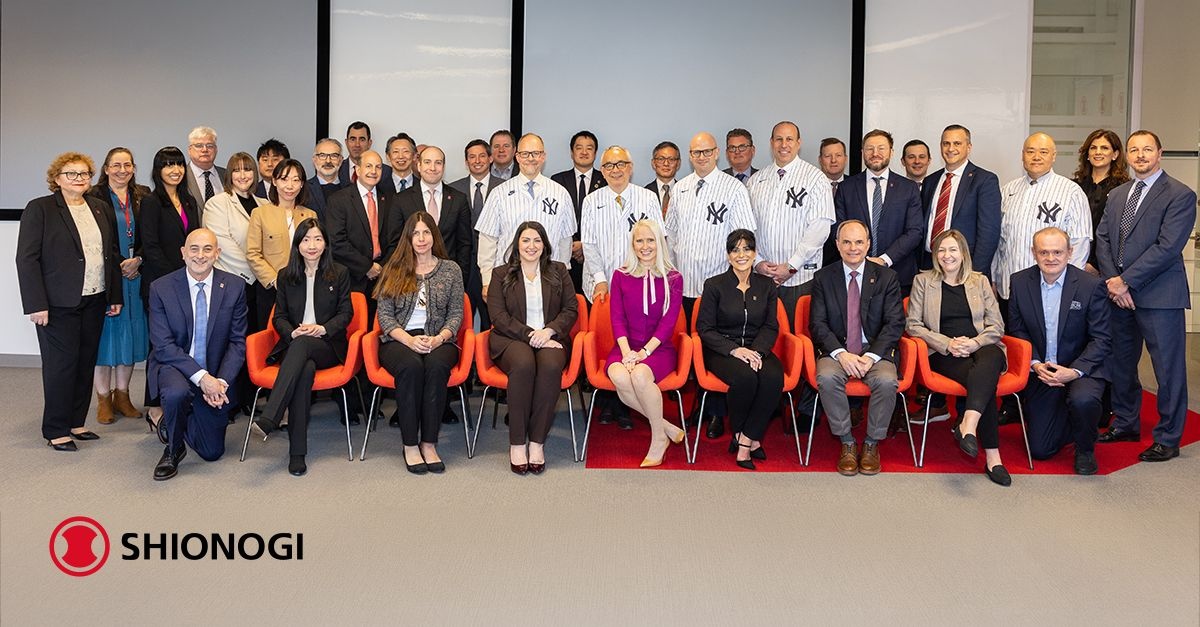
The completed transaction involved a $2.5 billion upfront payment through Shionogi Inc. Its scale belonged to the corporate announcement. In McCutcheon’s own welcome, the headcount gave that expansion another unit of measurement: more than 100 colleagues. Those are different ways of describing the same change in the business.
He also spoke publicly about the incoming team’s contribution to the U.S. organization’s capabilities. That returned the discussion to a familiar subject from the Qpex interview: an acquisition brings experienced people into a combination, and their expertise is part of what the company expects to build upon.
The photograph cannot tell us how integration proceeded. It does record a moment when the people involved assembled in one room. For a career story concerned with broader responsibilities and larger teams, that is an apt image. The CEO appears within the group he is describing.
The next agreement, still in the future tense
On October 5, 2026, Shionogi announced an agreement under which its U.S. subsidiary would acquire IntraBio for $2 billion upfront. The planned transaction would make IntraBio wholly owned by Shionogi Inc. McCutcheon’s public role now included another proposed addition to the organization.
The announcement scheduled completion for November or December 2026, subject to conditions and approvals. As of this profile’s October publication, it remained an agreement awaiting completion. That is a meaningful point on the timeline: a plan has been announced, while the combined business is still prospective.
McCutcheon again emphasized capabilities and resources in discussing the proposed combination. Across his public comments, the recurring interest is what an expanded organization would be able to do. The test of that proposition lies in the work that follows a completed transaction.
His own progression has brought him closer to that test. He arrived with responsibility for a commercial function. He now leads a U.S. company with a wider place in its parent’s plans and new colleagues to welcome. The handshake supplies a photograph of agreement. McCutcheon’s assignment continues when everyone goes back to work.