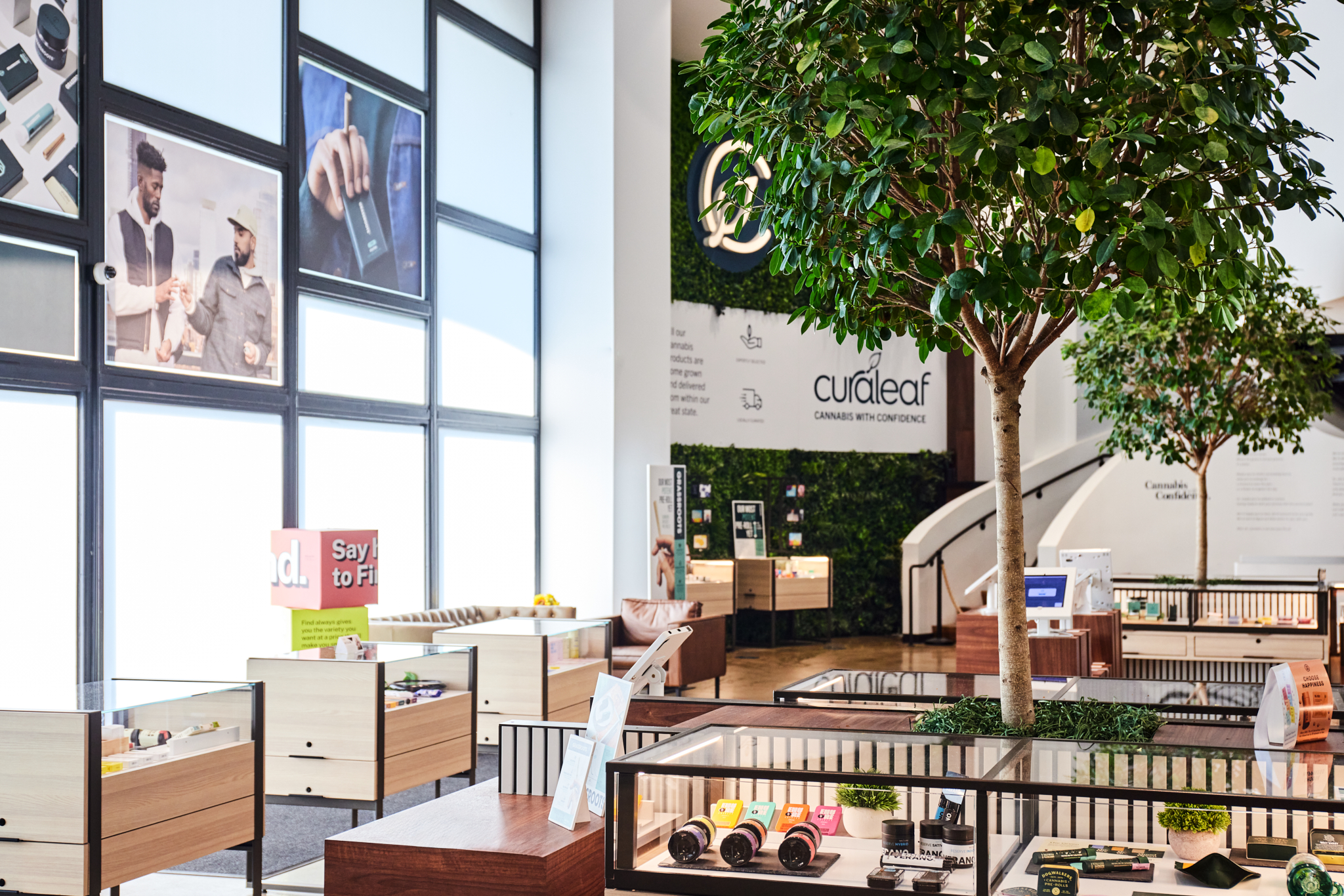
Walk into Curaleaf’s Skokie dispensary and the trees might catch your eye before the cannabis does. Tall windows, pale wood, glass counters: the room has the composed air of a shop selling something perfectly ordinary. That appearance is an achievement. Behind the counter sits a business whose central difficulty is getting a plant through an extraordinary number of doors.
- Own the route: grow, manufacture, distribute and sell.
- Choose the geography: some markets earn their place; others get cut.
- Read past revenue: scale and profit tell different stories.
Curaleaf is a cannabis operator with consumer brands, dispensaries and an international medical network. It sells flower, pre-rolls, oils, vapes and other products. Its customers include American medical patients, eligible recreational shoppers, independent retailers buying wholesale, and medical patients served through overseas channels. The interesting part is how differently those customers must be reached.
First, build the doors
The operating business began in 2010 as PalliaTech, initially working on medical cannabis delivery technology. Boris Jordan became executive chairman in 2014 and acquired majority control in 2015. Joseph Lusardi helped turn the enterprise into a vertically integrated operator. Company investor materials identify both men as co-founders. Jordan added the chief executive role in August 2024.
Vertical integration sounds dry until you consider what it buys. Curaleaf can cultivate a crop, process it, put it into branded packaging and sell it through its own stores. It can also supply somebody else’s dispensary. At the end of 2025, its U.S. network served more than 1,300 wholesale partner accounts. A customer need never enter a Curaleaf shop to buy a Curaleaf product.
The portfolio gives that machinery several shop windows. Select is associated with cannabis oils and vapes; Grassroots covers flower and concentrates; FIND offers flower. The October 2026 Florida assortment also included Dark Heart flower and Anthem pre-rolls. Availability depends on the market. This is a collection of local menus, rather than one universal catalogue.
The map gets smaller
For a while, expansion supplied a convincing plot: acquire more businesses, enter more states, reach more customers. Then the economics interrupted. In January 2023, Curaleaf announced plans to close most operations in California, Colorado and Oregon. Its subsequent accounts also classified businesses in Michigan, Kentucky CBD and adult-use Maine as discontinued operations.
Those exits were a response to unprofitable operations and unfavorable market conditions. The 2024 financial statements describe the decisions as a strategic shift. Selling three Colorado properties in 2023 brought in a combined $2.4 million and produced a $2 million disposal loss. Leaving a market has a price, too.
The useful lesson is to test expansion against local prices, competition and costs. Owning more stages of production gives management more control, but it also leaves management paying for facilities when the economics deteriorate. A crowded market can make an impressive footprint an expensive obligation.
Two segments. Very different weather. Bars show the magnitude of change; labels show direction.
A prescription changes the route
Curaleaf competes in the same U.S. multistate field as Green Thumb Industries, Trulieve, Cresco Labs and Verano. Vertical integration is familiar in that group. Curaleaf’s particular combination adds an international medical supply chain, clinics and pharmacy services to American consumer retail. Its expertise spans growing and extracting cannabis, managing branded products and operating through several kinds of regulated distribution.
Across the Atlantic, Curaleaf was assembling another kind of access. Its 2021 acquisition of EMMAC created the foundation for Curaleaf International. The announced base price was approximately $285 million in cash and shares, with up to $57 million tied to milestones. That was the announced deal value, not an all-cash bill.
The attraction was an existing system: cultivation, processing, distribution and research relationships across European markets. Today, the international business includes Portuguese cultivation, processing capabilities and medical distribution. In Britain, the group also has a clinic and a pharmacy. Getting cannabis to a patient can involve a prescriber and a prescription, rather than a recreational retail transaction.
Cultivation → Manufacturing → Licensed dispensary → Eligible shopper
Clinical assessment → Prescription → Pharmacy → Eligible patient
Patients can seek an assessment through Curaleaf Clinic; shoppers can locate a dispensary and browse a local menu through the U.S. website. These services solve practical access problems. They do not make every product available everywhere, or make every patient eligible for treatment.
The UK Medical Cannabis Registry adds a feedback mechanism, collecting information about prescribed patients’ outcomes and side effects. Curaleaf International describes research partnerships with Imperial College London and the University of Pennsylvania. Registry observations can inform research; they do not by themselves establish that cannabis caused a reported improvement.
A good quarter needs a second look
In the second quarter of 2026, revenue reached $340.1 million, up 10% from a year earlier. International revenue reached $51.4 million. Jordan said, “Our U.S. business has clearly regained momentum.” The domestic segment had delivered a second consecutive quarter of annual revenue growth.

But the income statement deserves its own reading. Consolidated net income was approximately $12.5 million, alongside a $26.3 million pretax loss and a $38.8 million income tax benefit. Cash stood at $107 million; debt, net of specified discounts and financing fees, was $611.5 million. Growth had returned. The financing burden remained.
A market earns its place in the business through its economics.Our reading of Curaleaf’s retreat and rebuild
Two joints, a different ledger
There is another cost in this industry’s history. Bernard Noble served seven years of a 13-year sentence after a cannabis possession arrest. In July 2021, Curaleaf partnered with Noble and Fab 5 Freddy to launch B NOBLE pre-rolls. The original two-pack recalled the small quantity behind Noble’s case; the launch pledged 10% of product proceeds to local social equity organizations.
That specificity makes the initiative worth examining alongside the company’s broader Rooted in Good commitments. It connects a product, a person and a funding promise. It also puts the cheerful dispensary interior in a less comfortable historical frame.
By October 2026, Curaleaf was again adding stores and pursuing acquisitions. Its Port Orange announcement put the U.S. footprint at 190 locations. Its enhanced proposal for Aurora remained contested. The next chapter will test whether another set of doors improves the business behind them.