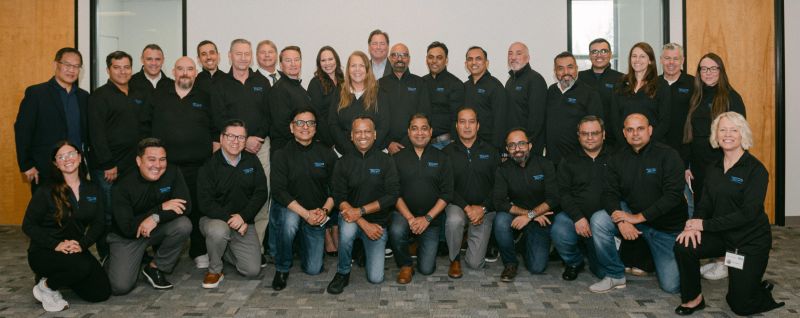
In December 2024, Ravi Chowdhury brought TSP’s leadership teams from the United States, Latin America and India to Folsom. The gathering was called TSP Thrive. There was a group photograph, a roomful of people in company shirts, and the familiar business of deciding what the following year should look like. For a founder whose work crosses borders, getting everyone into one room was itself a useful piece of engineering.
Chowdhury’s account of the meeting was generous with names. Colleagues in sales, delivery, operations and regional leadership all got a mention. The list gives the occasion its texture: a company assembled from people, practices and previous businesses, briefly gathered in the California city where its CEO is based. Enterprise software can make for abstract conversation. A group photograph brings the discussion back to human scale.
A founder, with a long middle chapter
Chowdhury started his entrepreneurial life at 19. His early ventures included an internet loyalty business serving India and the United States, followed by a sales and marketing services business for technology clients. The attraction to customers and technology was there early; the particular form of the business would change.
His career then ran through Rapidigm, Fujitsu Consulting, Sparta Consulting and KPIT. Inside those larger organizations, his work included opening business lines and entering new geographies. Founding a company and building a business within an existing company have different stationery. Both require someone to persuade customers, recruit colleagues and make the economics work.
That middle chapter matters to the shape of TSP. Chowdhury arrived at enterprise services with experience of selling and building inside established organizations. His story makes room for a kind of entrepreneurship that receives less attention than the launch: the years spent learning how a business actually delivers what its sales team promises. The interesting transition is the return to ownership, carrying that experience along.
Folsom was part of the plan
By 2020, Chowdhury was describing an ambition that connected regional roots to international expertise. He wanted TSP to become a preferred enterprise partner locally while bringing SAP and automation experience from work around the world into the region. Folsom supplied a base for a business whose customers and capabilities extended beyond it.
Moneta Ventures, also based in Folsom, was an investor and partner. Its managing partner Lokesh Sikaria served on TSP’s board. The local relationship gave the company’s growth a geographical character: enterprise technology experience and investment capital meeting in the Sacramento region. A global services business still has somewhere it keeps its keys.
In November 2020, TSP joined the Google Cloud Partner Program as a services partner. Its offerings included advice and migration work for SAP customers moving to cloud infrastructure. That expanded the practical territory around the software at the center of Chowdhury’s business: customers needed help with the surrounding environment as well as the application itself.
“Since our inception, the firm has grown significantly every year.”Ravi Chowdhury, November 2020
Six weeks to something a customer could try
One episode from Chowdhury’s joint interview with delivery leader Sandeep Mathur captures TSP’s approach. A customer considering a move to SAP S/4HANA needed to understand the consequences. TSP used a copy of the customer’s production system to create a sandbox, completing the migration exercise in six weeks and handing it over for evaluation.
The attraction of that sequence is easy to understand. A presentation asks a buyer to imagine the future. An environment the buyer can explore gives imagination a keyboard. The customer could examine scenarios and applications before committing to the larger change.
The interview also described Kelvin, TSP’s assessment tool, which analyzed extracts from a customer’s SAP system without requiring software installation in that environment. This was an early expression of a recurring idea in Chowdhury’s business: expertise could be packaged into something usable. Consultants would bring judgment; tools could take on a share of the repeated work. The combination gave the services company a second way to apply what it had learned.
Buying experience, one team at a time
In April 2021, TSP announced the acquisition of iXerv Americas. The business brought SAP SuccessFactors expertise, including work on employee systems and cloud payroll. Chowdhury’s explanation centered on the management team and the capabilities it added. People who knew a particular corner of SAP were joining people who knew other corners.
It was a useful expansion for a firm seeking a broader relationship with enterprise customers. Financial systems, employee systems and automation can occupy different boxes on an organization chart; the customer still has to make the whole organization function. Bringing those practices into one business widened the work TSP could undertake.
Later that year, TSP agreed to acquire Austin-based Logic Point, whose specialty included utilities. The two moves show the specificity behind an otherwise rather bland word, expansion. Each prospective addition had a subject it understood. For Chowdhury, acquisition was becoming a way to add experience that already existed in teams, along with the markets those teams knew.
These transactions also give his career a different rhythm from the early startup years. A new venture begins by finding people to build with. An acquisition brings an established group into the picture, carrying its own working habits and customer commitments. The task becomes one of continuity as well as change. That is the everyday setting for the larger numbers that would follow.
The arithmetic got bigger
In April 2025, Ameri100 joined forces with TSP in a combination backed by Delta-v Capital and Moneta Ventures. The announced consulting capacity exceeded 700 people across North America, India and Latin America. The combined project record included more than 250 SAP projects, with over 100 involving S/4HANA.
Those were company figures, describing the combined operation at that moment. For Chowdhury, the rationale was complementary experience: Ameri100’s SAP and industry knowledge alongside TSP’s international infrastructure and automation approach. Maria Wei, Ameri100’s CEO at the time of the announcement, became a central figure in the combination.
The investment also brought a new financial partner into TSP’s next stage. In a public response to Delta-v’s announcement, Chowdhury welcomed the firm’s participation in the company’s growth. The founder’s job now included an enlarged consulting business and the relationships that came with it.
Two months later, TSP announced Scott Parrish as chief financial officer. His remit covered financial strategy, corporate finance, investor relations and planning. It was a practical accompaniment to the transaction: a larger organization needed financial leadership built for the work ahead. Growth, eventually, asks for a spreadsheet of its own.
Combined consultants announced with the Ameri100 transaction in April 2025, across North America, India and Latin America.
There is a ceremony. Then there is the work.
Chowdhury represented TSP at an August 2023 awards ceremony recognizing the Sacramento region’s growing companies. TSP placed ninth in that year’s ranking. His explanation of the growth was considerably more concrete than the usual vocabulary of momentum: hiring people, delivering projects within agreed schedules and budgets, and making acquisitions that complemented the services footprint.
That account gives a reader something to examine. Hiring increases capacity. Delivery earns the next conversation with a customer. An acquisition can add a capability the business previously lacked. None automatically produces the others. Bringing them together is much of the operating task.
TSP went on to report another appearance in the regional growth ranking in 2024. Chowdhury’s response thanked employees, clients and partners. The emphasis echoed the later Folsom gathering: even when the occasion was a company ranking, he used it to acknowledge the people around the result.
The gatherings and the rankings provide public moments in a career largely concerned with work inside other businesses. Customers encounter TSP when they are weighing a change, extending an application or trying to keep a project moving. Chowdhury’s role sits across those encounters. The founder has to give the company a direction that makes sense to buyers, colleagues and investors at once. That helps explain why his public milestones so often involve another team: a partner, an acquired business, a delivery group or a regional leadership gathering. The organization he is building depends on those relationships continuing to function after the announcement.
The next bottleneck has a name: testing
In June 2026, TSP introduced AI Hub, a framework spanning assessment, project delivery and ongoing application support. Its components included ATLAS for assessing an existing SAP environment, ARIA for coordinating work across a transformation, and ATOM, an internal assistant for consultants. The tools put a software layer around work the services organization repeatedly performed.
The company described the framework as a way to carry project knowledge forward: decisions, workshops and artifacts would contribute to an accumulated record. For a business built through experienced teams, this is a consequential design choice. Experience is useful in a colleague’s memory. It becomes useful in a different way when the next team can retrieve and apply it.
In August, TSP announced a partnership with Tricentis to connect its implementation tools with testing capabilities. Chowdhury pointed to the gap between building a system and checking that it works. His diagnosis located the problem in the handover between activities, a place where a company’s promise has to survive contact with another team’s work.
That is a fitting problem for this stage of his career. Chowdhury began with ventures of his own, spent years building inside larger organizations, and returned to founding with a business that has since brought more teams together. The next task is visible in the systems those teams deliver: make the connections hold. A good group photograph needs everyone to face the same direction for a moment. A working enterprise needs something considerably more durable.